Recommended resources
The freely available resources this lesson will direct you to.
- HOW TO SOLVE PROBLEMS - How do consulting firms work (hypothesis-based problem solving explained)www.youtube.com
- How to pitch a stock (equity research)www.youtube.com
- Market entry framework: how consultants evaluate new markets | StrategyU Blogstrategyu.co
- Decision Insights - Don't ask the same old questions - Business Spectator | Bain & Companywww.bain.com
Hello! This module turns portfolio setup into a first, resume-ready company research brief. Before gathering figures or building charts, you need to decide what the brief is trying to resolve. A recruiter can assess a reasoned recommendation much more readily than a folder full of company facts.
Today you will learn to turn an interest in a company, sector, or acquisition into one decision-oriented research question. The aim is not to know the answer yet. It is to define a question that public evidence could help you answer—and that you could defend in an interview. Allow about 35–40 minutes, including the resources and a short working draft.
The difference between a topic and a decision
“Study Company A’s growth” is a topic. It invites useful research, but it does not tell you when the research is finished or what the findings mean. “Is Company A a good business?” is closer, yet good could mean fast-growing, profitable, resilient, inexpensive to acquire, or something else entirely.
A decision-oriented question names an action under consideration. For a first company brief, that action need not be “buy the shares.” If you have not yet built a valuation, a more defensible action is prioritize the company for deeper diligence—or do not. That is still a real research decision: it asks whether the available evidence merits further work.
Scoping matters because the request you first hear is not always the decision you need to support. The iceberg below illustrates that distinction; it does not mean you should assume every stated question conceals a different problem. It means you should check.
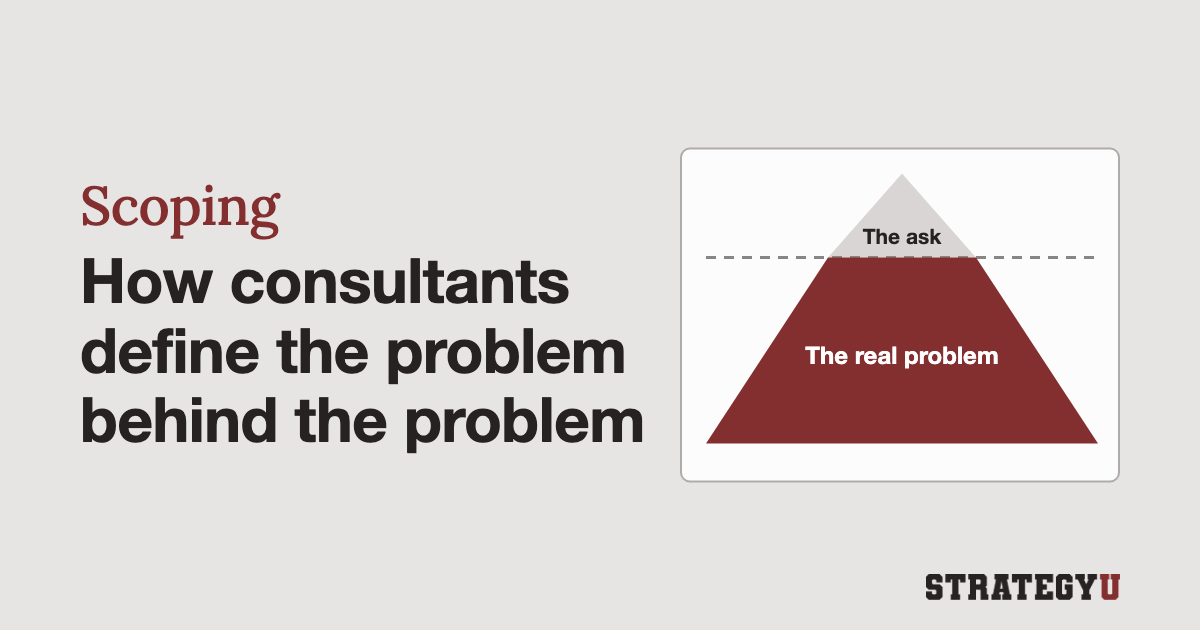
StrategyU’s Market entry framework: how consultants evaluate new markets is a useful example. Its market-entry decision is broader than your first company brief, but it shows why an apparently simple yes-or-no question needs an explicit basis for judgment.
Market entry framework: how consultants evaluate new markets | StrategyU Blog
Read Paul Millerd’s StrategyU article to see how a broad business question becomes a decision with defined considerations.
In the introduction, begin where the author challenges the idea that market entry is a single question. Read the four questions through the end of “The four questions.” Notice that market growth alone cannot settle the entry decision. Then go to “How to structure the analysis.” Read the scoping steps, stopping at the end of “Gather the facts.” Focus on the order: clarify the situation and scope before deciding what evidence to collect.
Your first brief will have a narrower scope than a market-entry engagement. The transferable principle is this: the decision determines which facts matter. Three years of revenue figures may be central to one question and nearly irrelevant to another.
Build the question around a specific reader and action
A practical research question contains five elements:
- Decision-maker: Who would use the answer? You may write for a hypothetical research team, management team, or buyer; do not imply you advise an actual organization.
- Choice: What alternatives are being considered? Examples include “prioritize for diligence or set aside,” “expand the core offering or pursue an adjacent category,” and “pursue the acquisition at announced terms or decline.”
- Subject and boundary: Which company, segment, transaction, and time period are in scope?
- Decision criteria: Which two or three considerations would reasonably change the choice?
- Evidence limit: What can public sources support, and what would remain unknown?
Consider this progression for a hypothetical publicly listed Company A:
Topic: Company A’s growth.
Better, but vague: Is Company A an attractive company?
Decision-oriented: Should a research team prioritize Company A over one listed peer for deeper diligence as a potential growth business over the next two years, considering their disclosed revenue growth, operating-margin trends, cash generation, and principal risks?
The last version identifies a user, a choice, a comparison, a horizon, and evidence to examine. It does not assert that Company A will grow, outperform its peer, or make an attractive investment. The eventual answer might be “prioritize Company A,” “prioritize the peer,” or “neither—public evidence does not yet justify that conclusion.”
This distinction is particularly useful for a portfolio case. You can make an original recommendation without pretending that a short, public-source brief is equivalent to full investment due diligence. A later valuation could support a stronger investment question; you do not need to promise a DCF in this first brief merely because you intend to learn one.
Audience also changes the question. In How to pitch a stock (equity research), Henry Chien (Buttonwood) contrasts what different investors need to hear and explains why a collection of company facts is not a call to action.
How to pitch a stock (equity research)
Watch Henry Chien (Buttonwood)’s “How to pitch a stock (equity research)” for the distinction between informing an audience and giving it a usable recommendation.
Watch know the audience for how investment horizons and priorities change a pitch. Then watch state the action for why a company description alone is insufficient. His example is a stock recommendation; for your first brief, the appropriately scoped action may instead be a recommendation about further diligence.
The same discipline works beyond company research. A sector case might ask, “Which of two defined segments should a research team investigate first, given disclosed growth, competitive intensity, and the quality of available evidence?” A retrospective M&A case might ask, “Based only on information available when the deal was announced, was pursuing the acquisition at the announced terms strategically and financially justified?” That last boundary prevents later outcomes from being quietly treated as facts the buyer knew at the time.
Give the question a testable starting view—not a predetermined answer
Once the question is clear, you can record an initial hypothesis: your provisional answer and why it might be true. This keeps research focused, provided you also specify what could prove you wrong.
For the Company A question, a starting view could be:
Initial hypothesis: Company A merits deeper diligence over the peer because its recent growth may be accompanied by more resilient operating margins and cash generation. This view should be revised if the apparent strength depends on a one-off item, the comparison uses incompatible definitions, or the peer shows stronger underlying economics.
The research question and the hypothesis have different jobs. The question stays open. The hypothesis is a claim to test and, if needed, discard.
Firm Learning’s How to Solve Problems explains why professionals often begin with a provisional answer rather than wait until every fact has been collected. Watch especially for what happens when the example’s initial assumption about competition does not hold.
HOW TO SOLVE PROBLEMS - How do consulting firms work (hypothesis-based problem solving explained)
Watch Firm Learning’s “HOW TO SOLVE PROBLEMS - How do consulting firms work (hypothesis-based problem solving explained)” to see how an early view directs research without becoming a fixed conclusion.
In form a hypothesis, distinguish known facts from missing evidence and note why an initial answer is revisable. In test the view, follow the market-entry example: one early assumption fails, so the reasoning has to change.
A good hypothesis saves time only if you actively look for disconfirming evidence. Suppose Company A reports rising revenue. That supports neither durable growth nor an investment conclusion on its own. Margins might be deteriorating, cash generation might not follow reported profit, or a peer might be improving faster. Conversely, a weak year need not settle the issue without understanding its disclosed context. The purpose of the question is to make those findings consequential, not to force them into an answer chosen in advance.
Make it feasible for a first portfolio release
Before settling on a question, check whether it passes three practical tests.
Can the choice change? If every plausible finding would produce the same conclusion, you have written a theme, not a decision. Name at least one finding that would favor the alternative.
Can public evidence address the criteria? “Will management’s undisclosed product plans succeed?” requires information you probably cannot verify. A question based on reported financial trends and clearly disclosed strategic priorities is more tractable. If a desired measure is unavailable or defined differently across companies, narrow the question or state the limitation; do not substitute an estimate and present it as a fact.
Can you answer it at the promised depth? For a two-page first brief, one company, one defensible comparison, a defined historical period, and a small set of decision criteria are usually more useful than a survey of an entire industry. More research is not automatically better research. As with defining the output of an analytical model, adding variables will not fix an undefined decision.
A compact working specification for your case could look like this:
Decision: Whether to prioritize Company A or one listed peer for deeper diligence.
Question: Should a research team prioritize Company A over the peer as a potential growth business over the next two years, based on disclosed growth, operating margins, cash generation, and principal risks?
Initial hypothesis: Company A merits priority, subject to testing the quality of its growth and the peer comparison.
What could change the call: Evidence of weaker underlying economics, a stronger peer, or disclosures too limited for a reliable comparison.
Boundary: Use identified public reporting periods; recommend further diligence, not an investment or acquisition.
This is a working specification, not a conclusion. Once a company is selected, replace the placeholders, verify that its disclosures support the proposed measures, and tighten the period and comparison. Keep this short enough that an interviewer can understand both your decision and what would make you reverse it.
Key takeaways
Start with who must decide what, not with a list of facts you hope to collect. Bound the subject and time period, choose criteria that bear on the decision, and frame an initial hypothesis that evidence can overturn. For your first portfolio brief, recommending whether a company merits deeper diligence is a credible endpoint when public information does not justify a buy call.
The next lesson will take your main question and break it into answerable subquestions using a research tree. That is where you will determine precisely which analyses belong in the brief—and which do not.