Recommended resources
The freely available resources this lesson will direct you to.
Good to have you back. In the previous lesson, you chose which moments deserved panels and which movements a reader could infer between them. Once you have chosen a moment, the next task is to describe it so an artist can draw it. The challenge is to be specific about the story, but not so specific about the drawing that you leave the artist no room to solve it.
This lesson focuses on that balance. You’ll learn what a panel description needs to communicate, what it can leave open, and how to recognize details that matter to later panels. Allow about 35–40 minutes, including the short reading and video.
Describe the image the story needs
A panel description is not the finished comic’s prose. Its immediate reader is the artist, who must turn it into an image that works alongside the other panels. A useful description answers three questions: Where are we? What is happening at this drawable instant? What must the reader notice?
Return to the train-platform scene from the previous lesson. At the moment of hesitation, you might write:
Panel 2: At the open train doors, the commuter stares at a dropped ticket beside their shoe. The passenger who dropped it is already inside the car, facing away.
An artist can draw that moment. The open doors preserve the chance to board; the ticket presents the competing choice; the passenger’s turned back shows why the commuter must intervene. The description does not prescribe a camera angle, panel shape, or arrangement of every person on the platform. Those choices can be made in service of the page.
Compare a less useful version:
Panel 2: The commuter realizes that doing the right thing may cost them the train, and struggles with a lifetime of putting others first.
This tells the artist what the moment means, but not what a reader will see. You can add a brief note about intention when it helps a collaborator interpret an action. It cannot replace the action or detail that conveys that intention. Here, the commuter’s position at the doors and attention to the ticket give the artist something to work with.
Watch how a working comic writer treats the script as a guide for a team rather than a specification for every mark on the page.
Comics School Live - Writing Conan the Barbarian
In “Comics School Live - Writing Conan the Barbarian,” Jim Zub shows part of an actual comic script. Watch for the distinction between information his collaborators need and visual choices he leaves open.
In the discussion of the script for Conan the Barbarian #13, watch page intent: Zub states the atmosphere and why he wants restricted views. Then skip to visual details, where he discusses details in a panel and why specifying daytime matters to the colorist. Notice that even a relatively descriptive writer selects what to settle and what not to settle.
A short description is not automatically a good one. “Commuter sees ticket” uses fewer words, but leaves the artist to guess where everyone is and whether the train can still be boarded. Concise means carrying the necessary information without making the artist sift through unnecessary instructions.
Give the artist the story constraints, not a drawing recipe
The artist needs to know what cannot change without damaging the story. That might be a character’s action, a prop’s location, the direction someone is facing, or a detail that will pay off later. The artist usually does not need you to dictate the viewing angle, exact pose, background decoration, and lighting in every panel.
Oneshi Press’s guide approaches this question from a writer-and-artist collaboration. Read its advice on brevity, but especially its warning that omitting an important detail can create as much work as including too many.
How to Write Comics: Panel Descriptions - Oneshi Press
Read Oneshi Press’s “How to Write Comics: Panel Descriptions” for a practical account of what artists need from a script.
In “Be concise,” read from the discussion beginning “Sure, you want to describe the scene” through the prose warning. In “But Don’t Leave Out Important Information,” read the prop example; consider why an artist needs to know about a later payoff before drawing an earlier panel. In “Describe the Results,” read the physical-action advice. Finally, in “Be a Team Player,” read the collaboration advice.
Suppose the ticket in our scene bears a distinctive red stamp that will identify it again on the last page. “A ticket lies on the platform” may seem adequate now, but the artist needs to establish that stamp while the ticket is visible. You could write: “The fallen ticket, marked with a red circular stamp, lies beside the commuter’s shoe. The stamp must be recognizable here; it returns on the last page.” The note gives the artist a reason to preserve the detail, without dictating precisely how to draw it.
Not every object deserves that treatment. If a bench is only background, describing its material, age, advertisements, and scratches makes the artist do work that does not help the reader follow the scene. If a character later retrieves a key taped beneath that bench, its presence and position become story information worth establishing.
The same principle applies to mood. “The station feels lonely” can guide a scene, but it is too vague as the whole content of a panel. “The commuter stands alone on the platform after the train has left; its last lit window disappears into the tunnel” gives the artist an observable result. You need not specify every shadow to communicate the loneliness.
Specify composition when it protects meaning
Writers sometimes hear “leave room for the artist” and conclude that they should never mention framing or placement. That goes too far. If a panel must show both the commuter’s hand offering the ticket and the closing train doors, say so: the reader needs to register that the helpful act has a cost. If the doors can be outside the image without affecting the story, leave the framing open.
Alec Worley offers a useful working standard for deciding how much direction to give. Treat his suggested length as a target for ordinary panels, not a limit that prevents you from explaining an unusual setting or a vital action.
How I Format a Comic-Book Script - by Alec Worley - Substack
In “How I Format a Comic-Book Script,” writer Alec Worley gives concise rules of thumb for panel descriptions. Read them as decisions to consider, not a rigid template.
Find “Panel Descriptions, Again,” immediately after “Page and Panel Numbers.” Read the opening rules, from his length recommendation through his advice on camera angles. Continue to his point about emotional direction, from emotional guidance. Focus on the difference between naming an emotional intention and prescribing every visual method for expressing it.
Here is the train scene’s choice panel described two ways:
Overdirected: Extreme low-angle view from beside the commuter’s right shoe. Put the ticket in the lower-left corner, the commuter’s face in the upper-right corner, three commuters behind them, and a precisely half-closed train door at the far right. Make the overhead lights cast long shadows.
Story-directed: The commuter remains on the platform, holding the ticket out to its owner inside the train. The doors are closing between them; the owner reaches for it.
The second version preserves the relationships the reader must understand: who has the ticket, who needs it, and what threatens to separate them. It leaves the artist choices about how best to fit those elements into the panel and across the page. If the precise position of a door or hand proves essential to a later image, add that constraint. Otherwise, a layout instruction should earn its place by solving a storytelling problem.
Remember that a panel also shares space with lettering. This comparison shows line art with marked areas on the left and the colored, lettered page on the right. It is not a script comparison: it shows how much a finished page gains after the art stage, and how words occupy space alongside the drawings.
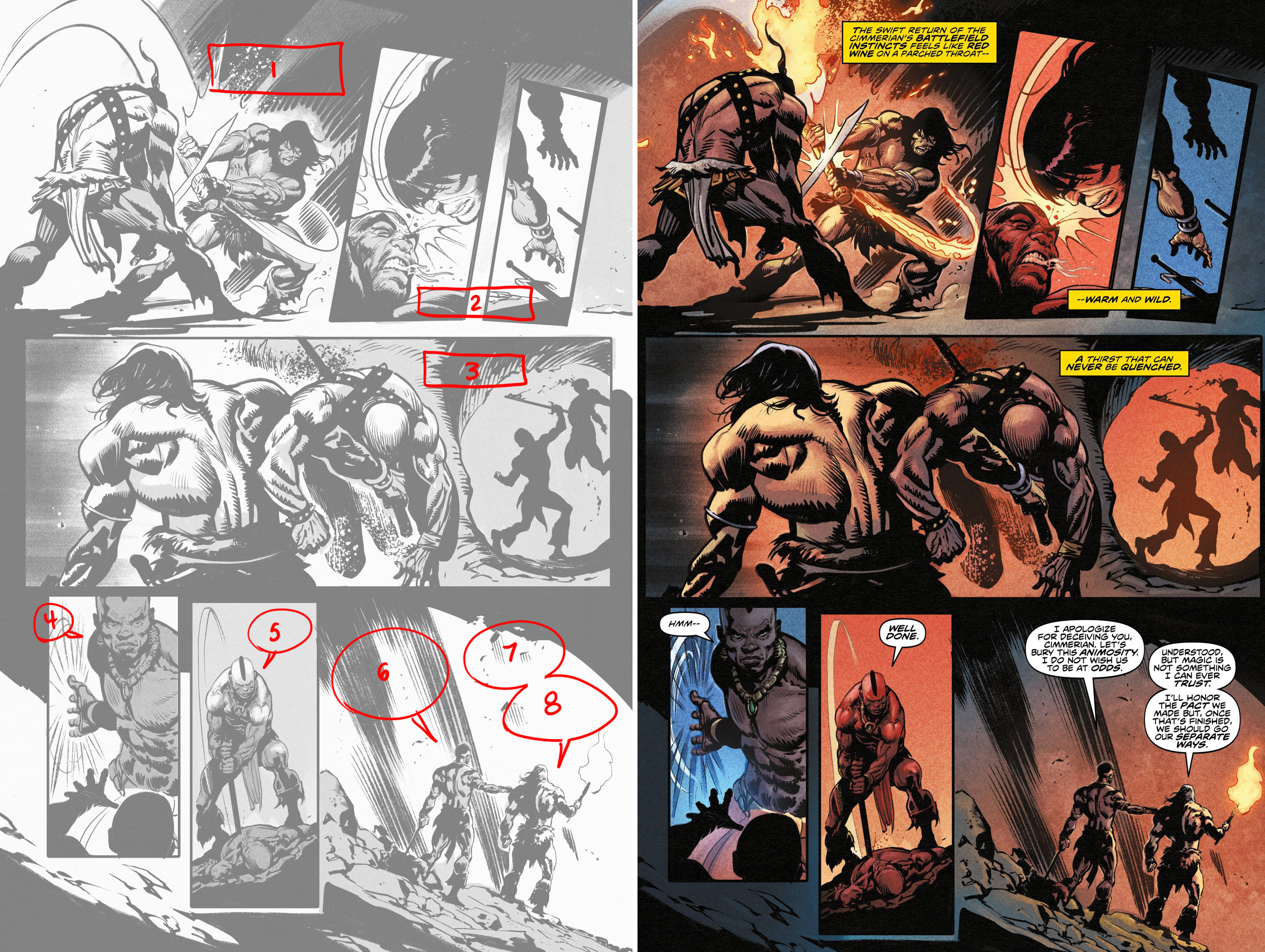
You do not need to place every balloon in a panel description. You do need to be aware when a description demands a crowd, a crucial facial reaction, an important background clue, and a long conversation all in a small panel. Clear priorities help the artist decide what must remain visible. Later in the course, you’ll address the placement and amount of dialogue more directly.
A quick edit for artist-readable descriptions
When a draft description feels crowded, keep its narrative purpose in view and make four passes:
- Find the instant. If the sentence says a character grabs a ticket, crosses the platform, and hands it over, it describes successive moments. Choose the image this panel needs; give the next significant change another panel.
- Keep drawable evidence. Replace an explanation such as “she regrets her decision” with an action or visible result, while retaining a short emotional note if it clarifies the intended reading.
- Mark essentials. Keep details needed for continuity, a later payoff, or the reader’s understanding of the action. Tell the artist when an apparently minor detail matters later.
- Release optional choices. Remove angles, exact poses, and decoration that do not serve a particular storytelling need.
This is not an instruction to reduce every panel to one bare sentence. A first view of an unfamiliar place may need more description than the fifth panel in the same room. An action with confusing physical relationships may need careful staging. The aim is for an artist to understand the panel’s priorities on one read and have room to make a strong image from them.
Conclusion
An effective panel description identifies a drawable instant and the details the story depends on. It communicates intention through visible action, alerts the artist to important setup, and specifies composition when meaning would otherwise be lost. Concision is not withholding information; it is making the important information easy to use.
Next, you’ll explore how panel size, density, and page turns can shape the pace and emphasis of the moments you choose.