Recommended resources
The freely available resources this lesson will direct you to.
Introduction
In our previous lessons, we've explored concepts like public goods and externalities, both of which are situations where the free market, left to its own devices, might not produce the most efficient or desirable outcome for society. We saw how the market can underprovide goods like national defense and overproduce "bads" like pollution. Today, we're going to tie these ideas together under the broader, and highly contentious, concept of market failure.
This lesson will first define what economists mean by "market failure" and outline its most common forms, establishing the standard textbook understanding. Then, we will dive into the heart of a major economic and philosophical debate by exploring why many economists, particularly those with libertarian leanings, are deeply skeptical of this concept. You will learn about the "nirvana fallacy" and the idea of "government failure," two powerful counterarguments that are central to the case for free markets.
This topic is a critical juncture in our course. Understanding the debate around market failure is essential for grasping why libertarians are so wary of government intervention, even when markets appear to be imperfect.
What is Market Failure? The Mainstream View
In economics, a market failure is a situation in which the allocation of goods and services by a free market is not socially optimal, leading to a net loss of economic value. Essentially, it's a case where the "invisible hand" seems to fumble, and the individual pursuit of self-interest does not lead to an efficient outcome for the group.
The video below from Crash Course Economics provides an excellent overview of the mainstream perspective on market failure, covering its causes and the standard government-led solutions.
Market Failures, Taxes, and Subsidies: Crash Course Economics #21
This video, "Market Failures, Taxes, and Subsidies," clearly explains the conventional economic view on why markets sometimes "fail" and how governments try to correct them.
Please watch the following segments: The introduction to market failure: Intro. The discussion on the free-rider problem and public goods: Free-riders & public goods. The explanation of the Tragedy of the Commons: Tragedy of the Commons. The overview of externalities and proposed solutions: Externalities.
As the video and our previous lessons have shown, market failures are typically categorized into a few key types. Let's briefly formalize them.
-
Public Goods: As we've learned, goods that are non-excludable (you can't stop people from using them) and non-rivalrous (one person's use doesn't diminish another's) are unlikely to be provided by private firms due to the free-rider problem. National defense and streetlights are classic examples.
-
Externalities: These are the "spillover" costs or benefits that affect third parties. Negative externalities like pollution lead to overproduction because the producer doesn't bear the full social cost. Positive externalities like vaccination lead to underproduction because the provider isn't compensated for the full social benefit.
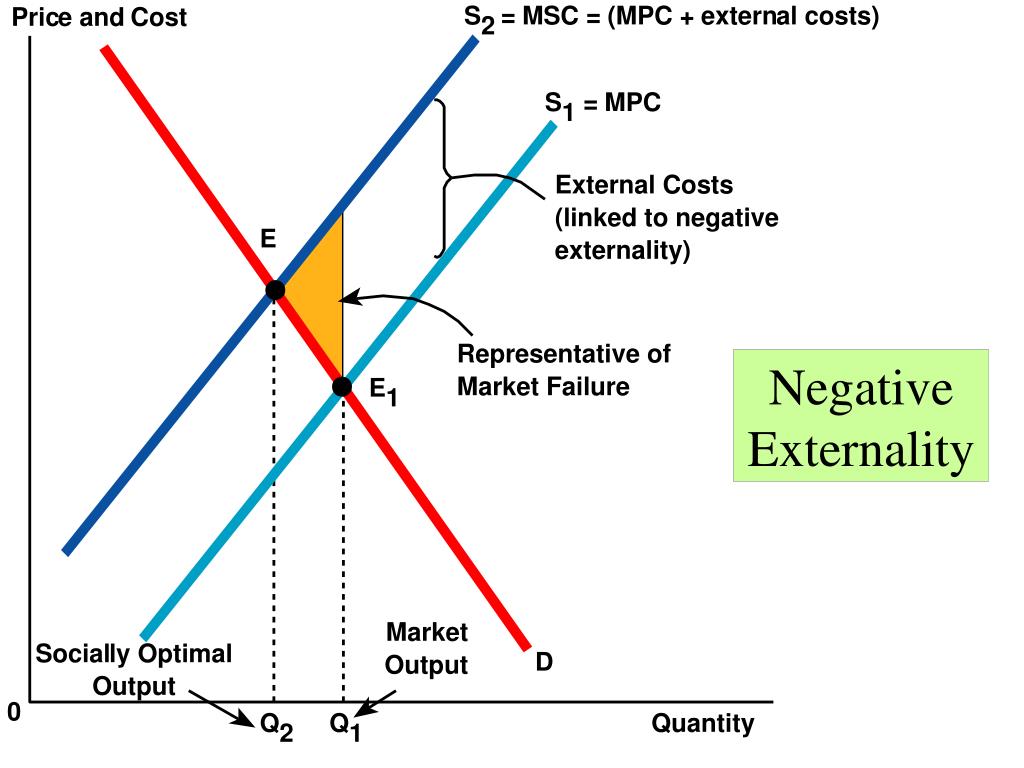
-
Market Power: When a single seller (monopoly) or a small group of sellers (oligopoly) dominates a market, they can restrict output and raise prices above competitive levels. This leads to an inefficiently low quantity of the good being sold, harming consumers.
-
Information Asymmetry: Sometimes, one party in a transaction has much more information than the other. The classic example is the market for used cars, where the seller knows the car's hidden defects but the buyer doesn't (the "lemons problem"). This can lead to a breakdown of trust and cause markets to function poorly or even collapse.
The image below helps visualize how economists classify goods based on the properties of rivalry and excludability, which determines whether they are likely to be a source of market failure.

In the mainstream view, identifying a market failure is the first step. The second step is often to propose a government intervention—such as taxes, subsidies, or regulations—to "correct" the failure and push the market toward the socially optimal outcome.
The Libertarian Critique: Is It Really a "Failure"?
This is where the debate truly begins. Libertarians and many Austrian and Chicago school economists challenge the concept of market failure on several grounds. Their critique isn't necessarily about denying that problems like pollution exist, but rather about questioning the diagnosis and the proposed cure.
1. The Nirvana Fallacy
The first major critique is that the very concept of "market failure" is based on a flawed comparison. It judges real-world markets, which are messy and imperfect, against an imaginary, unattainable ideal of "perfect competition." Economist Harold Demsetz named this the nirvana fallacy.
The following video by economist Thomas DiLorenzo powerfully articulates this critique. He argues that what is labeled a "failure" is often just the natural process of an imperfect world.
The Myths of Market Failure | Thomas J. DiLorenzo
This lecture from the Mises Institute, titled "The Myths of Market Failure," introduces the core of the libertarian/Austrian critique.
Watch the opening section where DiLorenzo explains the origin of market failure theory and the concept of the nirvana fallacy: The Nirvana Fallacy. Focus on the idea that comparing the real world to an unachievable ideal is not a useful form of analysis.
The essence of the nirvana fallacy argument is this: it's intellectually dishonest to find that a real market doesn't work as well as a perfect theoretical model and then declare the real market a "failure." The proper comparison is not between real markets and utopia, but between real markets and their real, imperfect alternatives—namely, government intervention.
2. Entrepreneurship and Private Solutions
A second, related critique is that the static models used to identify market failures often ignore the dynamic and creative nature of entrepreneurship. Many problems that seem to require government intervention can be, and often are, solved by market participants themselves.
Let's return to DiLorenzo's lecture, where he provides historical examples of how entrepreneurs solved problems that were long considered classic market failures.
The Myths of Market Failure | Thomas J. DiLorenzo
DiLorenzo's lecture continues by debunking several textbook examples of market failure, showing how markets found solutions without government.
Please watch these segments: Lighthouses (Public Good): The Lighthouse Example. This challenges the idea that lighthouses could only be provided by government. Roads (Public Good): The Roads Example. This shows evidence of private road companies. Bees (Positive Externality): The Fable of the Bees. This reveals how beekeepers and orchard owners used private contracts to solve the externality problem. The "Lemons Problem" (Asymmetric Information): Asymmetric Information. This segment explains how warranties and reputation solved the problem of bad used cars.
These examples illustrate a core libertarian insight: where there is a problem, there is also often a profit opportunity for the entrepreneur who can solve it. Private contracts, warranties, inspection services (like Carfax), and the development of reputation are all market-based mechanisms that evolved to solve these "failures."
3. Transaction Costs and Government Failure
The third and perhaps most sophisticated critique comes from Nobel laureate Ronald Coase. He argued that whether an externality is a "problem" depends on transaction costs—the costs of negotiating and enforcing a solution.
The following reading explains Coase's argument and builds on it to introduce the crucial concept of political costs and government failure.
When Is a Market Failure Not a Market Failure? - Libertarianism.org
This article from Libertarianism.org provides a clear, structured argument against automatically jumping from "market failure" to "government intervention."
Please read the following sections: Start at the heading When Is a Market Failure?. This section explains Coase's insight that if transaction costs are low, people can solve externalities through private bargains. It also makes the crucial point that if transaction costs are high, then the "problem" may not be worth solving. Continue with the next section, Political Costs. This part introduces the concept of "government failure"—arguing that even if a market solution isn't perfect, the government "solution" might be even worse due to lobbying, lack of information, and self-interested politicians. Finally, read the concluding section, A Presumption of Liberty. This summarizes the argument by stating that the burden of proof should be on those who advocate for government regulation.
This line of reasoning leads to a powerful conclusion. The debate should not be between imperfect markets and perfect government. It must be between imperfect markets and imperfect government.
Libertarians argue that while markets can be flawed, governments are subject to their own set of failures:
- Information Problems: Central planners can never have the local knowledge that millions of market participants possess.
- Special Interests: Regulations are often influenced or "captured" by the very industries they are supposed to regulate, benefiting producers at the expense of the public.
- Slow and Inflexible: Democratic and bureaucratic processes are slow to adapt to new information and correct mistakes.
Therefore, even if a market failure is genuinely identified, the costs of government intervention (political costs) may be far greater than the costs of the original market failure itself.
Conclusion
Today we've tackled the complex and contested idea of market failure. It represents a fundamental dividing line between different economic and political philosophies.
Here are the key takeaways from our exploration:
- Market Failure Defined: The mainstream economic definition of market failure is a situation where a free market fails to allocate resources efficiently from a social perspective. The main types are public goods, externalities, market power, and information asymmetry.
- The Standard Prescription: The typical response to a perceived market failure is to call for government intervention in the form of taxes, subsidies, or direct regulation.
- The Libertarian Critique: Libertarians and like-minded economists challenge this framework on several grounds:
- The Nirvana Fallacy: Judging real markets against an impossible ideal of "perfect competition" is a misleading way to analyze the world.
- Private Solutions: The market is a dynamic, entrepreneurial process that often develops its own solutions (contracts, warranties, reputation) to apparent failures.
- Government Failure: The proper comparison is between imperfect markets and imperfect government. When the costs of political intervention are considered, leaving the market alone is often the better (or least bad) option.
This debate over market failure versus government failure is not just academic. It underlies nearly every policy debate about the role of government in the economy, from environmental regulation to healthcare to education.
Having now established the core economic arguments for and against government intervention, we are ready to dive deeper into the positive case for free markets. In our next module, we will begin by exploring Adam Smith's foundational concept of the "invisible hand"—the very mechanism that market failure theory claims can sometimes go astray—and then examine the powerful arguments against central planning from economists like Ludwig von Mises and F.A. Hayek.