Recommended resources
The freely available resources this lesson will direct you to.
Introduction
In our last lesson, we constructed a detailed technical model of an autonomous agent, breaking it down into the core cycle of perception, memory, planning/reasoning, and action. You now have an architect's blueprint for how an agent operates internally.
Today, we translate that technical model into a compelling business case. The objective of this lesson is to equip you to formulate the value proposition of agentic AI for enterprise workflow automation. We will move from the "how" to the crucial "why," connecting the agent's autonomous capabilities directly to tangible business outcomes. As an executive and aspiring AI architect, mastering this bridge between technical function and business value is paramount.
From Automating Tasks to Orchestrating Outcomes
The primary value of agentic AI isn't simply doing existing tasks faster; it's a paradigm shift from rigid automation to goal-oriented autonomy. Traditional Robotic Process Automation (RPA) is excellent for automating highly structured, repetitive tasks with clear rules. Agentic AI, however, excels where the process is complex, the data is unstructured, and the path to the goal requires discretion.
This distinction between a pre-programmed assistant and a goal-seeking agent is fundamental. Let's explore this with a concrete example.
Orchestrating Complex AI Workflows with AI Agents & LLMs
The following video from IBM Technology provides an excellent walkthrough contrasting traditional automation with an agentic orchestration layer. It uses the practical business process of generating a customer quote to illustrate the value.
Please watch the following segments: Assistants vs. Agents (01:55 - 03:56): Focus on the distinction between a 'prompt-response' framework and a 'goal-outcome' framework. This defines the core concept of 'agency'. RPA vs. Orchestration (04:16 - 05:53): This sets up the comparison that the rest of the example will explore. The Quote Generation Example (05:53 - 19:03): This is the core of the video. Pay close attention to how a 'master agent' delegates tasks to a series of specialized agents (e.g., a CRM agent, a product SKU agent, a pricing agent). This demonstrates how agents can navigate ambiguity and interact with multiple systems to achieve a complex goal. The Paradigm Shift (19:03 - 19:39): The conclusion summarizes why this is more than an incremental improvement over RPA.
The customer quote example crystallizes the core value proposition:
- Handling Complexity and Ambiguity: An agentic system can interpret unstructured data (e.g., notes in a CRM), manage dependencies between systems, and make judgments (e.g., checking SKU compatibility). This would be extremely brittle or impossible to program with traditional RPA.
- Dynamic Task Orchestration: Instead of a fixed, linear script, the system dynamically composes a plan, delegates sub-tasks to specialized agents, and synthesizes the results. This is analogous to a project manager coordinating a team of specialists.
- Higher-Order Value Creation: The ultimate goal is not just to automate a process but, as the video concludes, to free up human teams from low-value coordination so they can focus on high-value, revenue-generating activities like strategy and client relationships.
This architectural difference is what unlocks the next level of enterprise automation.

A Framework for Enterprise Value in Financial Services
For a banking executive, the value proposition must be framed in terms of concrete business levers. Agentic AI's impact on an enterprise can be categorized into three main areas.
S2:E6 | Agentic innovation and AI in financial services
This clip from a Deloitte discussion on AI in financial services provides a clear, executive-level framework for categorizing the business value of AI.
Watch from the beginning to 02:21. The speaker outlines three primary buckets for AI application in the financial services industry: Risk, Cost, and Product.
Let's break down these three value drivers—Risk Mitigation, Cost Reduction, and Product Innovation—with specific agentic use cases relevant to your field.
-
Risk Mitigation
This involves reducing operational risk and improving compliance. Agentic systems can continuously monitor, analyze, and report on activities that require deep, contextual understanding.A prime example is Anti-Money Laundering (AML).
How banks can supercharge intelligent automation with agentic AI
The Deloitte article 'How banks can supercharge intelligent automation with agentic AI' provides a detailed use case for AML.
Read the section titled 'Anti-money laundering: A use case for agentic AI'. Notice how the multi-agent system divides the labor: one agent reviews the alert, another analyzes transaction history, and a third documents the findings for a human to validate.
The value here is not just speed but also depth. The system can "independently analyze data sets, learning from emerging fraud patterns, and making informed decisions," potentially revealing illicit activity that a human, constrained by time and cognitive load, might miss.
2. Cost Reduction
This is about improving operational efficiency by automating complex, knowledge-based work that was previously resistant to automation. A powerful example is in software engineering and IT operations.
S2:E6 | Agentic innovation and AI in financial services
Returning to the Deloitte video, this segment provides a striking real-world example of an agent massively increasing productivity.
Watch from 04:24 to 05:53. The speaker describes an agent that autonomously scans code for vulnerabilities, writes the fix, and submits it for human review, accomplishing in two days what a team used to do in two weeks.
This demonstrates a step-change in productivity. The agent isn't just flagging a problem; it's performing the entire end-to-end workflow of analysis, remediation, and administration. This is the "one digital worker" concept in action, directly reducing costs and speeding up cycle times.
3. Product Innovation
This is the most strategic application: using agentic AI to create new revenue streams or fundamentally enhance customer-facing products. The Deloitte article you read earlier mentions that several financial institutions are already experimenting in this space.
How banks can supercharge intelligent automation with agentic AI
Let's revisit the Deloitte article to see examples of product innovation and early adoption.
Read the section 'Unlocking the vast potential of AI agents in the banking industry'. Note the examples like BNY using agents for payment validation, JPMorgan Chase's 'LAW' for legal contracts, and the concept of 'agentic commerce'.
These examples show a shift from internal process optimization to external value creation. An agent that can autonomously validate complex payment instructions or analyze legal contracts with high accuracy becomes part of the bank's service offering, not just an internal tool. According to McKinsey, financial services is one of the top five industries poised to drive this opportunity, which could unlock a new value pool worth $100 billion to $400 billion in annual spending.
Formulating the Implementation Strategy
As an architect, formulating the value proposition also means outlining a practical path to achieving it. An all-or-nothing approach is rarely feasible. A strategic, phased implementation is key.
How banks can supercharge intelligent automation with agentic AI
This final reading from the Deloitte article outlines three pragmatic approaches for introducing agentic AI into an enterprise.
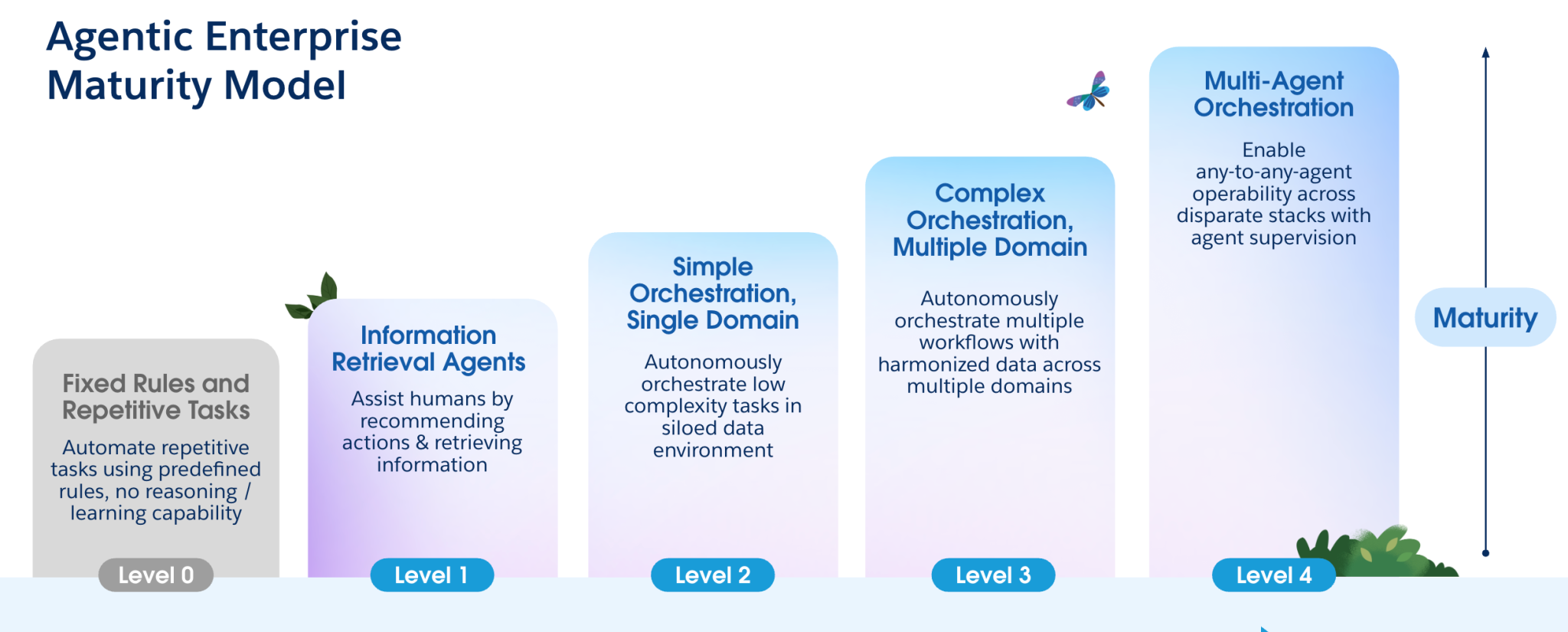
Please read the section 'How can banks agentify their operations?'. Focus on understanding the three approaches: 'Smart overlay', 'Agentic by design', and 'Process redesign'. Think of these as a maturity curve for adoption.
These three approaches give you a strategic toolkit:
- Smart Overlay: The path of least resistance. Wrap an agent around an existing, well-defined process. This is for quick wins and demonstrating value with minimal disruption.
- Agentic by Design: More ambitious. Build new, agent-native applications to replace legacy systems, similar to a microservices architecture. This tackles core inefficiencies.
- Process Redesign: The most transformative approach. Re-engineer an entire business workflow from the ground up with agents at its core. This unlocks the highest potential but also requires the most significant investment and change management.
This progression can be visualized using a maturity model, which provides a powerful communication tool for stakeholders.
A Pragmatist's Guide to Realizing Value
Finally, to make the value proposition credible, especially to a skeptical audience, you must address the "how-to" of successful implementation. This is where you connect the grand vision to pragmatic execution.
The Deloitte video and article provide several high-signal, no-fluff recommendations that will resonate with your preference for rigor.
- Be Intentional with Metrics: As the speaker in the Deloitte video advises, "Employ the scientific method." Establish baseline metrics for a process before introducing an agent, then measure again. This is the only way to prove ROI and combat claims that the technology has "no material impact on earnings."
- Embed Compliance at the Core: In a regulated industry like finance, compliance cannot be an afterthought. It must be designed into the agent's logic, guardrails, and oversight mechanisms from day one.
- Foster Human-AI Collaboration: The goal is not to replace humans but to elevate them. The operating model must shift so that humans guide, oversee, and handle exceptions, with agents executing the core tasks.
- Start Small, Share Wins: Use the "smart overlay" approach to score early, measurable victories. Then, as the video suggests, "be the hero" and share those win stories to build momentum and drive broader adoption.
Conclusion
In this lesson, we have connected the technical architecture of an agent to its strategic value for the enterprise. You are now equipped to move beyond describing what an agent is to articulating why it matters.
Key Takeaways:
- The core value proposition of agentic AI is the shift from automating rigid tasks (RPA) to orchestrating complex, goal-oriented outcomes.
- For financial services, this value can be articulated through three primary levers: Risk Mitigation (e.g., AML), Cost Reduction (e.g., developer productivity), and Product Innovation (e.g., agentic commerce).
- A practical implementation strategy follows a maturity curve: from Smart Overlay for quick wins, to Agentic by Design for core systems, to full Process Redesign for transformation.
- Realizing this value requires a rigorous, metrics-driven approach, with compliance built-in from the start and a focus on effective human-AI collaboration.
Preview of the Next Lesson:
Now that you can define an agent conceptually and articulate its business value, we will begin Module 3 by diving deep into the technical architecture. In our next lesson, we will map the core components of a single agent: the LLM backbone, memory, tools, and orchestration layer. This will provide you with the detailed schematic required to begin designing these powerful systems yourself.