Recommended resources
The freely available resources this lesson will direct you to.
Introduction
Welcome to the first lesson of our second module. In Module 1, we focused on the fundamental components of modern AI systems—the "what." You learned how text embeddings create semantic meaning, how context windows act as an operational memory, and how to choose between prompting, RAG, and fine-tuning to customize a model's knowledge and behavior.
Now, we shift from the static building blocks to the dynamic process of execution—the "how." This module introduces the conceptual frameworks that make an AI system truly agentic.
Today's learning outcome is to define agentic AI using the Observe-Orient-Decide-Act (OODA) loop as an execution model. This powerful mental model, originating from military strategy, provides a rigorous, systems-thinking approach to understanding how an autonomous agent interacts with its environment to achieve a goal. It moves us beyond the simple prompt-and-response paradigm of a chatbot and into the realm of continuous, goal-directed action.
The OODA Loop: A Framework for Strategic Action
Before applying it to AI, let's understand the OODA loop in its original context. Developed by U.S. Air Force Colonel John Boyd, the OODA loop is a model for decision-making in competitive and uncertain environments. Its primary insight is that success often goes not to the most powerful actor, but to the one who can cycle through their decision-making process faster and more effectively than their opponent.
To get a concise overview of the framework, please watch the following video.
The OODA Loop: A Competitive Decision-Making Tool
This video from DecisionSkills, 'The OODA Loop: A Competitive Decision-Making Tool', explains the origin and four stages of Boyd's model. Pay close attention to the emphasis on the 'Orient' phase as the most critical part of the cycle.
Watch the entire video (4 minutes, 52 seconds). It will walk you through each of the four stages and explain the overall philosophy of gaining a competitive advantage by operating 'inside' an opponent's loop.
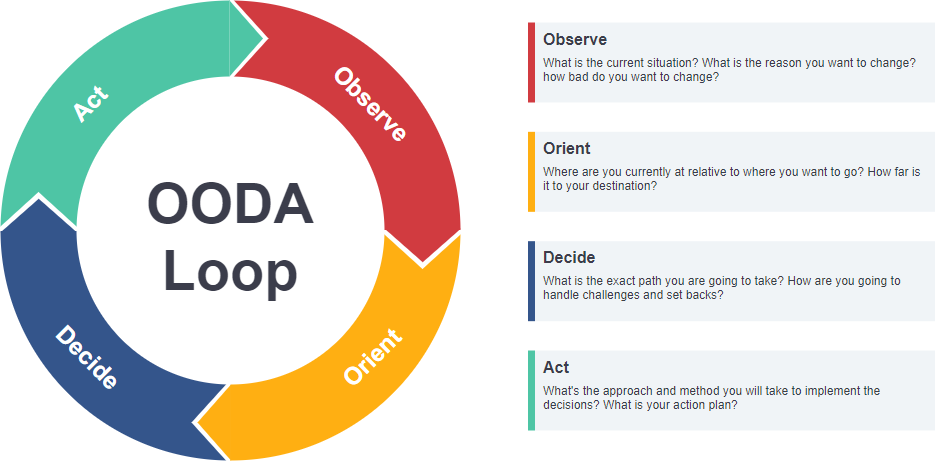
As the video highlights, the four stages are:
- Observe: Gather raw sensory data from the environment. What is happening?
- Orient: This is the most crucial phase. It involves interpreting the observed data within the context of your previous experience, goals, and mental models. This is where you make sense of the situation and build situational awareness.
- Decide: Based on your orientation, formulate a hypothesis or select a course of action from available options.
- Act: Execute the decision, which in turn changes the environment.
- Loop: The results of your action become the new input for the Observe phase, beginning the cycle anew.
Mapping the OODA Loop to Agentic AI
An agentic AI is a software entity that autonomously executes this very cycle. It isn't just responding to a single prompt; it's continuously looping to make progress towards a high-level goal. The OODA loop provides the perfect architectural blueprint for how these systems function.
To explore this connection, let's read an article that directly discusses the implementation of OODA in AI systems.
How the OODA Loop Revolutionized AI Decision-Making and ...
The article 'How the OODA Loop Revolutionized AI Decision-Making' from SandGarden provides a clear explanation of how each phase of the OODA loop is implemented within an AI architecture.
Please read the introduction and the section titled 'The Architecture of Intelligent Adaptation.' This will detail how abstract concepts like 'Observe' and 'Orient' translate into concrete technical components like sensor fusion and machine learning models.
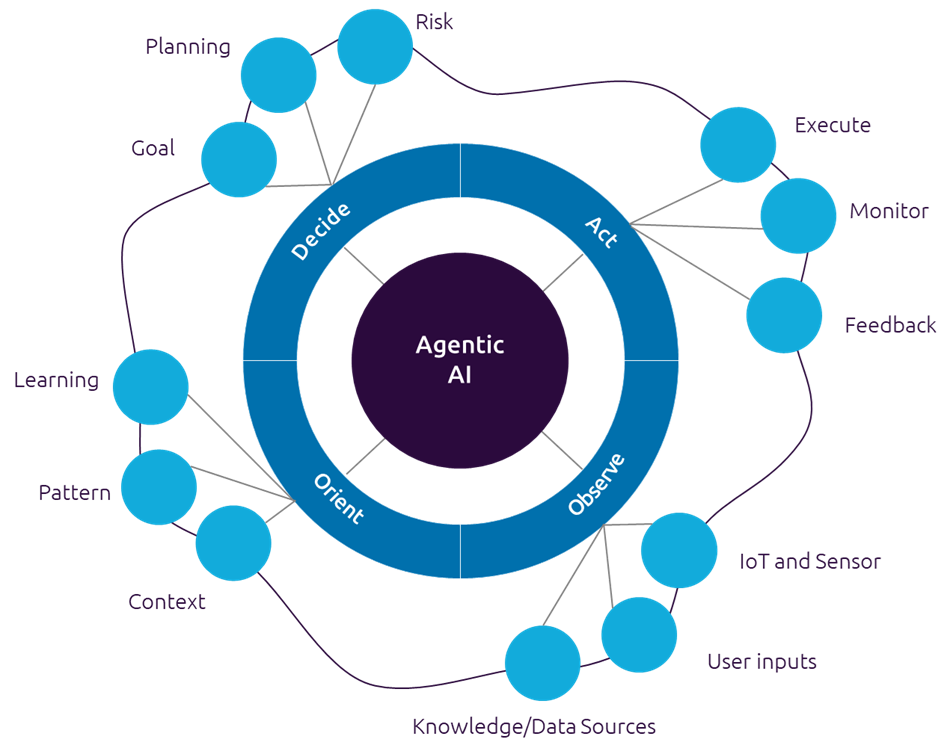
Building on that reading, let's create a precise mapping from the OODA framework to the components of an agentic AI system:
- Observe: The agent uses its tools and sensors to gather data. This isn't just about physical sensors; it's about API calls to fetch data, running web searches, reading files from a disk, or receiving input from a user. This is the agent's "perception" layer.
- Orient: This is the LLM's core reasoning engine. It takes the raw data from the
Observephase and integrates it with its existing knowledge. This is where the components from our last module come into play:- The LLM uses its context window as a short-term memory to hold the new observations.
- It may trigger a RAG process to pull in relevant long-term memory or external knowledge from a vector database (e.g., "What is our company policy on this observation?").
- Its fine-tuned behaviors guide how it should interpret the information and what patterns to look for.
- The output of this phase is an updated "world model" or situational awareness.
- Decide: Based on its updated understanding, the agent plans its next action. The LLM, guided by its main objective, breaks the problem down and chooses the next logical step. This could be selecting another tool to use, asking the user for clarification, or formulating the final answer.
- Act: The agent executes the decision by using one of its tools. It calls an API, writes code, sends an email, or returns a response to the user. This action alters the state of the environment.
This entire process then repeats, with the agent observing the outcome of its action, re-orienting, and deciding on the next move, until the overarching goal is achieved.
From Passive Workflow to Active Agent
The OODA loop helps clarify the fundamental difference between a simple AI workflow and a true AI agent. In a workflow, a human defines a rigid, pre-determined path. In an agentic system, the LLM itself is the decision-maker, autonomously navigating the OODA loop.
The following video provides an excellent, non-technical breakdown of this crucial distinction.
In 'AI Agents, Clearly Explained', Jeff Su makes a sharp distinction between LLMs, AI Workflows, and AI Agents. This will help solidify why the OODA loop concept is so central to agentic AI.
Please watch from 02:12 to 07:34 and then the final summary from 09:12 to 09:51. Focus on: The definition of an AI Workflow, where a human sets a predefined path (02:12 - 05:23). The key transition to an AI Agent, where the LLM replaces the human as the decision-maker, enabling it to reason and act autonomously (05:23 - 07:34). The concluding visual summary that neatly contrasts the three levels (09:12 - 09:51).
As the video explains, the defining characteristic of an agent is that it embodies the Orient and Decide steps. It's not just following a script; it is reasoning about the state of the world and making its own decisions about how best to proceed toward its goal.
Practical Application: Agentic Underwriting
Let's ground this in the underwriting workflow you're focused on. Imagine an agent tasked with performing a preliminary risk assessment on a loan application.
Goal: Provide a preliminary credit risk recommendation for Applicant Corp.
-
OODA Loop 1: Data Ingestion
- Observe: The agent receives the initial prompt: "Assess Applicant Corp." It ingests the attached loan application PDF.
- Orient: The agent parses the document. Its internal model, shaped by its system prompt and training, recognizes that a PDF application is insufficient for a full assessment. It cross-references its required data points (3 years of financials, director history, adverse media checks) with what it has. A significant information gap is identified.
- Decide: The agent plans a multi-step data acquisition strategy: "First, query the internal document management system for financial statements. Second, query the web for recent news about the company."
- Act: The agent executes two tool calls:
search_internal_docs(company="Applicant Corp")andweb_search(query="Applicant Corp news").
-
OODA Loop 2: Risk Analysis
- Observe: The agent receives the outputs from its tool calls: three annual report PDFs and a list of URLs with news headlines.
- Orient: The agent now performs a deeper analysis. It extracts key financial ratios from the PDFs. It uses RAG to retrieve the bank's current underwriting policy thresholds. It compares the applicant's ratios to the policy. It analyzes the sentiment of the news headlines and finds one article mentioning a pending lawsuit. The agent's "world model" is now much richer and includes a potential legal risk.
- Decide: The agent determines that while the financial ratios are acceptable, the legal risk is material and requires human judgment. It decides not to proceed automatically. Its plan is now: "Synthesize findings, flag the legal risk, and escalate to a human underwriter for review."
- Act: The agent generates a structured summary report, highlighting the acceptable financials but clearly flagging the lawsuit with a link to the source article. It then sends this report to the human underwriter's queue via an API call.
This iterative process—action, observation, re-evaluation—is the essence of agentic behavior, perfectly captured by the OODA loop.
A Stoic's Caution: The OODA Loop Problem
Your preference for rigor and skepticism is well-placed. The OODA model, when applied to AI, reveals significant security challenges. Boyd's original framework assumed a pilot could generally trust their own senses (Observe) and reasoning (Orient). For an AI agent connected to the internet, this assumption is dangerously false.
Security expert Bruce Schneier has written about this "Agentic AI's OODA Loop Problem."
Agentic AI’s OODA Loop Problem
To provide a critical and balanced perspective, let's briefly review Bruce Schneier's analysis of the vulnerabilities inherent in the agentic OODA loop.
Please read the short, bulleted section that breaks down the risks at each stage of the loop ('Observe', 'Orient', 'Decide', 'Act'). This will give you a sense of the security mindset required when designing agentic systems.
Schneier's point is that each stage of the loop can be attacked:
- Observe: Poisoned with bad data (prompt injection).
- Orient: Corrupted by malicious training data.
- Decide: Hijacked by reward hacking or logic manipulation.
- Act: Subverted through tool confusion.
We will address these governance and security issues in detail in Module 10. For now, it is sufficient to recognize that while the OODA loop is a powerful model for defining agentic behavior, its implementation requires a robust security framework that treats every input and every step of the cycle with suspicion.
Conclusion
In this lesson, we established a formal definition of agentic AI using the OODA loop as an execution model. This framework provides a significant conceptual upgrade from thinking about AI as a passive tool to understanding it as an autonomous, goal-seeking system.
Key Takeaways:
- Agentic AI is defined by its continuous execution of the Observe-Orient-Decide-Act (OODA) loop to achieve a goal.
- This model distinguishes proactive agents from passive AI workflows. The agent itself is the decision-maker, not just a follower of a human-defined script.
- The Orient phase is the cognitive core, where the LLM reasons, makes sense of data, and leverages components like RAG and fine-tuning to update its situational awareness.
- Applying the OODA loop to practical workflows like underwriting makes the abstract concept concrete and demonstrates its value for designing complex automation.
- The OODA framework also highlights inherent security vulnerabilities at each stage, demanding a rigorous, zero-trust approach to agent design.
Preview of the Next Lesson:
Now that we have defined agentic AI through its execution model, our next lesson will formalize the contrast. We will differentiate agentic systems from non-agentic AI (e.g., static analytics, chatbots) based on autonomy and proactivity, building directly on the concepts of self-directed decision-making introduced today.