Recommended resources
The freely available resources this lesson will direct you to.
- The RATE of NATURAL INCREASE and Population Dynamics [AP Human Geography Review—Unit 2 Topic 4]www.youtube.com
- Urbanisation: Natural Increase & Push/Pull Factors | AQA GCSE 9-1 Geographywww.youtube.com
- Population - KS3 Geography - BBC Bitesizewww.bbc.co.uk
- Global Warmingeducation.nationalgeographic.org
Hello! This course is designed to help you revise the geographical ideas on your assessment list. We’ll begin with the vocabulary that later topics depend on, then move on to human and environmental impacts, rainforests, and population patterns.
In this first lesson, you’ll learn to use nine terms accurately in short answers. The aim is not just to recognise a word, but to give a definition that earns its place in an answer—and to avoid mixing up terms that sound similar.
Relief: describing the land
In geography, relief means the height and shape of the land. Mountains, hills, valleys and low-lying plains are all features of relief. A steep hillside and a flat plain differ in relief even if they are close together.
The mountain in the diagram gives you a visual example. Its height and slopes are its relief. The rain shown on one side is an effect of the mountain’s relief, not the meaning of the word.
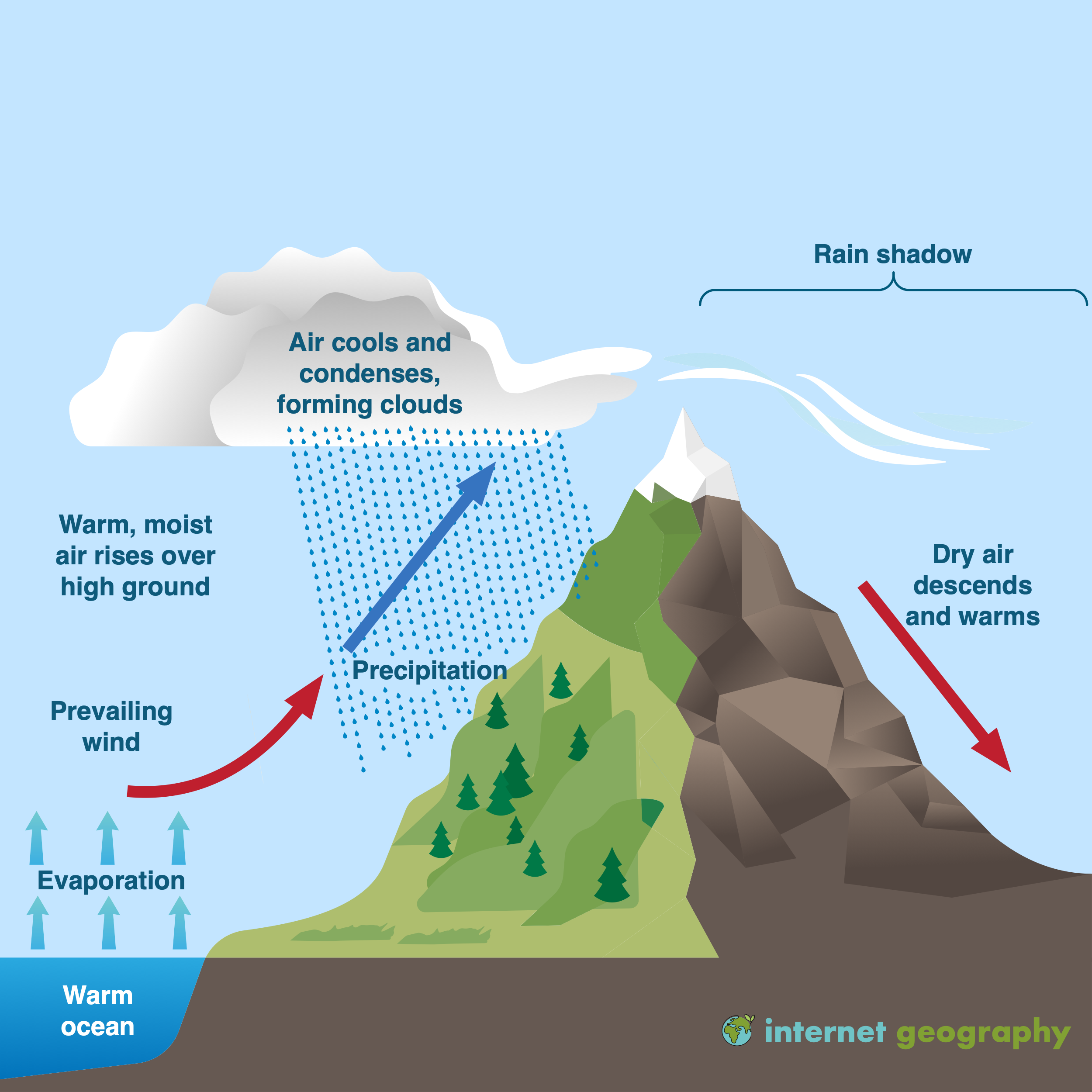
For a short-answer definition, “the height and shape of the land” is more precise than “what a place looks like.” The latter could include buildings or vegetation, which are not relief.
Sustainability: thinking beyond the present
Sustainability means meeting people’s needs now without preventing future generations from meeting their needs. It asks whether a way of using resources can continue without exhausting or seriously damaging what people will need later.
Imagine a woodland used for timber. Cutting trees can provide a useful material and support livelihoods today. If trees are removed faster than the woodland can recover, however, the supply and the habitat may be lost for people in the future. Managing the woodland so that it can recover is a more sustainable approach.
Sustainability is not simply “never use resources.” It is about how resources are used over time. A strong short answer includes both halves of the idea: present needs and future needs. You will use this term again when considering the impacts of human activities.
Global warming and climate change: related, not identical
Global warming is the rise in Earth’s average global temperature over a long period. “Average” matters: a cold day in one place does not disprove a long-term rise in the global average. Human activities, particularly burning fossil fuels, have increased heat-trapping gases in the atmosphere and are a major cause of current global warming.
Climate change is broader. It means long-term changes in climate patterns, which include temperature but also rainfall, seasons and the frequency or intensity of some extreme weather. Global warming is one aspect of today’s climate change and helps drive other changes.
Read the opening explanation and the later comparison in National Geographic’s Global Warming. The second passage is especially useful for keeping the two definitions distinct.
Read National Geographic's “Global Warming” to distinguish a rise in average temperature from wider changes in climate.
Under the “Global Warming” title, find the paragraph after the photograph beginning “Global warming refers to the increase”. Read the opening explanation. Later in the article, find the paragraph beginning “Global warming has presented humans with another issue”. Read the comparison, stopping before the paragraph about droughts. Focus on what each term measures or describes.
A useful distinction in an assessment answer is: global warming concerns the global average temperature; climate change concerns wider, long-term changes in climate patterns. Climate can also change through natural processes, but the rapid changes being discussed today are strongly influenced by human activity. Avoid defining climate change as “the weather changing”: weather describes conditions over shorter periods, whereas climate describes longer-term patterns.
Population: a number that can change
A population is the number of people living in a particular area. Always keep the area in mind: you might discuss the population of a village, a country or the world. Population is a count of people, not a measure of how crowded a place feels.
Three things can change an area’s population: births, deaths and migration. Migration means people moving from one place to another to live. It can happen within a country or between countries. A holiday is not migration because the traveller is not moving home.
Births and deaths can also be described using rates, which make populations of different sizes easier to compare:
- Birth rate is the number of live births per 1,000 people per year.
- Death rate is the number of deaths per 1,000 people per year.
The units are part of each definition. “How many babies were born” gives a total number, not a birth rate. If one place has many more people than another, it might have more births in total but a lower birth rate.
BBC Bitesize’s Population gives concise versions of these definitions and brings them together with natural increase. Read the specified passages rather than the later material on the Demographic Transition Model; that model belongs to a later part of the course.
Population - KS3 Geography - BBC Bitesize
Read BBC Bitesize's “Population” for the core definitions and for the difference between population change caused by births and deaths and change caused by migration.
In “What do you know?”, read the answer to the opening question. Then go to “Population change” and its “Changes in population” subsection. Start at the sentence explaining the three factors that change population and read through the migration explanation. Focus on the “per 1,000 people per year” units for rates and on which changes count as natural change. Stop before the “Question” heading.
Natural increase occurs when the birth rate is higher than the death rate, so births add more people than deaths remove. The word natural tells you what to include: births and deaths, not migration. If deaths exceed births, that is a natural decrease.
For example, suppose an area has 10,000 people, a birth rate of 20 per 1,000 per year and a death rate of 8 per 1,000 per year. In one year, that represents 200 births and 80 deaths: a natural increase of 120 people. If 150 people also move away and nobody moves in, the population actually falls by 30. Natural increase does not guarantee that the total population grows, because migration can change the final result.
That distinction is worth remembering for later lessons: population figures describe what is changing; births, deaths and migration help explain why.
Making definitions work in short answers
When a question says define, give the distinguishing feature of the term rather than a loose example. “Relief means mountains” names one possible feature; “relief is the height and shape of the land” gives the definition. Similarly, “sustainability means helping the environment” misses the essential link between present and future needs.
When a question says explain, use the definition to make a connection. For instance:
Model answer: “Natural increase occurs when the birth rate is higher than the death rate. This means more people are being born than are dying, so births and deaths alone would cause the population to grow.”
The second sentence explains the consequence without mistakenly including migration. For global warming and climate change, an answer should keep the narrower temperature change separate from the wider changes in climate patterns. Precise terms make even a brief response clear.
You now have the key vocabulary for describing land, resource use, climate and population. The distinctions to hold on to are relief versus its effects, global warming versus wider climate change, and natural increase versus total population change. Next, you’ll apply geographical categories to the positive and negative impacts of tourism.