Recommended resources
The freely available resources this lesson will direct you to.
Hello! Earlier modules focused on handling particular situations—shopping, appointments, travel, and conversation. This final module shifts toward using Norwegian independently. The first step is preparing just enough language for an interaction you can predict, rather than trying to remember every word you might possibly need.
By the end of this lesson, you’ll have a repeatable way to prepare a small, useful vocabulary set before an errand or appointment. We’ll use a grocery trip as the main example, then see how the same method transfers to another situation. Allow about 40 minutes, including the short readings and a brief spoken rehearsal.
Start with the interaction, not the dictionary
Suppose you need to buy bread and oat milk. “Food vocabulary” is a reasonable topic, but it is too broad a study target. The likely interaction is narrower: you may need to find an item, respond if it is unavailable, and answer a checkout question. Words that support those moves are worth preparing; names of unrelated foods are not.
NTNU’s LearnNoW table of contents is useful as a topic map. It shows how broad everyday themes can point you toward a relevant vocabulary area without requiring you to study an entire chapter before one errand.
Table of Contents - LearnNoW - NTNU
Read NTNU’s topic map to see how you might choose a vocabulary area for a predictable interaction.
In the first table, under “What to learn,” find the rows “5 New friends” and “6 A Trip to town.” Read the chapter 5 themes and the chapter 6 themes. Then locate “10 Illness, health and sports” and scan its themes as an example of a different interaction domain. Finally, glance at the lower “Extras” table to see how entries such as “Food” and “Shopping centre” narrow a theme further. Focus on choosing a relevant area, not learning all its vocabulary now.
A topic map helps you decide where to look. It does not decide which words you will actually say or hear. For that, picture the specific encounter. Ask yourself: What am I trying to accomplish? What is the first thing I may need to say? What is the most likely question or obstacle?
For the grocery trip, your preparation might cover only these situations:
- You cannot find the oat milk.
- The shop has none, so you ask about an alternative.
- The cashier asks whether you want a bag.
That is a more useful target than “learn twenty food nouns.”
Turn words into a compact preparation card
The illustrated list below contains useful food and drink words, including brød (bread), eple (apple), and kaffe (coffee). A picture list can help you recognize an item, but a real interaction also requires phrases and responses. The list itself does not tell you what to say when the shelf is empty.
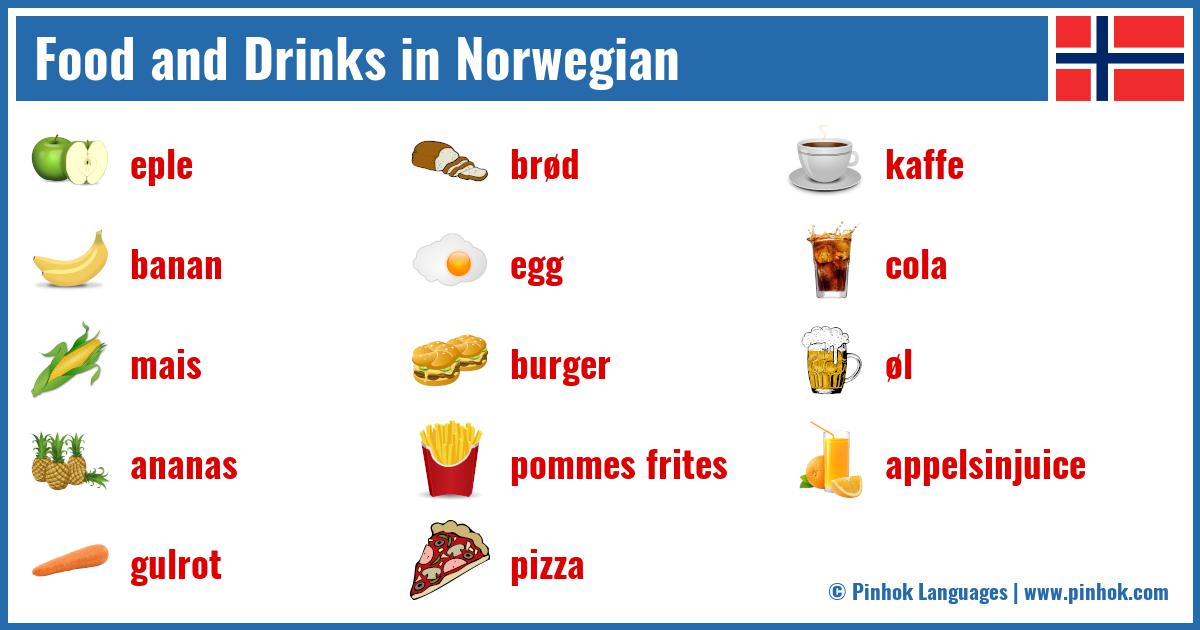
For one grocery trip, a preparation card can be smaller and more practical than a conventional vocabulary list:
| Prepare | Norwegian | Why it earns a place |
|---|---|---|
| Essential items | havremelk (oat milk); et brød (a loaf of bread) | These are the things you need. |
| Finding an item | Hvor finner jeg havremelk? (Where can I find oat milk?) | Gives you a usable opening. |
| Checking availability | Har dere havremelk? (Do you have oat milk?) | Works if you cannot see it. |
| Handling a problem | Har dere et alternativ? (Do you have an alternative?) | Keeps the interaction moving if it is unavailable. |
| Recognizing a likely reply | Den er utsolgt. (It’s sold out.) | Helps you understand the reason for the problem. |
| Checkout | Vil du ha pose? (Do you want a bag?); Ja takk, en pose. (Yes, a bag, please.) | Prepares both what you may hear and what you can say. |
Notice the balance: item words, ready-to-use phrases, and likely words from the other person. If you prepare only what you intend to say, a routine reply can still stop the conversation.
Keep nouns with a useful form when you can: et brød, en pose, en kvittering (a receipt). For verbs, a short phrase is often easier to retrieve in the moment than an isolated dictionary entry. Hvor finner jeg …? is immediately usable; å finne (“to find”) alone still leaves you to build a question at the shelf.
Aim for a card you could glance at in under a minute: perhaps three to five key words, two or three phrases you might say, and one or two replies you expect to hear. You can add a word if the situation calls for it, but the aim is coverage of likely turns, not a long list.
Learn the card in the direction you need it
NTNU’s NoWiN guide describes vocabulary lists, audio for entries, and flashcard options in both Norwegian-to-English and English-to-Norwegian directions. Those options serve different purposes. Recognizing utsolgt when you hear or read it is not the same task as producing Hvor finner jeg havremelk? when you need help.
Read NTNU’s explanation of its vocabulary tools, paying attention to how you can use them for both recognition and recall.
On the “Guide” page, go to the subsection “Vocabulary.” Read the vocabulary guidance, from its opening explanation through the description of flashcards. Notice the lists, the blue audio links, and the two translation directions. For an upcoming interaction, consider which words you mainly need to recognize and which phrases you must be able to produce without looking.
Use that distinction when reviewing your card. For likely replies, check whether you understand the Norwegian promptly: Den er utsolgt needs to mean “it’s sold out” to you without a long pause. For your own opening, start with the intended meaning—“Where can I find oat milk?”—and retrieve Hvor finner jeg havremelk? aloud. Listen to available audio for words you are uncertain how to pronounce, then say your phrases at conversational speed rather than spelling them out word by word.
Do not make every item equally demanding. If bread is visible and self-service, recognizing brød may be enough. If finding oat milk is the likely reason you will speak to someone, the full question deserves rehearsal.
A short routine you can reuse
Before a predictable interaction, work through four decisions:
- Define the outcome. “I need oat milk and bread” is more actionable than “I’m going shopping.”
- Anticipate two or three turns. Include your likely opening, a likely answer or obstacle, and your next response.
- Select a small vocabulary set. Prefer specific nouns with useful forms, whole phrases you can say, and key words you may hear.
- Rehearse once aloud. Say your opening without reading it. Imagine one ordinary reply and answer it.
For the grocery example, a short rehearsal might be:
You: Unnskyld, hvor finner jeg havremelk?
Staff member: Den er utsolgt.
You: Har dere et alternativ?
You are not trying to predict the exact dialogue. You are making the first likely turns easier to handle. If the reply is unexpected, the repair phrases you learned earlier remain available; preparation does not require a perfect script.
The same method works for changing an appointment. Instead of collecting every health-related word, you might prepare en time (an appointment), å flytte timen (to move the appointment), and ledig tid (available time), together with Kan jeg flytte timen min? (“Can I move my appointment?”). You would also prepare to recognize a proposed day or time and answer Det passer (“That works”) or Det passer ikke (“That doesn’t work”). The topic has changed, but the selection principle has not.
Key takeaways
Prepare vocabulary for what you need to do and what you are likely to hear, not for an entire broad topic. A compact set of item words, usable phrases, anticipated replies, and one response to a likely obstacle gives you a practical starting point. Review the words you must recognize differently from the phrases you must produce, and say your opening aloud before the interaction.
In the next lesson, you’ll build on this preparation by initiating a Norwegian interaction even when English is available.