Recommended resources
The freely available resources this lesson will direct you to.
Hello! Last time, you listened for a speaker’s overall point and chose a detail that supported it. Today the task is narrower: sometimes a single letter or digit is the answer. You will practise recording names, numbers, dates, and contact details accurately, then use those skills in a short note-completion recording. Allow about 40–45 minutes, including pauses to write and check.
The recordings below are English-listening practice, not official Password materials. The aim is to build a method you can use whenever a listening question asks for an exact detail.
Names: listen for the spelling, not just the sound
If you hear a familiar first name, you may be able to write it immediately. A surname is less predictable. Two people can have names that sound similar but are spelled differently, so an accompanying letter-by-letter spelling is valuable evidence.
Before listening, make a space for each answer. Write the letters as you hear them, rather than waiting until the speaker finishes the whole name. If the speaker repeats it, use the second hearing to check the uncertain letters, not to start again from memory. For a street name, separate the identifying name from the final word, such as Road or Avenue.
Listening Practice (IELTS) | Surnames, Telephone Numbers, Street Names and Email Addresses
Watch “Listening Practice (IELTS) | Surnames, Telephone Numbers, Street Names and Email Addresses” from Pronunciation with Emma. Its first two practice sections give you surnames and street names spelled aloud.
Use surname practice and street names. Write each item before looking at its answer. On the second spelling, mark any letter you need to change; check the street ending as carefully as the name itself.
When you check your work, classify a mistake precisely. Did you mishear a letter, lose your place while writing, or assume a familiar spelling instead of following the letters spoken? The remedy differs: replaying a sound helps with the first problem, while leaving a little space between groups of letters helps with the second.
Numbers and contact details: preserve every character
Numbers are often spoken in groups, but the groups do not change their order. A telephone number needs all its digits, including any zero that you hear as “oh.” If a speaker says “double five,” write 55: double tells you how many times to write the digit. Keep the groups apart in your notes until you can check that none is missing.
An email address requires a different kind of attention. The spoken words at, dot, and underscore represent @, ., and _. A dot is not an underscore; a missing symbol can make an otherwise correct address unusable. Write the address in short sections as it is spoken, then inspect the joins between those sections.
Listening Practice (IELTS) | Surnames, Telephone Numbers, Street Names and Email Addresses
Continue Emma’s listening practice with telephone numbers and email addresses. This moves from spelling words to recording strings of digits, letters, and symbols.
Watch telephone numbers, keeping the spoken digit groups separate while you write. Then use email addresses; pay particular attention to where the speaker says “at,” “dot,” or “underscore.” Check your answers only after writing each item.
A useful final check depends on the answer type. For a phone number, count and compare digit groups. For an email address, check the letters and the symbols. For a name, inspect initials and surname spelling. Do not spend your checking time polishing an answer that is already clear while leaving a missing digit unnoticed.
Dates: make the day, month, and year unmistakable
A spoken date may begin with the month—“March seventh”—or with the day—“the seventh of March.” Both refer to 7 March. In speech, the day normally uses an ordinal word such as seventh, twenty-first, or thirty-first. In writing, the form 7 March is clear without an ordinal ending.
The Woodward English infographic shows why a string of numbers can be risky: 3/7/17 is read as March 7 in the US convention, but as 3 July in the UK convention. Unless a task specifies a numerical format, writing the month as a word avoids that day–month ambiguity. Follow any format or word-limit instruction given with the question.
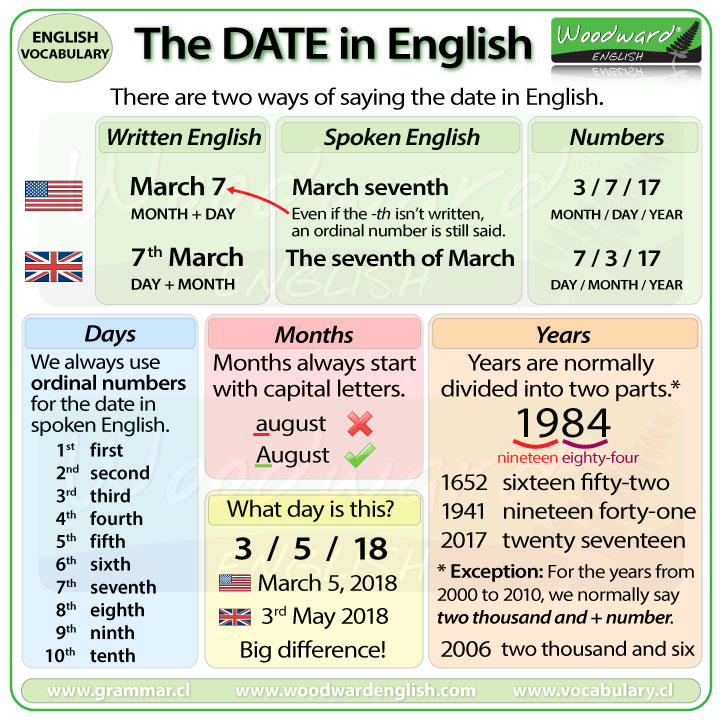
The next video offers eight dates to catch on a single hearing. Its presenter recommends a compact numerical style; for your answers, prefer a clear, unambiguous format where the task permits one.
IELTS Listening Practice - Dates
Watch “IELTS Listening Practice - Dates” from The IELTS Coach for short date dictation. Use it to test whether you captured the correct day, month, and year, rather than relying on one particular written layout.
First hear date formats. Then, with captions and the answer display hidden, write the eight dates during date dictation. Finally, use the answers to check each component. If a date includes only a month and year, do not add a day.
For each error, locate the part that changed: day, month, or year. This is more useful than merely marking the whole date wrong. If you heard the date correctly but wrote it ambiguously, the next step is a writing-format change; if you confused the spoken numbers, you need another careful listen.
Bring the details together in one recording
In an information talk, you will not know in advance which sentence contains a name or number. The notes themselves help you prepare: a gap beside “Number of places” calls for a quantity; a gap beside “company” calls for a name. Read the surrounding words before playing the audio so you know what kind of detail to catch.
B1 Preliminary for Schools Listening Part 3: free practice test
Use Exam English’s “B1 Preliminary for Schools Listening Part 3” as an integrated note-completion task. It is for a different exam, but its summer-course announcement brings several precise details into one recording.
In “B1 Preliminary for Schools Listening, part 3,” read the task instructions, especially the answer-length limit and the option to listen twice. Under “Summer course,” scan the six notes, from the first course-content gap through the final booking-information gap. Predict whether each gap needs words, a name, or a number before pressing play.
On the first play, fill what you can and put a small mark beside an uncertain gap. Keep following the talk if you miss one answer; the next detail may be close behind it. On the second play, check the marked gaps and the spelling of names or other exact words. Finally, read each completed note as a whole: does your answer fit its label and stay within this task’s stated limit? The limit belongs to this practice task; always check the instructions on the task in front of you.
Key takeaways
Accurate detail listening has three parts: predict the type of answer, record what you hear without replacing it with a guess, and check the features that matter for that answer type. Names need careful letters, numbers need every digit, dates need the right components in a clear order, and contact details need their symbols as well as their words.
You have now practised listening both for a message and for exact information. The next lesson turns to writing: analysing an opinion-essay prompt and planning a clear position.