Recommended resources
The freely available resources this lesson will direct you to.
Hello! This course begins at B1 and will build reading, listening, writing, and speaking skills across everyday and academic topics. Today we start with a reading task: putting seven sentences into an order that makes a clear, connected text.
The key is not to find sentences that share a word. It is to work out what each sentence needs from the sentences around it. By the end of this lesson, you will be able to use reference words, time markers, and cause-and-effect links to reconstruct a sequence—and check that the whole passage makes sense.
What holds a sequence together?
A reader can follow a paragraph because its sentences are cohesive: words in one sentence connect to words or ideas in another. The paragraph is coherent when the complete order also makes sense as a whole. A sentence may fit neatly beside one other sentence but still be in the wrong place in the story.
Watch this short explanation before examining the clues yourself:
Coherence and Cohesion in Academic Writing
Watch “Coherence and Cohesion in Academic Writing” from EAPFoundation.com for a distinction between local links and the meaning of a whole text. Although the examples concern writing, the same links help you reconstruct a reading passage.
Watch cohesion and coherence, then reference words. Finish with transition signals, focusing on expressions that indicate a cause or result.
Reference words include it, they, them, their, this, and these. Ask what—or whom—each word refers to. In “Five students borrowed bicycles. They used them every morning,” they refers to the students, while them refers to the bicycles. A possible order fails if its reference word has no clear match, or if a singular word such as it is meant to refer to several people.
Time markers place events in relation to one another: at first, the following week, later, after, and finally. Read the entire sentence, though. In “Because the bus had stopped running, the school introduced bicycles,” the bus stopped first in the events, but the sentence itself could appear after an introductory sentence about the school.
Cause-and-effect links explain why something happened or what followed from it. Because often introduces a reason; therefore and as a result introduce a result. The expression must match the relationship between the ideas, not merely look useful as a linking word.
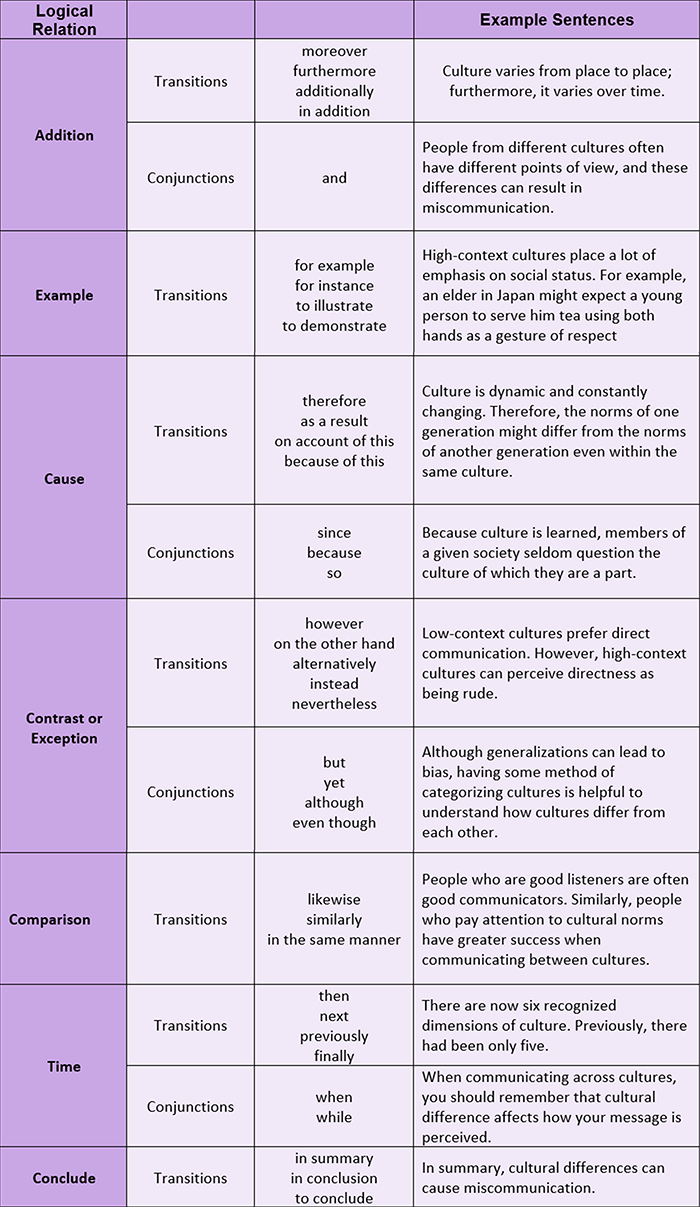
The chart offers a helpful distinction: then suggests a time order, whereas therefore claims a consequence. Two events occurring one after the other do not automatically mean that the first caused the second.
See the clues in an exam-style text
The following Cambridge B1 resource uses a gapped-text task, not the seven-sentence Password sequence in this lesson. Its value here is its close explanation of how a reference word must fit both the surrounding meaning and the grammar.
Developing reading skills for B1 Preliminary for Schools ...
Read the Part 4 example and answer explanation in Cambridge English’s teacher guide. It shows why an apparently relevant sentence needs a precise link to its neighbours.
Find “Part 4: Task familiarisation” on printed page 19. Read the example and explanations, continuing into the answer key on printed page 20. In particular, identify what “some” and “them” refer to in option D, and what “this” refers to in option G.
Notice the standard of evidence in that explanation. A sentence does not earn its position simply because it mentions the same sport. Its small words must point to identifiable things, and its idea must advance the passage. We can apply that standard to a complete seven-sentence sequence.
Reconstruct a seven-sentence sequence
Here are seven shuffled sentences about travel to school. Read them once for the general topic before trying to connect individual pairs.
- A. This route avoided the busiest road near the school.
- B. At first, only five students signed up for the bicycle scheme.
- C. Their comments persuaded the school to mark a safer route on a map.
- D. Last autumn, a secondary school started a project to help students travel to school.
- E. The following week, several of them told their teacher that the journey felt dangerous.
- F. After the school shared the map, more students began cycling to school.
- G. Because the local bus service had stopped, the school decided to lend bicycles to students who lived nearby.
Start with D. It introduces a secondary school and a project without expecting us to know either already. G then explains the school’s decision to lend bicycles. The bus service had stopped earlier, but G belongs here in the paragraph: it explains the project introduced in D.
B follows the decision in G. “The bicycle scheme” now has a clear meaning, and “at first” begins the account of participation. E follows B for two independent reasons: “the following week” moves time forward, and “several of them” can refer to the five students who signed up.
Next comes C. “Their comments” refers to the students’ report that the journey felt dangerous. This is more than a repeated topic: the report persuaded the school to act. A must follow C because “this route” needs the safer route just introduced. F makes a fitting ending: once the map has been created and the route described, the school shares it and participation increases.
The resulting order is D, G, B, E, C, A, F:
Last autumn, a secondary school started a project to help students travel to school. Because the local bus service had stopped, the school decided to lend bicycles to students who lived nearby. At first, only five students signed up for the bicycle scheme. The following week, several of them told their teacher that the journey felt dangerous. Their comments persuaded the school to mark a safer route on a map. This route avoided the busiest road near the school. After the school shared the map, more students began cycling to school.
Read it once more as a whole. It has an introduction, an initial response, a problem, an action, and a later development. That overall progression helps confirm the local word-level clues.
A reliable way to check your order
When you face a new seven-sentence sequence, use three passes rather than committing to an order on the strength of one matching word.
- Find the likely opening. Look for a sentence that introduces the people, place, or situation. Be cautious about opening with unexplained words such as their or this.
- Build and test neighbouring pairs. For each proposed link, name its evidence: “them refers to the five students,” or “the following week comes after their first sign-ups.” Check time, grammar, and meaning together.
- Read the full sequence without stopping. Does every reference have a clear meaning? Does a result have a plausible cause? Do the events develop naturally, rather than jumping backwards without a reason?
If two sentences both seem possible in one position, inspect what would come after each choice. In the example, F mentions the map, so it might look acceptable immediately after C. But A supplies the important detail about this route before the passage moves to the outcome of sharing the map. Checking both neighbours gives a stronger answer than checking just one.
Key takeaways
To reconstruct a sequence, treat each sentence as part of a whole text. Reference words point to people, things, or ideas; time markers establish when events occur; and cause-and-effect links show why events occur or what results from them. Use those clues together, then reread the complete passage for a coherent progression.
In the next reading lesson, you will apply the same care to a different task: choosing words for a cloze by checking grammar, meaning, and natural word combinations.