Recommended resources
The freely available resources this lesson will direct you to.
Hello! Last lesson, you analysed a Password essay title, chose a position, and planned reasons that support it. Now we will turn that plan into the first paragraph. By the end of this lesson, you should be able to restate the prompt in your own words and tell the reader exactly where you stand. Allow about 40 minutes, including the short video and reading.
Give the introduction two clear jobs
An opinion-essay introduction does not need to present your entire argument. In two or three sentences, it can do two things:
- Identify the proposal or debate without copying the title.
- State your position clearly enough that the reader can anticipate the essay.
The illustrated essay below provides a useful starting point. Look at its title, opening paragraph, and highlighted opinion phrases. Notice that “I think” and “I believe” can make a view explicit; they are tools, not phrases you must repeat in every paragraph.
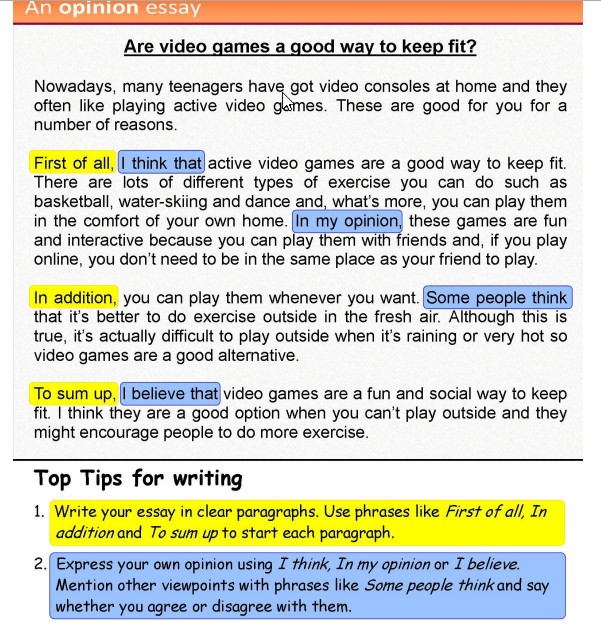
The example’s opening says that active video games are “good for you for a number of reasons.” We understand that the writer is in favour, but not yet how the games help with fitness or whether the claim applies to every kind of game. A more focused introduction might be:
Whether video games help people keep fit depends on the kind of game they play. I believe active games can offer a convenient way to exercise at home, although they should not replace other physical activity entirely.
The first sentence frames the question; the second gives a qualified answer. Its qualification does not hide the position: the writer supports active games as one way to exercise.
Paraphrase the claim, not just its individual words
Let us return to the school-subjects title from the previous lesson:
“School children should choose the subjects they study from a young age and stop doing subjects they find uninteresting.”
The essential meaning has two parts: children should choose subjects early, and they should be able to stop studying subjects that do not interest them. A paraphrase must preserve both parts. Changing children to pupils is possible, but word substitution alone is not the goal.
In this video, Emma demonstrates two useful methods: choosing accurate alternative words and changing sentence structure. Her example comes from another writing test, so use the paraphrasing technique, not any claims about Password scoring.
How to write a good essay: Paraphrasing the question
Watch “How to write a good essay: Paraphrasing the question” from English with Emma · engVid for practical ways to restate a prompt while keeping its meaning.
Watch word choices for the use of synonyms and, especially, the warning that a word with a slightly different meaning may not fit. Then watch sentence changes for examples of changing word form and order. As you watch, consider which changes would preserve both parts of the school-subjects claim.
Here is one careful restatement:
Some people believe that children should select their school subjects from an early age and be allowed to drop those they do not enjoy.
The new sentence changes the structure by introducing the proposal as something some people believe. It also uses select for choose and drop for stop doing. More importantly, it keeps the early age and the permission to discontinue disliked subjects. It does not mistakenly say that children already have this choice.
Paraphrasing is not a contest to replace every word. School subjects may be the clearest expression for the topic, and it is fine to retain it. Compare these two attempts:
- Meaning changed: “Students should be able to study their favourite subjects.” This leaves out from a young age and the proposal to stop studying other subjects.
- Meaning preserved: “Young pupils should have a say in which subjects they study and be able to discontinue those that do not interest them.” The two proposals remain, even though the wording changes.
Before accepting a paraphrase, compare it with the title. Check particularly for small words that control the claim: should, young, and stop all matter here.
Make the position visible in the opening
A paraphrase tells the reader what is being discussed. It does not, by itself, tell the reader what you think. The British Council’s An opinion essay advises writers to restate the question in their own words. Its model is useful for noticing the difference between introducing an issue and stating a position.
An opinion essay | LearnEnglish
Read the British Council’s “An opinion essay” to see how its opening restates a question, then consider when its writer’s own view becomes clear.
In “Reading text,” read the italicised internet-and-memory question, the opening paragraph, and the next paragraph, from question to argument. Then look at the beginning of “Tips,” from tips 1–3. Notice that the model introduces what “some people say” in its opening; the writer’s opposing view becomes clear in the following paragraph. For our present task, we will make that view explicit in the introduction.
For the school-subjects title, the position planned last lesson was mostly disagree: pupils could have some choice, but should continue studying a range of core subjects. An introduction can state that boundary immediately:
Some people believe that children should select their school subjects from an early age and be allowed to drop those they do not enjoy. I mostly disagree: although pupils could choose a few optional subjects, they should continue studying a broad range of core subjects.
The bold sentence does more than say “I disagree.” It identifies which part of the proposal the writer accepts and which part the writer rejects. The body paragraphs can then explain why keeping future options open and learning useful skills support that position.
A position can be qualified without becoming uncertain. Compare:
There are advantages and disadvantages to letting children choose subjects.
This announces a discussion but gives no answer. By contrast, “I mostly disagree, although pupils could choose a few optional subjects” makes the direction of the argument clear.
Keep the opening focused and proportionate
Here is the school-subjects introduction with a brief indication of its main reason:
Some people believe that children should select their school subjects from an early age and be allowed to drop those they do not enjoy. I mostly disagree: although pupils could choose a few optional subjects, they should continue studying a broad range of core subjects to keep their future options open.
The final phrase connects the introduction to a planned body paragraph. It does not try to explain the whole example about a future career; that work belongs in the body.
The same pattern works for a different title. Last lesson’s second title asked about the value of older people in society and whether they should be respected:
Many people consider older adults an important part of society and believe that they should therefore be treated with respect. I strongly agree: their contributions deserve recognition, and respectful treatment should be given to people of every age.
This introduction paraphrases the claim, states a strong degree of agreement, and gives the essay a direction. It does not need a long general opening such as “Since the beginning of time, society has included people of different ages.”
When you review an introduction, make three checks:
- Accuracy: Does the restatement preserve every important part of the title?
- Position: Can a reader tell whether you agree, disagree, or agree only to a stated extent?
- Focus: Does the final sentence point towards reasons you can actually develop in the body?
Aim for a short, purposeful opening rather than an impressive-sounding one. Clear and accurate wording will serve this task better than unfamiliar synonyms or a long list of arguments.
Key takeaways
A strong opinion-essay introduction restates the prompt faithfully and answers it with a focused position. Change wording or structure where you can do so accurately, but keep the title’s essential conditions. If your view is qualified, state the limit clearly rather than leaving the reader to guess.
In the next writing lesson, you will develop one of your planned reasons into a body paragraph with an explanation and a specific example.