Recommended resources
The freely available resources this lesson will direct you to.
Introduction
Welcome to the sixth module of our course. In the previous modules, we've conducted a deep-dive into the incumbent technology for titanium production: the Kroll process. We've analyzed everything from its fundamental chemistry and mass balances to the strategic factors, like feedstock quality and energy prices, that determine its profitability. You now have a solid understanding of why this 80-year-old process continues to dominate the industry, despite its significant drawbacks in terms of energy consumption, batch processing, and reliance on hazardous materials like chlorine.
This module, "The Future of Titanium: Alternative Production Routes," shifts our focus from the present to the future. We will explore the most promising alternative technologies that aim to disrupt the Kroll process and unlock the potential for cheaper, more abundant titanium.
In this first lesson, we will tackle the most widely researched alternative: the FFC Cambridge process. Our goal is to explain the principles of electrometallurgy and their application in the FFC Cambridge process for direct electrochemical reduction of TiO₂. By the end of this lesson, you will understand the fundamental science behind this innovative approach.
The Principles of Electrometallurgy
Before diving into the FFC process, let's establish the foundational concept of electrometallurgy. At its core, electrometallurgy uses electrical energy to drive chemical reactions that extract or purify metals. You can think of it as the inverse of a galvanic cell (like a battery), which uses a spontaneous chemical reaction to produce electricity. In an electrolytic cell, we apply an external voltage to force a non-spontaneous reaction to occur.
This is particularly useful in metallurgy for reducing stable metal oxides, where simply heating them with a reducing agent (pyrometallurgy) is inefficient or requires extreme temperatures.
An electrolytic cell consists of three main components:
- Cathode: The negative electrode, where reduction (gain of electrons) occurs.
- Anode: The positive electrode, where oxidation (loss of electrons) occurs.
- Electrolyte: An ionically conductive medium (often a molten salt at high temperatures) that allows ions to move between the electrodes, completing the electrical circuit.
The FFC process was born from a clever application of this principle. Researchers initially wanted to find a way to remove the oxygen-rich "alpha case" from the surface of finished titanium parts without physically grinding it away. They demonstrated that by making the titanium part the cathode in a molten salt bath, they could electrochemically pull the dissolved oxygen out of the metal. This led to a breakthrough idea: if you can pull oxygen out of a metal, why can't you pull it directly out of the metal's oxide?
This is the central premise of the FFC Cambridge process: the direct, solid-state, electrochemical reduction of titanium dioxide.
The FFC Cambridge Process
The FFC process (named after its inventors Fray, Farthing, and Chen) uses an electrolytic cell to strip oxygen atoms directly from solid titanium dioxide, leaving behind pure titanium metal.
Let's start with a high-level overview.
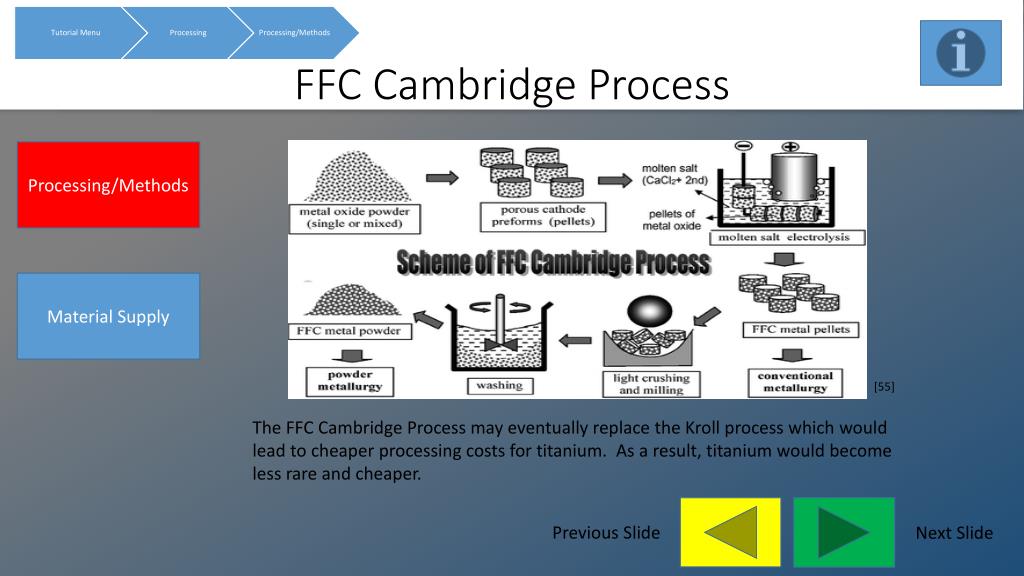
Now, let's examine the components and chemistry of the central electrolysis step.
Development of the Fray-Farthing-Chen Cambridge Process
To understand the core chemistry of the FFC process, this section from the paper 'Development of the Fray-Farthing-Chen Cambridge Process' clearly lays out the components of the electrochemical cell and the fundamental reactions.
Please read the section titled 'Concept of the FFC-Cambridge Process'. Focus on the description of the cell, the overall reactions, and the specific reactions at the cathode and anode. Pay close attention to Figure 1a, which illustrates the setup.
As the reading explains, the process setup is elegant in its conception. Let's break down exactly what happens at each location in the cell, which typically operates around 900°C:
1. The Cathode (Negative Electrode)
- What it is: A porous pellet made of pressed titanium dioxide (TiO₂) powder. This is the key innovation—the material to be reduced is the electrode itself.
- The Reaction: The TiO₂ is connected to the negative terminal of a power supply. Electrons are driven into the cathode, where they ionize the oxygen atoms within the solid oxide lattice. These newly formed oxygen ions (O²⁻) then dissolve into the surrounding electrolyte. The titanium atoms are left behind, gradually transforming the pellet from an oxide into a porous metal sponge.
2. The Electrolyte
- What it is: Molten calcium chloride (CaCl₂).
- The Role: The CaCl₂ acts as an ionic solvent. Its crucial property is that it readily dissolves oxygen ions (O²⁻) but does not dissolve TiO₂ or metallic titanium. It therefore serves as a transport medium, carrying the O²⁻ ions away from the cathode and towards the anode. The Ca²⁺ ions in the salt simply maintain overall charge neutrality in the electrolyte.
3. The Anode (Positive Electrode)
- What it is: Traditionally, this is a block of carbon (graphite), although this poses problems we will discuss shortly.
- The Reaction: The O²⁻ ions, having migrated through the salt, arrive at the positive anode. Here they are oxidized, giving up their excess electrons to the external circuit. With a carbon anode, the oxygen reacts with the carbon to produce carbon oxides. The overall reaction for the entire cell is thus the carbothermic reduction of TiO₂, but achieved electrochemically at a much lower temperature than would be required for direct pyrometallurgical reduction.
A Deeper Look: Reaction Pathway and Practical Challenges
The simple reactions above describe the overall process. However, your background in complex systems will appreciate that the reality is more nuanced. Detailed studies, referenced in the paper "The FFC-Cambridge Process for Titanium Metal Winning," show that the reduction doesn't happen in a single step. Instead, it proceeds through a complex series of intermediate calcium-titanium-oxide compounds (like CaTiO₃ and CaTi₂O₄). This complex pathway presents kinetic barriers that can slow the process and reduce efficiency—a key reason the process is still in development.
A more immediate and critical challenge for commercialization lies with the anode.
The FFC-Cambridge Process for Titanium Metal Winning
A major challenge in scaling up the FFC process is the anode. Using a simple carbon anode creates significant operational and contamination problems. This excerpt from 'The FFC-Cambridge Process for Titanium Metal Winning' explains the issue and the research into a more advanced 'inert' anode.
Please read the section 'Recent Research and Development Activities'. Focus on the first four paragraphs, which describe the problems caused by carbon anodes (sludge, contamination, low efficiency). Then, read the remainder of the section, which describes the clever materials science solution: the development of the CaTiO₃/CaRuO₃ solid-solution inert anode.
The issue with the anode is a perfect example of a practical engineering problem that can hinder an otherwise promising technology. Let's summarize the key points:
-
Carbon Anode Problems:
- Consumption: The anode is consumed during the process, requiring periodic replacement.
- Contamination: The anode can disintegrate, creating carbon sludge in the expensive electrolyte. More subtly, CO₂ can dissolve in the melt to form carbonate ions (CO₃²⁻), which can travel to the cathode and deposit carbon, contaminating the final titanium product.
- Inefficiency: This parasitic reaction of carbonate reduction lowers the overall current efficiency, as electrons are wasted reducing carbonate instead of titanium oxide.
-
The Inert Anode Solution:
The ideal solution is an inert anode that does not react but simply facilitates the oxidation of oxygen ions, producing pure oxygen gas as the only byproduct.This would create a cleaner, more efficient, and truly "green" process, with solid titanium and oxygen gas as the only products. The reading describes the development of a promising candidate: a ceramic composite (a solid solution) of calcium titanate (CaTiO₃) and calcium ruthenate (CaRuO₃). CaTiO₃ is stable in the melt but a poor conductor, while CaRuO₃ is an excellent conductor but is made from expensive ruthenium. By creating a composite, engineers aim to achieve sufficient conductivity and stability at an acceptable cost—a classic techno-economic trade-off.
Conclusion
In this lesson, we have explored the fundamental principles of the FFC Cambridge process, a leading candidate to replace the Kroll process.
Key Takeaways:
- The FFC Cambridge process is an application of electrometallurgy, using an electrolytic cell to drive the direct reduction of solid TiO₂ to titanium metal.
- The key components are a porous TiO₂ cathode, a molten CaCl₂ electrolyte that dissolves and transports oxygen ions, and an anode.
- At the cathode, TiO₂ is reduced to Ti by gaining electrons, releasing O²⁻ ions into the electrolyte.
- At the anode, the O²⁻ ions are oxidized. With a consumable carbon anode, this produces CO₂ and potential contamination. With an advanced inert anode, it produces pure oxygen gas.
- While theoretically superior to Kroll (single-step, potentially continuous, cleaner), the process faces significant practical challenges related to slow reaction kinetics, process control, and the development of a cost-effective, durable inert anode.
You now understand how the FFC process works in principle. In our next lesson, we will build on this by directly comparing the theoretical advantages and practical challenges of the FFC Cambridge process against the Kroll process, creating a framework to assess its commercial potential and the hurdles it must overcome to displace the incumbent technology.