Recommended resources
The freely available resources this lesson will direct you to.
Introduction
Welcome back. In our last lesson, we conducted a detailed due diligence, comparing the FFC Cambridge process with the incumbent Kroll process. We concluded that while FFC is theoretically superior on many fronts—process simplicity, feedstock flexibility, and environmental impact—it is held back by significant practical challenges in scalability, current efficiency, and anode durability. This gap between laboratory promise and industrial reality is a critical theme for any aspiring technologist or investor.
Today, we will broaden our perspective beyond FFC to fulfill the learning outcome: to survey other proposed next-generation titanium production methods and their current technology readiness level. You'll see that the landscape of titanium innovation is vast and varied, littered with clever ideas and cautionary tales. For someone with your goal of identifying opportunities in industrial sectors, understanding this landscape is equivalent to mapping the competitive and R&D environment. It helps answer the questions: Who else is trying to solve this problem, how are they approaching it, and how far have they come?
To do this systematically, we will first introduce a formal framework for assessing technology maturity.
The Technology Readiness Level (TRL) Framework
When evaluating a new technology, whether for investment or for adoption into a business, it's crucial to have a standardized way to gauge its maturity. A concept that works in a lab is very different from a process ready for a multi-million dollar plant. The Technology Readiness Level (TRL) scale is the industry-standard tool for this assessment.
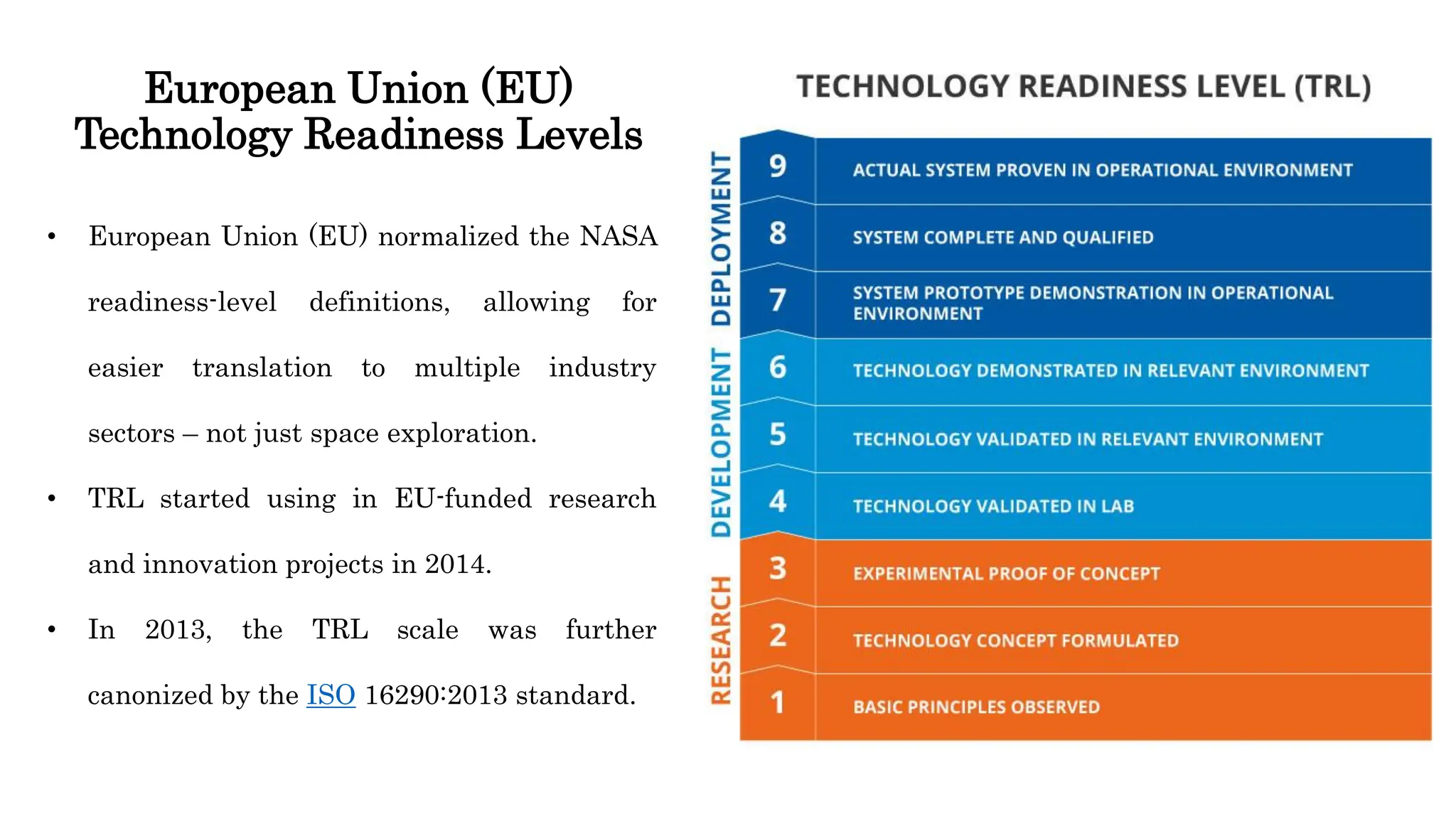
As you can see, the scale is divided into three main phases:
- TRL 1-3: Research. Basic principles are observed and a concept is formulated. This is the domain of university labs and early-stage R&D.
- TRL 4-6: Development. The concept is validated in a lab, then as a component in a "real-world" setting, and finally as a prototype system. This is where most promising academic inventions face their first major tests. The FFC process sits squarely in this range.
- TRL 7-9: Deployment. The prototype is demonstrated in an operational environment, the system is completed and qualified, and finally proven through successful operation. The Kroll process has been at TRL 9 for decades.
Keep this framework in mind as we survey the field. For each process, we'll ask: Where does it sit on this scale? The answer is a strong indicator of its associated risk and timeline to commercialization.
A Survey of Alternative Processes
The world of titanium R&D is rich with ideas. We can broadly categorize them into two families, following the same split we've seen before:
- Thermal Reduction Processes: Methods that use a chemical reducing agent (like magnesium, sodium, or calcium) at high temperatures.
- Electrolytic Processes: Methods that use electricity as the primary "reducing agent."
We'll now explore key examples from each family, drawing heavily from the comprehensive review paper you'll read below.
Research Progress of Titanium Sponge Production: A Review
To begin our survey, please consult this excellent review paper, 'Research Progress of Titanium Sponge Production'. It provides a catalog of the most significant alternative methods developed over the years.
For now, please scan Section 2 ('Thermal Reduction') and Section 3 ('Electrolysis'). Don't worry about understanding every detail. The goal is to get a sense of the sheer variety of approaches. Notice how many processes exist and how they are distinguished by their precursor (e.g., TiCl₄ vs. TiO₂) and their reductant (e.g., Na, Mg, Ca, electricity). We will dive into specific examples next.
As you can see from that scan, there's no shortage of attempts to dethrone Kroll. Let's analyze a few of the most instructive examples.
1. Advanced Thermal Reduction Methods
These processes generally accept the basic chemistry of metallothermic reduction but seek to overcome Kroll's key weaknesses: its batch nature, high energy consumption, and reliance on costly purification steps.
The Armstrong Process: Continuous Sodium Reduction
The Armstrong Process is essentially a continuous and modernized version of the old Hunter process (which used sodium instead of magnesium).
- Principle: Gaseous TiCl₄ is continuously injected into a stream of molten sodium. The reaction produces solid titanium particles and molten sodium chloride (NaCl) salt. The flowing sodium carries the products out of the reactor.
- Key Advantage: It is a continuous process, which promises significant capital and operational cost savings over Kroll's batch reactors. It aims to produce titanium powder directly.
- Status & TRL: The process was developed by a company called International Titanium Powders (ITP). According to the paper "A critical evaluation of processes to produce primary titanium" (Table IV), it reached pilot-scale demonstration. This suggests a maturity of TRL 6-7. However, the major challenge lies in the complex purification steps required to separate the fine titanium powder from the salt and excess sodium, which can drive costs up.
The HAMR Process: A Multi-step TiO₂ Route
The Hydrogen-Assisted Magnesiothermic Reduction (HAMR) process is a great example of a different strategy: starting with TiO₂ to bypass the entire chlorination stage.
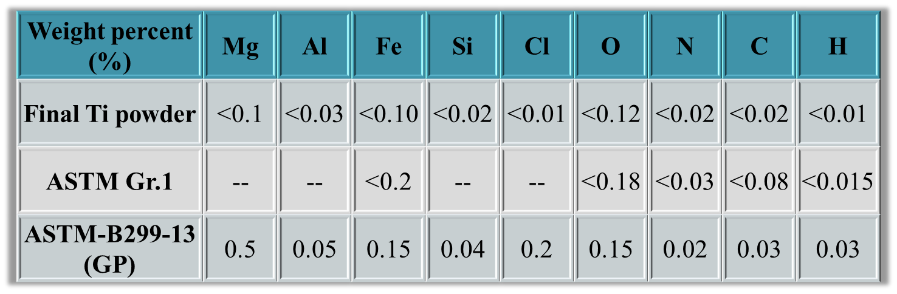
- Principle: It's a multi-step process. First, TiO₂ is reduced by magnesium (Mg) in a hydrogen atmosphere to form titanium hydride (TiH₂). This TiH₂ is then heat-treated to drive off the hydrogen, leaving titanium metal. A final deoxidation step using calcium (Ca) is used to achieve high purity.
- Key Advantage: It avoids the TiCl₄ precursor and has been demonstrated to produce very high-purity powder that meets aerospace standards.
- Status & TRL: The HAMR process is a sophisticated, multi-step lab/bench-scale process developed at the University of Utah. The detailed research papers and focus on powder quality are characteristic of technologies in the TRL 4-5 range. While the chemistry is sound, scaling a multi-step solid-state process with expensive reagents like Ca is a significant economic challenge.
The MHR Process: A Cautionary Tale
The Metal Hydride Reduction (MHR) process was once a commercial reality in Russia.
- Principle: TiO₂ is reduced by calcium hydride (CaH₂) to produce titanium powder.
- Key Advantage: A simple, single-step reaction.
- Status & TRL: The process was operated at scale, putting it at TRL 9 for a time. However, the plant was eventually shut down. The primary reason was the high cost of the reducing agent, CaH₂. This is a crucial lesson: a process can be technically mature but commercially unviable. A "better" technology that can't compete on cost is not better in the marketplace.
2. Alternative Electrolytic Methods
We've already studied the FFC process, where the solid TiO₂ is the cathode. Other electrolytic methods rearrange the electrochemical cell in different ways.
The OS (Ono-Suzuki) Process: In-Situ Reductant
The OS process looks similar to FFC at first glance but operates on a fundamentally different principle.
- Principle: Like FFC, it uses a molten CaCl₂ salt bath. However, the electricity is used to electrolyze CaO in the salt to produce dissolved calcium (Ca) metal at the cathode. This dissolved calcium then acts as the reducing agent for TiO₂ powder that is separately added to the bath. It's an indirect electrochemical process.
- Key Advantage: It avoids the need to make a sintered, conductive TiO₂ cathode preform, as required by FFC. You can, in theory, just feed TiO₂ powder into the reactor.
- Status & TRL: The OS process has been heavily researched, primarily in Japan. However, like FFC, it suffers from low current efficiency and the risk of contamination. The paper "A critical evaluation of processes" notes its continuation is "uncertain," placing it firmly in the TRL 4-5 range.
The USTB Process: Using a Consumable Anode
The University of Science and Technology Beijing (USTB) process flips the cell design on its head.
- Principle: Instead of a carbon anode, this process uses a consumable anode made of a titanium suboxide/carbide mixture (TiCₓO₁₋ₓ). During electrolysis, this anode dissolves, releasing titanium ions (Tiⁿ⁺) into the molten salt. These ions then travel to the cathode and deposit as pure titanium metal.
- Key Advantage: This cleverly avoids using a carbon anode, thus eliminating CO/CO₂ emissions at the anode and a major source of carbon contamination for the titanium product.
- Status & TRL: This is an elegant concept that has been demonstrated successfully at the lab scale. Its reliance on producing a high-quality, specialized anode as a feedstock adds a complex and potentially costly upstream step. It is a clear example of a TRL 4 technology.
Summary and Comparative Assessment
Let's consolidate what we've learned. The field of titanium R&D is a story of trade-offs. Processes that promise continuous operation often introduce new purification complexities. Processes that use cheaper TiO₂ feedstock often require more expensive reducing agents or face challenges with reaction kinetics.
The following table summarizes the alternatives we've discussed, providing a snapshot of their maturity and strategic position relative to Kroll.
| Process | Principle | Key Advantage | Key Challenge | Estimated TRL / Status |
|---|---|---|---|---|
| Kroll | Batch Mg reduction of TiCl₄ | Proven, reliable, high-purity | Inefficient, high energy, batch process | TRL 9 (Industry Standard) |
| FFC (recap) | Direct electrolysis of solid TiO₂ cathode | Single-step, feedstock flexible, no Cl₂ | Low current efficiency, slow kinetics, anode life | TRL 4-6 (Lab/Pilot) |
| Armstrong | Continuous Na reduction of TiCl₄ | Continuous operation | Complex purification, handling sodium | TRL 6-7 (Pilot Demo) |
| HAMR | Mg reduction of TiO₂ + H₂ assist + Ca deox. | Avoids Cl₂, high powder purity | Multi-step process, expensive reagents (Ca) | TRL 4-5 (Bench Scale) |
| MHR | CaH₂ reduction of TiO₂ | Single-step process | Very high cost of CaH₂ reductant | Defunct (Formerly TRL 9, but commercially failed) |
| OS Process | Electrolytic generation of Ca to reduce TiO₂ | Can use TiO₂ powder directly | Low current efficiency, contamination risk | TRL 4-5 (Lab Scale, "uncertain continuation") |
| USTB Process | Electrolysis with a consumable TiCₓO₁₋ₓ anode | Avoids carbon anode issues | Requires complex, pre-made anode feedstock | TRL 4 (Lab Concept) |
Conclusion
Key Takeaways:
- The innovation landscape for titanium production is rich and diverse, with dozens of processes proposed over the last 70 years. They can be broadly categorized into thermal reduction and electrolytic methods.
- Each alternative process represents a different bet against the Kroll process's specific weaknesses, such as its batch nature (e.g., Armstrong) or its reliance on TiCl₄ (e.g., HAMR, FFC).
- The Technology Readiness Level (TRL) framework provides an essential tool for an investor or strategist to assess the maturity and inherent risk of these competing technologies. Most alternatives are at TRL 6 or below, indicating significant development and scaling risk.
- The commercial failure of technically mature processes like MHR serves as a critical reminder: in industrial production, techno-economic viability is paramount. A process must be not only scientifically sound but also cheaper and more reliable than the incumbent it seeks to replace.
This survey reveals a clear pattern: despite decades of brilliant research and significant investment, no single process has yet managed to assemble the winning combination of low cost, high purity, scalability, and reliability needed to displace Kroll. This leads us to the final, and perhaps most important, question of this module.
In our next lesson, we will synthesize everything we've learned to analyze the deep technical and economic factors that explain the remarkable, 80-year dominance of the Kroll process.