Recommended resources
The freely available resources this lesson will direct you to.
Hello. This module examines the execution layer beneath Exponent’s yield-market interface: what actually happens when a user selects Instant versus Limit, why PT and YT can draw on shared liquidity despite trading differently, and where an institutional desk must look for execution and settlement risk.
We will use the stripping identity without re-teaching it:
The important implication is that a market need not hold every instrument directly to provide exposure to it. Exponent V2 uses that identity differently in its Rate CLMM and Rate Order Book.
The interface is a routing choice, not merely a ticket type
The V2 interface presents a yield market in terms familiar to a trader: implied APY, an execution choice, an order book, and portfolio views. But each control maps to a different on-chain mechanism.
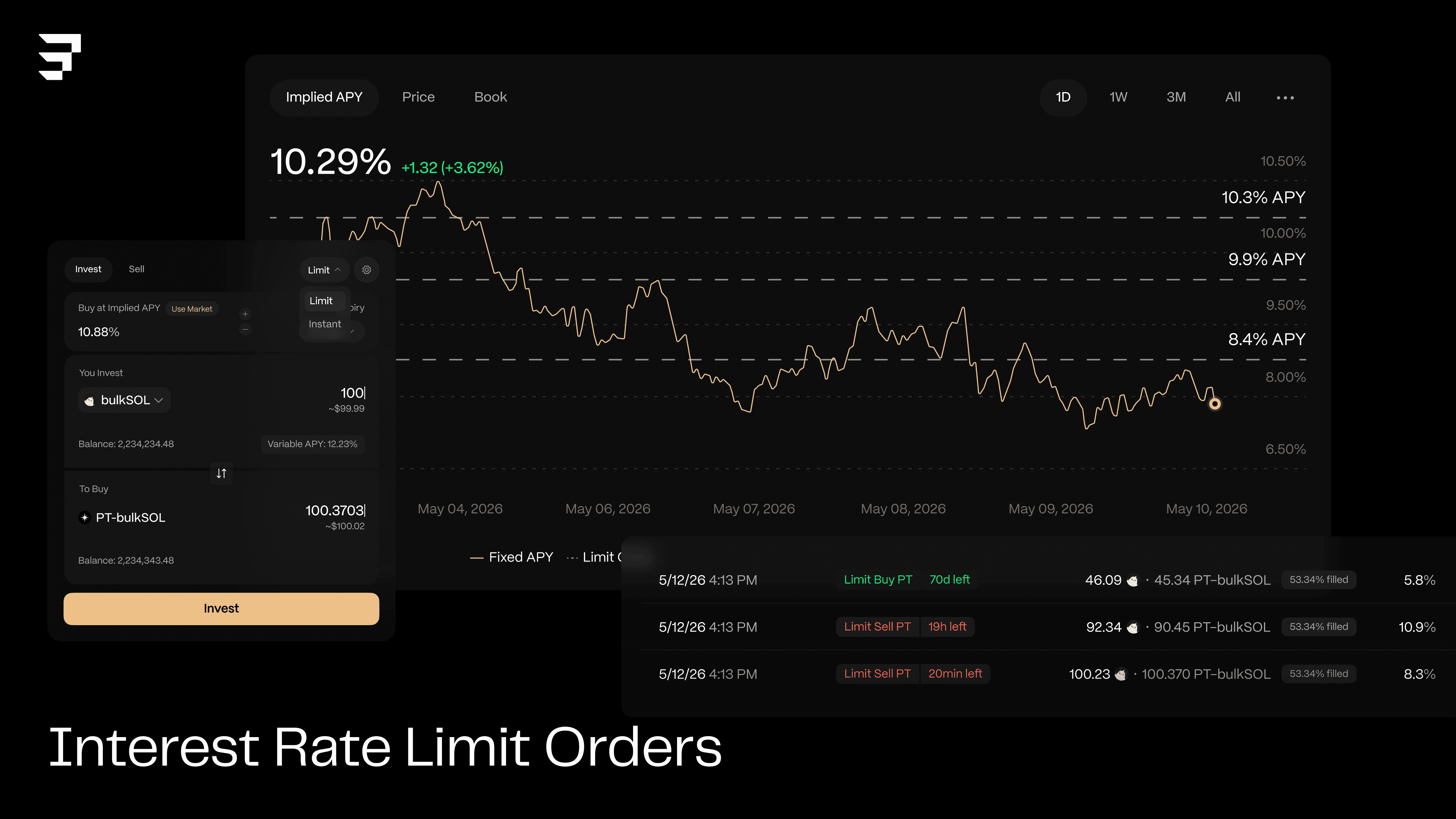
A practical map is:
| Interface area | Economic objective | Primary mechanism |
|---|---|---|
| Instant / Swap | Execute now at the available on-chain quote | Rate CLMM |
| Limit | State an APY boundary and allow matching now or later | Rate Order Book |
| Liquidity | Provide tradeable PT/SY inventory around chosen implied-APY levels | Rate CLMM liquidity position |
| Income | Take PT-oriented fixed-maturity exposure | PT exposure |
| Farm | Take YT-oriented variable-yield exposure | YT exposure |
The last two labels describe the intended exposure, not a guarantee about returns. A PT position may be held to maturity for its contractual redemption mechanics, but protocol, underlying-asset, liquidity, and operational risks remain. A YT position is exposure to the yield generated between acquisition and maturity; it is not a conventional fixed coupon.
For client conversations, avoid treating “Instant” as automatically better execution or “Limit” as automatically passive. Instant means pool liquidity and an immediate execution attempt. Limit means an APY constraint; it can still execute immediately if it crosses executable orders.
Also treat UI naming as a versioned product fact. Before using labels such as Income or Farm in external materials, verify the live interface and dated product documentation; interfaces can change while the underlying programs remain similar.
Instant execution: a native PT/SY market that can synthesize YT trades
Exponent’s Rate CLMM is natively a PT/SY liquidity pool. Liquidity providers supply PT and SY into ranges defined around implied-APY levels. This is different from a conventional constant-product pool whose price ranges are usually quoted directly as token prices.
Technical Concepts - Exponent Docs
Read Exponent’s Technical Concepts documentation to see how the Rate CLMM uses APY-based ticks and how a YT trade is synthesized from PT/SY liquidity.
In “APY-Based Tick System,” note that ticks are keyed to APY rather than ordinary token-price levels. Then read the full “YT Trading via Flash Swaps” subsection, beginning with the pool structure. Follow the Buy YT and Sell YT paths closely. Finish with “Swap Routing,” reading the routing and price-limit discussion, especially the role of the optional price limit.
APY ranges, not ordinary price ranges
The CLMM’s tick system is organized by implied APY. A liquidity provider selects an APY range in which to make PT and SY available. This gives capital efficiency: capital concentrated near the currently traded rate can support more size than capital spread across every possible rate.
It also produces a familiar market-making trade-off:
- A narrow range can earn more fees per unit of deployed capital if trading stays inside it.
- A narrow range is more likely to become inactive when implied rates move.
- A position’s inventory changes as trades consume one side of its liquidity.
- An institution must monitor both its inventory mix and whether its selected APY range remains active.
The pool’s native market is therefore:
| Trade intention | Native CLMM action |
|---|---|
| Buy PT | Swap SY for PT |
| Sell PT | Swap PT for SY |
| Provide liquidity | Deposit PT and SY across an APY range |
The PT path
For an Instant PT trade, the path is relatively direct.
- The interface creates or obtains the required SY representation from the user’s input asset where applicable.
- The transaction swaps PT and SY against active CLMM liquidity at the current APY tick and, if necessary, across additional active ranges.
- The user receives the output asset, subject to the transaction’s minimum-output or price-limit condition.
A large order can consume liquidity through multiple APY ranges. The quoted APY is therefore not enough for an institutional execution decision. The desk needs:
- executable size at the displayed level;
- cumulative depth through worse levels;
- estimated price impact and fees;
- a minimum output or maximum adverse price boundary;
- awareness that the quote may change between simulation and transaction inclusion.
The official documentation describes an optional priceSpotLimit for PT swaps. Operationally, this is a protection against execution beyond a defined threshold, including adverse movement associated with transaction ordering. It improves control; it does not create liquidity.
The YT path: synthetic exposure through an atomic flash swap
Because the pool holds PT and SY rather than YT, an Instant YT trade is synthesized within one transaction. The user is not taking out a persistent loan.
For an Instant Buy YT, the conceptual sequence is:
- The CLMM temporarily supplies SY.
- That SY is stripped into matching PT and YT.
- The buyer receives the YT.
- The newly created PT is sold through the PT/SY CLMM.
- The SY proceeds, together with the buyer’s net payment where required, settle the temporary obligation within the same transaction.
For an Instant Sell YT, the mechanics reverse:
- The CLMM temporarily supplies PT.
- That PT is merged with the trader’s YT into SY.
- Part of the SY is used to acquire the PT needed to settle the temporary obligation.
- The trader receives the remaining SY, after the transaction’s pricing and fee effects.
The transaction is atomic: it completes with all required legs settled, or it fails. There is no user-facing flash loan left outstanding after a successful trade. However, atomicity does not mean price certainty. The YT trade remains economically dependent on the available PT/SY liquidity, active APY ranges, swap fee, and transaction limits.
Exponent documents that YT trade fees are assessed on the YT value rather than the full PT notional used temporarily in the synthetic route. That design recognizes that the PT leg facilitates the YT transaction rather than constituting the user’s desired economic exposure.
A useful institutional interpretation is:
Instant YT liquidity is PT/SY liquidity transformed through the PT/YT issuance identity.
That is powerful, but it makes the route more complex than a direct YT pool. A desk should request or simulate the full route, not rely only on a headline YT quote.
Limit execution: native YT/SY matching plus virtual PT liquidity
The Rate Order Book takes the opposite starting point. It allows orders to be quoted at specific implied-APY levels, with funds placed in protocol-controlled escrow for settlement. Direct YT offers are native to the book; PT exposure becomes available through virtual offers that strip or merge assets when matched.
Read the official Trading guide’s Orderbook Trading and Virtual Offers sections. It explains escrow balances, yield collection on resting SellYT offers, and how virtual offers let PT and YT traders use one book.
In “Orderbook Trading,” read from the orderbook overview through the escrow and withdrawal takeaways. Focus on the distinction between wallet balances and orderbook escrow balances. Then read the full “Virtual Offers: Trade PT Directly on the Orderbook” subsection, beginning with the virtual-offer introduction. In the code comments, follow the settlement descriptions for Virtual SellYT and Virtual BuyYT.
Direct offers and resting orders
A direct YT seller places YT into the order-book settlement structure and offers it at a specified implied APY. A buyer provides the consideration required by the order. If orders are compatible, they can match; otherwise, the order remains open until it is filled, cancelled, or expires.
This creates a different type of execution risk from the CLMM:
- The limit sets a rate boundary, but does not assure execution.
- A large order may receive partial fills at several APY levels.
- Residual size can remain resting in the book.
- An apparent top-of-book quote says little about executable institutional size.
- An expired or cancelled order must be operationally reconciled, including the return or withdrawal of escrowed balances.
The documentation makes an important distinction: YT sitting in an open SellYT offer continues to earn yield. That is economically material. A trader with a resting SellYT order has not necessarily stopped accruing the underlying variable yield. The accrued yield still requires appropriate collection and reconciliation through the order-book workflow.
A marketable limit order can fill immediately
A limit order is not necessarily a waiting order. Suppose a Buy YT order specifies the maximum implied APY the buyer is willing to accept, following the convention in the SDK examples. If existing SellYT offers satisfy that constraint, the buy order is marketable and can execute immediately.
The result can be:
- a full immediate fill;
- an immediate partial fill, with the remainder resting;
- no fill, with the full order resting;
- transaction failure if the chosen instruction requires all-or-nothing execution.
The limit is still valuable because it protects the rate boundary. The buyer accepts immediate execution only at acceptable implied-APY levels.
Matching-priority caution: price-time priority, often described as FIFO at the same price level, is a common order-book convention. Under a FIFO design, older eligible orders at the same rate fill before newer ones. For operational diligence, do not assume that policy solely from a familiar order-book model. Confirm the matching rule for the deployed Exponent version using current documentation, program behavior, and transaction-level evidence.
Virtual offers: how the same book serves PT and YT needs
The virtual-offer labels can initially feel counterintuitive. Focus on the resulting exposure rather than the label alone.
| Offer form | Escrowed input | What occurs when matched | Economic result for offer creator |
|---|---|---|---|
| Direct SellYT | YT | YT is transferred to a YT buyer in exchange for the agreed consideration | Sells variable yield |
| Virtual SellYT | SY | SY is stripped into PT and YT; counterparty receives YT | Receives PT, effectively selling PT for SY |
| Virtual BuyYT | PT | PT is merged with counterparty-provided YT into SY | Receives SY, effectively buying SY with PT |
The documentation’s key point is that virtual and non-virtual offers share the same order-book liquidity. A YT buyer may therefore match either:
- a direct YT seller transferring pre-existing YT, or
- a virtual SellYT offer that strips SY during settlement and produces new YT for the buyer.
This shared liquidity is a major design feature, but it changes diligence. The visible book is not necessarily a simple inventory of YT already held by sellers. Some executable supply may be conditional on strip/merge settlement.
Worked trace: an immediately filled Limit Buy YT paid in ONyc
Consider an institutional trader selecting Limit Buy YT and paying with ONyc. This is an illustrative operational trace, not confirmation that ONyc is currently supported in every Exponent market. Before trading, confirm that the selected market’s live interface and transaction route accept ONyc and identify the exact conversion path, fees, and token program involved.
Assume the trader enters an amount, a maximum acceptable implied APY, and an expiry. There is already compatible sell-side liquidity on the book.
What the trader sees
The interface may show:
- a successful or partially successful fill;
- a YT position in a portfolio or fills panel;
- a claimable or escrow balance;
- no immediately spendable YT in the wallet’s ordinary token-account view.
This is not inherently contradictory. The order book can record an economic entitlement in its escrow and fill state before the trader withdraws the token to the wallet.
What must happen on-chain
A robust transaction trace should identify these stages:
-
Input conversion. ONyc is converted into the market’s SY representation if the route supports it. The exact mechanism must be established from the transaction instructions, not assumed from the asset label.
-
Order funding. The relevant SY amount is deposited into the order-book escrow or staging account. This collateralizes the buyer’s side of the order.
-
Matching. The Buy YT instruction finds one or more eligible SellYT offers. Because the buyer’s limit crosses the available offer, matching occurs in the same transaction or execution attempt.
-
Settlement. YT is credited to the buyer’s order-book balance or claimable balance. The seller receives the agreed settlement asset according to the matched route.
-
Claim or withdrawal. The trader invokes the interface’s claim or withdrawal action. The documentation refers to wrapper withdrawal instructions that move PT, YT, and SY from order-book balances to the trader’s wallet.
-
Reconciliation. Operations reconcile wallet balances, order-book escrow balances, trade fills, residual orders, input conversion, and transaction signatures.
The important distinction is between economic ownership and wallet delivery. A portfolio view may count credited YT held in the order-book system, while an Instant Sell control or external wallet application may only use YT that has been withdrawn to the trader’s wallet. A completed fill is not always equivalent to immediately wallet-available inventory.
Two plausible settlement routes
The front end alone generally cannot establish which route settled the order.
Route A: direct YT seller
A direct SellYT order already has YT committed to the order book.
- The buyer’s funded balance settles against that seller.
- The buyer is credited YT.
- The seller receives the agreed consideration.
- The corresponding PT from the original strip is not transferred as part of this trade.
That PT may be in many locations: the original holder’s wallet, another wallet after transfer, a Rate CLMM pool, an LP position, an order-book escrow, or another protocol account. Since PT and YT are fungible after issuance, it is usually incorrect to claim that a particular unit of PT is “paired” with the purchased YT in a traceable one-to-one sense.
Route B: virtual SellYT offer
The matched seller placed a virtual SellYT offer backed by SY.
- The offer’s SY is stripped during settlement.
- The buyer receives the newly produced YT.
- The virtual offer creator receives the resulting PT.
- The buyer’s ONyc-derived SY settles the economic terms of the match.
Here, the corresponding PT is much easier to conceptually locate: it is credited to the virtual-offer side, often first within protocol-controlled balances before withdrawal. Yet the same fungibility warning remains after settlement. Once transferred or used elsewhere, token provenance cannot be inferred from the UI alone.
The evidentiary standard
For a completed Buy YT order, do not state that it matched a direct seller or a virtual PT route merely because the UI says “filled.” To establish the route, inspect:
- the transaction instructions;
- order metadata, including whether the matched offer is virtual;
- token-account balance changes;
- strip or merge instructions;
- order-book escrow movements;
- resulting PT, YT, and SY account changes.
This distinction matters in institutional reporting. It determines whether the execution used standing YT inventory or minted YT through a virtual route, and it affects how the desk explains settlement, liquidity provenance, and operational dependencies.
Comparing execution risks and controls
Neither venue is universally superior. The venue should follow the mandate, urgency, size, acceptable rate, and operational capacity.
| Dimension | Rate CLMM / Instant | Rate Order Book / Limit |
|---|---|---|
| Primary liquidity | Active PT/SY liquidity in implied-APY ranges | Resting direct and virtual offers |
| YT execution | Synthetic flash-swap route using PT/SY | Native direct YT orders, potentially matched with virtual supply |
| Execution certainty | Immediate attempt, subject to price constraints and liquidity | Rate-constrained; may fill, partially fill, rest, expire, or be cancelled |
| Main economic risk | Price impact through APY ranges, pool fees, route complexity | Non-execution, partial fill, queue position, stale displayed depth |
| Main settlement concern | Correct atomic completion and output controls | Escrow balances, claims or withdrawals, residual order management |
| Large-trade evidence | Full-size simulated quote, tick-by-tick depth, maximum impact | Cumulative eligible book depth, virtual-offer availability, expiry and fill conditions |
| Counter-route | PT/SY route supports synthetic YT trading | Direct YT supply and virtual strip/merge supply can both contribute |
| Key control | Minimum output or price limit, pre-trade simulation, transaction-size limits | Explicit APY limit, order expiry, fill policy, cancellation and withdrawal controls |
For an institutional ticket, the pre-trade process should include the following.
-
Define the exposure. Is the client buying fixed-maturity principal through PT, variable yield through YT, or providing inventory as a liquidity provider?
-
Measure executable liquidity. For CLMM execution, obtain a full-size quote and inspect the APY ranges consumed. For order-book execution, inspect cumulative depth at eligible levels rather than only the best displayed order.
-
Check both liquidity sources. A YT trade may be achievable through the CLMM’s PT/SY route, direct order-book YT supply, or virtual offers. The best route cannot be inferred from a single displayed APY.
-
Set boundaries. Use a defined maximum adverse rate, minimum output, order expiry, approved size limit, and an explicit policy for partial fills.
-
Plan the post-trade workflow. Specify who claims or withdraws escrowed assets, how residual orders are monitored, what records constitute confirmation, and how wallet and internal-book balances are reconciled.
-
Separate liquidity from finality. Solana confirmation and atomic transaction settlement reduce some execution uncertainty, but they do not guarantee that a large position can be unwound later at a tolerable rate.
A large urgent trade often favors a carefully bounded Instant route if full-size depth and price impact are acceptable. A large price-sensitive trade may favor a Limit order, potentially staged across levels, if the client accepts uncertainty about fill timing and can manage escrow and claim operations. A sophisticated desk should evaluate both routes before choosing; “on-chain AMM versus order book” is not the same as “immediate versus safe.”
Key takeaways
Exponent V2 gives PT and YT traders two connected but mechanically distinct execution venues:
- The Rate CLMM is natively a PT/SY market organized around implied-APY ranges. PT trades swap directly; YT trades are synthesized atomically through flash swaps plus strip or merge operations.
- The Rate Order Book supports APY-constrained orders and uses escrowed settlement. Direct YT orders and virtual PT-oriented offers can share the same book.
- A marketable limit order can execute immediately while retaining its APY protection. A limit order still carries partial-fill, expiry, queue, and claim-workflow risks.
- A filled order-book position can appear in portfolio records before the YT is available in the wallet because the entitlement may remain in escrow until withdrawn.
- The UI cannot, by itself, prove whether a Buy YT order matched direct YT inventory or a virtual strip/merge route. Transaction instructions and account movements are the evidence.
The next lesson quantifies the economics of a specific Exponent liquidity position: trading fees, convergence toward maturity, underlying yield, incentives, inventory changes, and rebalancing costs.