Recommended resources
The freely available resources this lesson will direct you to.
Hello!
In our last lessons, we analyzed Aquinas's First and Second Ways, which argue from motion and efficient causation to the existence of a First Mover and a First Cause. We concluded that this first cause must be purely actual (actus purus), a concept borrowed directly from Aristotle. Today, we will explore one of Aquinas's most significant and original contributions to metaphysics, which provides a deeper foundation for this conclusion.
Our goal is to analyze how Aquinas integrates Aristotle's 'pure actuality' with his own, more fundamental concept of God as ipsum esse subsistens—subsistent being itself. We will see that for Aquinas, the First Cause isn't just a being that happens to be purely actual; it is purely actual because its very nature or essence is existence itself. This step marks a crucial development from Aristotelian philosophy to Thomistic theology.
The Innovation: Distinguishing Essence and Existence
To begin, we must introduce a distinction that is central to Aquinas's thought but was not a formal part of Aristotle's metaphysics. For Aristotle, to ask "what is it?" and "does it exist?" were not questions about two distinct principles within a thing. Aquinas, building on earlier Islamic philosophers like Avicenna, makes this distinction the cornerstone of his metaphysics.
He posits a real distinction in every created thing between its essence (quidditas) and its existence (esse).
- Essence is what a thing is—its definition or nature. You can understand the essence of a unicorn (a horse with a horn) or a phoenix without knowing if one actually exists.
- Existence (esse) is the act of being, that a thing is. It is the act that makes an essence real, rather than merely a concept.
This may seem like a subtle point, but it's a profound shift in thinking. Let's explore why it's such a "radical break" from Aristotle.
Aquinas on Existence and the Essence/Existence Distinction
This article, 'Aquinas on Existence and the Essence/Existence Distinction,' clearly outlines this foundational concept and its departure from Aristotelian thought.
Please read the sections 'The Essence/Existence Distinction Stated' and 'Aristotle on Existence and the Essence/Existence Distinction'. Focus on how Aquinas's separation of 'what it is' from 'that it is' fundamentally differs from Aristotle's view, where 'existing man' and 'man' were not seen as metaphysically distinct.
Existence as Act, Essence as Potency
With this new distinction in hand, Aquinas reframes Aristotle's potentiality-actuality framework in a more fundamental way.
- For Aristotle, in a changing object, matter is in potency to form.
- For Aquinas, the entire composite of matter and form—the essence—is itself in potency to the act of existence (esse).
An essence, like "humanity" or "treeness," is a potential principle. It only becomes a real, existing thing when it is actualized by esse. In this framework, existence is not a static property but the most fundamental act of all. As Aquinas puts it, esse is the "actuality of all acts, and therefore the perfection of all perfections."
This crucial move—seeing essence as potentiality and existence as actuality—is the key to understanding the link between actus purus and ipsum esse.
Aquinas on Existence and the Essence/Existence Distinction
Let's return to the previous article to see how Aquinas recasts the potentiality/actuality dynamic.
Read the section 'Aquinas’s Notion of Existence'. Pay close attention to the statement: 'As Matter is in potency to Form, Matter and Form together (i.e., an essence) is in potency to existence (esse). Form actualizes Matter; existence (esse) actualizes essence.'
The Argument to Ipsum Esse Subsistens
Now, let's see how this distinction leads directly to Aquinas's concept of God. The argument is elegant and has a structure that should feel familiar from our study of the Five Ways.
- In any being we encounter (a person, a rock, a star), its existence is distinct from its essence. We can understand what it is without knowing that it is, and its existence is not a necessary consequence of its essence (it is contingent).
- Whatever belongs to a thing must either be caused by the principles of its nature (its essence) or come from an external cause.
- A thing's existence cannot be caused by its own essence. If it were, the thing would have to exist prior to itself to bring itself into being, which is a logical contradiction.
- Therefore, any being whose essence is distinct from its existence must receive its existence from an external cause.
- This chain of causes conferring existence cannot be an infinite regress (this is the same per se or hierarchical series we saw in the First and Second Ways).
- Therefore, there must be a First Cause of existence which does not receive existence. In this being, essence and existence are not distinct. Its very essence is its existence.
This is what Aquinas calls ipsum esse subsistens—subsistent being itself. It does not have being; it is being.
The following video walks through this argument as presented in Aquinas's early work, On Being and Essence.
Thomas Aquinas II: Being and Essence
This lecture by Mark Thorsby on Aquinas's 'On Being and Essence' provides a detailed explanation of the argument for a First Cause whose essence is its being.
Please watch from 34:22 to 48:16. The video discusses incorporeal substances and how the essence/existence distinction applies to them, leading to the argument for a first being that is 'pure actuality' and 'being alone.' The argument culminates around the 46:00 mark.
The Synthesis: Why Ipsum Esse Must Be Actus Purus
We can now finally connect the two concepts and complete our analysis.
- Actus Purus (Pure Actuality): A being with no unactualized potential. This was the conclusion of the argument from motion.
- Ipsum Esse Subsistens (Subsistent Being Itself): A being whose essence is its existence. This is the conclusion of the argument from the essence/existence distinction.
Aquinas's synthesis is that ipsum esse subsistens provides the metaphysical reason for why the first cause must be actus purus.
Here's the logic:
Potentiality, in its most fundamental sense, is a capacity for some further act. The most fundamental act of all is the act of existence (esse). An essence is a potentiality precisely because it is a capacity for existence.
If you have a being whose very essence is the act of existence, there is no potentiality for existence left to be actualized. There is no capacity for being that is not already and completely fulfilled, because the being is that very act of being. It has no potency waiting to be actualized. Therefore, it must be pure actuality.
For Aquinas, ipsum esse is the more foundational concept. A being is actus purus because it is ipsum esse.
Bishop Robert Barron explains this connection with exceptional clarity.
“Ipsum Esse” and Catholic Social Teaching
In this short clip, Bishop Barron explains how the distinction between essence (potency) and existence (act) leads to the understanding of God as 'actus purus' and 'ipsum esse subsistens.'
Watch from 04:10 to 08:42. He explains that essence is a principle of potency, while existence (esse) is an active principle. Notice his conclusion that the First Cause must be a reality with no distinction between essence and existence, hence no potentiality—'actus purus'. He also connects this to the name of God revealed in Exodus: 'I am who I am.'
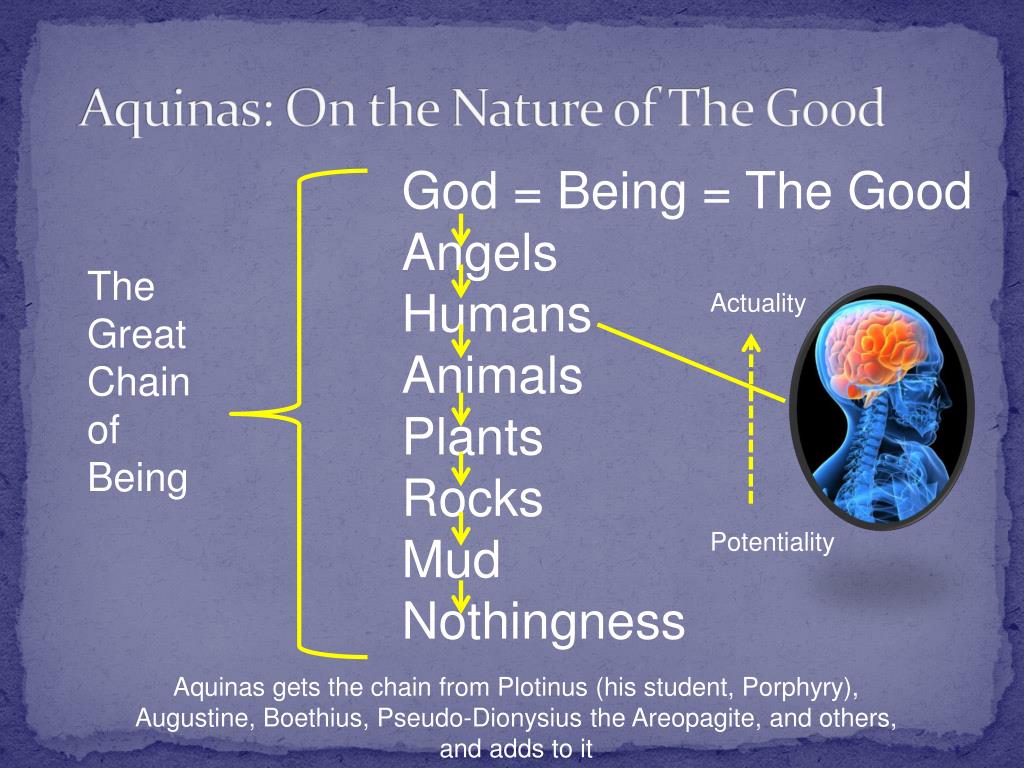
This view of God as Being Itself also explains the concept of participation. Created things do not have their own being, but participate in the being of God. They are limited instances of being, where their essence restricts the unlimited act of existence. God, as unlimited Being Itself, is not a being among other beings, but the very source of being in which all other things share.
This hierarchy is often depicted in the "Great Chain of Being," with God as Pure Being/Actuality at the summit.
Conclusion
Today we have unpacked one of the most profound ideas in Thomistic philosophy. By introducing the real distinction between essence and existence—a concept not found in Aristotle—Aquinas provides a deeper metaphysical explanation for the nature of the First Cause.
Here are the key takeaways:
- In all created things, Aquinas distinguishes between essence (what it is) and existence (esse, that it is).
- He frames this distinction in terms of potentiality and actuality: essence is a potency that is actualized by the act of existence.
- This leads to an argument for a First Cause of existence whose essence is its existence, a being he calls ipsum esse subsistens (subsistent being itself).
- This concept provides the ultimate explanation for why the First Cause must be pure actuality (actus purus). A being that is existence itself has no unactualized potentiality for being.
Aquinas thus integrates and deepens Aristotle's conclusion. The Unmoved Mover is not just a necessary logical terminus for a causal chain; it is the very ground of Being itself.
In our next lesson, we will explore a direct and immediate consequence of this doctrine: divine simplicity. We will analyze why a being whose essence is existence cannot be composed of any parts—physical, metaphysical, or even logical—and what this means for the divine attributes.