Recommended resources
The freely available resources this lesson will direct you to.
Hello! Welcome to the first lesson of your course. To fully tackle your question about the abolition of the law of sedition, we first need to build a firm foundation in some core principles of English law. This initial module is designed to do just that, ensuring we have a shared, precise vocabulary for the discussions ahead.
Today's lesson addresses the most fundamental distinction in this legal system: the difference between common law and statutory law. You'll learn what these terms mean, where each type of law comes from, and—crucially—how they interact. Understanding this is the essential first step, as the offence of sedition was a classic example of a common law crime that was ultimately abolished by a statutory act of Parliament.
The Two Primary Sources of English Law
At its heart, the law of England and Wales flows from two primary sources: decisions made by judges in courts (case law) and laws created by Parliament (legislation). These two streams give rise to common law and statutory law, respectively.
To begin, let's get a formal definition of these concepts. The Incorporated Council of Law Reporting (ICLR) provides a concise overview.
The English legal system - ICLR
This short article outlines the foundational sources of law in the English legal system.
Please read the introduction under the heading Sources of law, and then the section titled Common law and statute. Pay close attention to the definition of common law as "law declared by judges" and the principle that legislation can "supersede or replace" it.
As you've just read, common law is the body of law developed over centuries through judicial decisions. The doctrine of precedent, or stare decisis (Latin for "to stand by things decided"), means that a decision made by a higher court becomes a binding principle for lower courts to follow in similar future cases. Statutory law, by contrast, is law written down and enacted by Parliament.
Exploring the Concepts
Let's explore these two concepts in more detail. This video from BlackBeltBarrister provides an excellent narrative explanation, clarifying what common law is and how it fits into the broader UK constitutional framework.
What is Common Law? | BlackBeltBarrister
This video, "What is Common Law?", gives a clear and practical introduction to the topic, distinguishing it from popular misconceptions.
Please watch from the explanation of how the judiciary creates a body of decisions known as common law. Then, continue through the next section, which contrasts common law with statute, using examples like nuisance, homicide, and self-defence. Note the key point that some offences, like murder, remain common law offences even if their penalties are modified by statute.
To reinforce this, another video from The Law Academy offers a slightly more academic breakdown, using different examples which help to solidify the distinction.
Sources of Law | English Legal System
The video "Sources of Law" provides a structured overview of the major sources of law in the English legal system.
Watch the section defining common law, which is described as judge-made law developed through precedent, using murder as a prime example. Then, immediately watch the following section on statute law. The presenter here draws a sharp contrast by using sexual offences, which are governed by a specific Act of Parliament, and explicitly states that the common law is "subservient to the law of Parliament."
Distinctions and Overlaps
By now, the core distinction should be clear. Common law is an uncodified body of principles emerging from judicial case law. Statutory law is a codified body of rules created by the legislature. The following diagram provides a helpful visual summary.
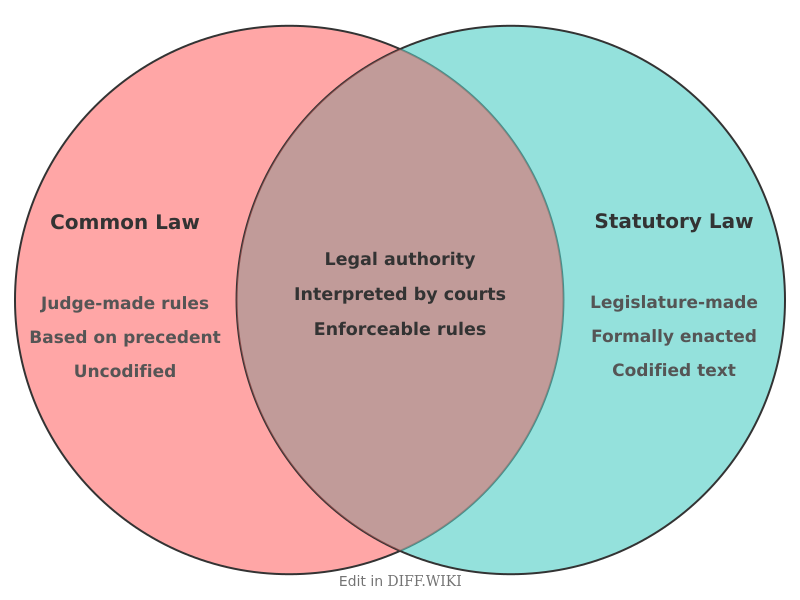
The most critical point of interaction is parliamentary sovereignty. In the English legal system, Parliament is the supreme law-making body. This means that a statute can create new law, change the common law, or abolish a common law rule or offence entirely. The common law cannot override a statute.
The Hierarchy in Practice: A Prosecutor's Perspective
This hierarchy isn't just a theoretical concept; it has direct practical consequences. A fantastic way to see this is to look at the official guidance for Crown Prosecutors, which sets out how they should choose the appropriate charges to bring against a suspect.
This document is not a textbook; it's an operational guide. You will see how it constantly refers to offences as either being "contrary to common law" or arising under a specific Act of Parliament.
Public Justice Offences | The Crown Prosecution Service
This prosecution guidance from the Crown Prosecution Service (CPS) lists various offences related to the administration of justice, clearly distinguishing between common law and statutory origins.
First, read the section on Perverting the Course of Justice. Notice the explicit statement that it is "charged contrary to common law, not the Criminal Attempts Act 1981." Next, contrast this with the section on Perjury, which is clearly identified as a statutory offence under the "Perjury Act 1911". Then, skim the headings for Escape and Breach of Prison and Preventing lawful burial, both of which are identified as common law offences. Finally, and most importantly, read the section on the Selection of charges. Focus on the paragraph that begins "The offences carrying a maximum life sentence...". This section quotes a House of Lords ruling stating that statutory provisions should be used in preference to common law ones. This is the principle of parliamentary supremacy in action.
The guidance you just read is a perfect illustration of the legal hierarchy. Where conduct could fall under both a general common law offence (like perverting the course of justice) and a more specific statutory offence, the principle is that the statutory offence should be used. The courts have affirmed that this shows "respect for the primacy of statute." This is precisely the mechanism we will see at play later in the course, where a patchwork of specific statutory offences (like incitement to racial hatred) came to exist alongside, and eventually replace, the broad common law offence of sedition.
Conclusion
In this lesson, we have established the foundational distinction between the two main pillars of English law:
- Common Law: Judge-made law based on custom and binding precedent from higher courts. It is flexible but can be uncertain. Key examples include the offences of murder and, historically, sedition.
- Statutory Law: Law created and written down by Parliament in the form of Acts. It is codified, specific, and supreme.
- Hierarchy: Statutory law "trumps" common law. Parliament can alter, codify, or abolish common law rules at will.
You now have the essential framework to understand the legal context of your original question. We know where laws like sedition come from. In our next lesson, we will move on to define the fundamental building blocks of a criminal offence: the actus reus (the guilty act) and the mens rea (the guilty mind). This will equip us to dissect the specific elements of sedition and compare them to the modern statutory offences that replaced it.