Recommended resources
The freely available resources this lesson will direct you to.
Welcome back. In our previous lesson, we established the critical rules governing VAT deductibility. You learned how to identify non-deductible expenses as defined by Moroccan law (Article 106 of the CGI) and how to apply the prorata rule for businesses with mixed activities. This laid the groundwork for accurately determining the amount of VAT that a company can reclaim.
Today, we will synthesize all the pieces. Your learning outcome is to calculate the net VAT due or VAT credit for a given period. This is the culmination of our study on VAT mechanics and represents the central calculation an accountant performs when preparing a monthly or quarterly VAT declaration. We will combine the VAT collected from sales with the correctly calculated deductible VAT from purchases to determine the company's final position with the tax administration.
1. The Core Formula for Net VAT
At its heart, the VAT system is a balancing act between the tax a company collects on behalf of the state and the tax it pays on its own business expenses. The calculation to find this balance is straightforward.
To understand the official formula and its components, please review the following guide.
This section from the 'FISCALITÉ D'ENTREPRISE' guide by Dar Al Moukawil clearly presents the fundamental formula for calculating the net VAT position and provides a simple, direct example.
Please read the section titled 'Calcul de la TVA due / crédit de TVA' on page 19. Focus on the formula presented and how it is applied in the simple example for the month of January.
As you saw, the calculation involves three key elements:
-
TVA facturée(Collected VAT): This is the VAT a company adds to its invoices when it sells goods or services. It is collected from customers and is technically owed to the state. In your accounting records, this corresponds to account4455. Etat, TVA facturée. -
TVA récupérable(Deductible VAT): This is the VAT the company pays on its eligible business purchases (goods, services, fixed assets). This amount can be deducted from the VAT collected. It's crucial to remember that this is the amount after applying the rules we saw in the last lesson (i.e., excluding non-deductible items and applying the prorata if necessary). This corresponds to accounts like34551. Etat, TVA récupérable sur immobilisationsand34552. Etat, TVA récupérable sur charges. -
Crédit de TVA antérieur(Previous VAT Credit): If, in the prior period, the deductible VAT was greater than the collected VAT, the company would have a VAT credit. This credit is carried forward and used to reduce the VAT due in the current period. This corresponds to account3456. Etat, crédit de TVA.
The formula combining these elements is:
Net VAT Position = TVA facturée - TVA récupérable - Crédit de TVA antérieur
The result determines the company's obligation:
- If the result is positive, it is
TVA due(VAT Payable). This is the amount the company must pay to the tax authorities. - If the result is negative, it is a new
Crédit de TVA(VAT Credit). This amount is carried forward to the next declaration period.
2. A Step-by-Step Practical Example
Let's apply this to a typical scenario for a Moroccan SME.
Company: "Digital Solutions SARL," a monthly VAT declarant.
Period: April 2024.
Data for April:
- Revenue from IT consulting services: 150,000 MAD (excluding tax). All services are subject to the standard 20% VAT rate.
- Purchase of new servers (fixed asset): 50,000 MAD (excluding tax).
- Monthly software subscription fees: 10,000 MAD (excluding tax).
- Fuel expenses (gasoline -
essence) for the manager's passenger car: 2,000 MAD (excluding tax). - VAT credit carried forward from March 2024: 3,500 MAD.
Let's calculate the TVA due for April.
Step 1: Calculate TVA facturée
This is the VAT collected on sales.
TVA facturée= 150,000 MAD * 20% = 30,000 MAD
Step 2: Calculate TVA récupérable
This requires careful review of each expense.
- VAT on servers: 50,000 MAD * 20% = 10,000 MAD. (This is a fixed asset for business use, so the VAT is deductible).
- VAT on software: 10,000 MAD * 20% = 2,000 MAD. (This is a business service, so the VAT is deductible).
- VAT on gasoline: 2,000 MAD * 20% = 400 MAD. (As we learned, VAT on gasoline is non-deductible).
- Total
TVA récupérable= 10,000 + 2,000 = 12,000 MAD
Step 3: Calculate the Net VAT Position
Now, we apply the full formula.
- Net VAT =
TVA facturée-TVA récupérable-Crédit de TVA antérieur - Net VAT = 30,000 MAD - 12,000 MAD - 3,500 MAD = 14,500 MAD
Conclusion: The result is positive. Digital Solutions SARL has a TVA due of 14,500 MAD to pay for the month of April.
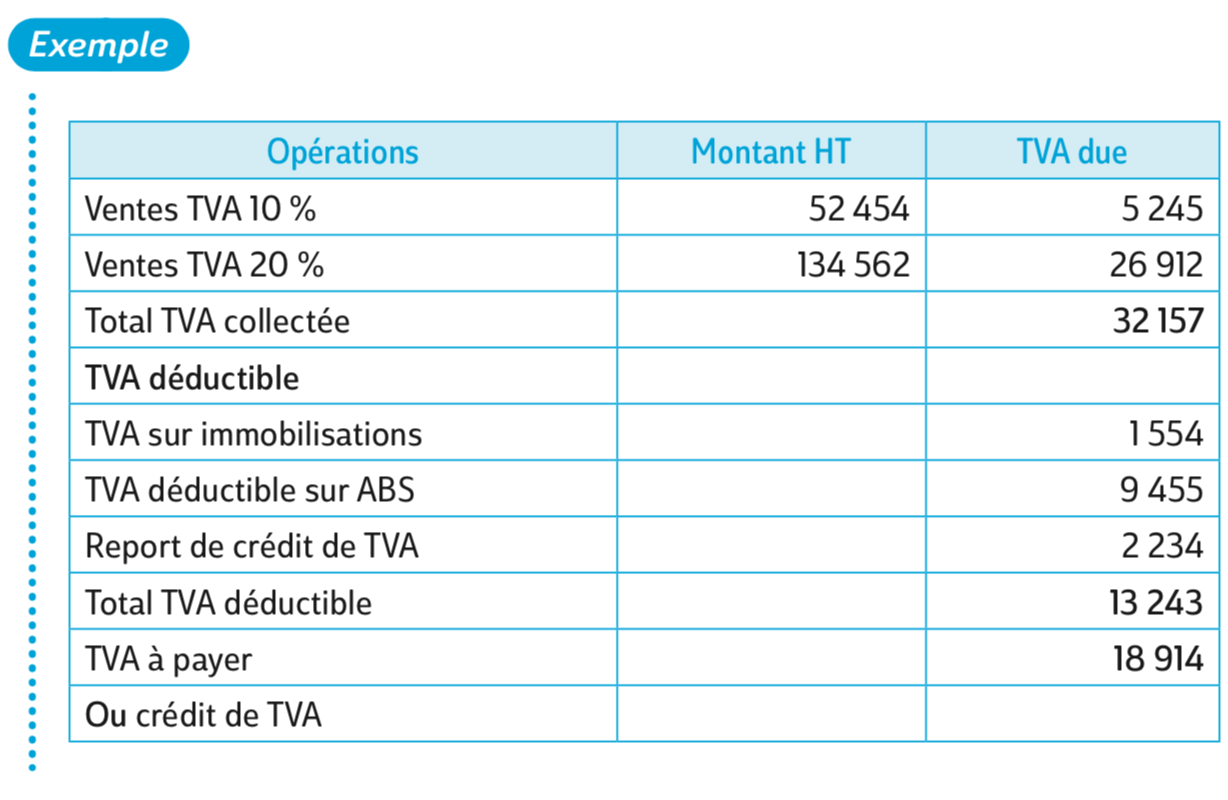
The image below shows a standard table format often used to structure this calculation, separating the different components of deductible VAT.
3. Declaration Periods: Monthly vs. Quarterly
The phrase "for a given period" refers to the frequency of the VAT declaration. In Morocco, this is either monthly or quarterly, depending on the company's annual turnover.
-
Monthly Declaration (
Déclaration mensuelle): This is mandatory for companies whose turnover (excluding tax) in the previous year was equal to or greater than 1,000,000 MAD. The declaration and payment must be made before the end of the month following the month of operations (e.g., April's VAT is declared and paid before the end of May). -
Quarterly Declaration (
Déclaration trimestrielle): This is for companies whose turnover in the previous year was less than 1,000,000 MAD. The declaration and payment must be made before the end of the first month following the quarter (e.g., Q1 (Jan-Mar) VAT is declared before the end of April).
Knowing your client's or employer's declaration regime is a fundamental part of the accountant's role.
Test your understanding!
A Moroccan company, "BATIPRO SARL," is in the construction business and files VAT declarations monthly. For the month of May, you have the following information. All amounts are excluding tax (HT).
- Sales of services invoiced in May: 800,000 MAD (VAT at 20%)
- Purchases of raw materials: 450,000 MAD (VAT at 20%)
- Acquisition of a new utility truck (
véhicule utilitaire): 250,000 MAD (VAT at 20%) - Restaurant bill for a team celebration: 8,000 MAD (VAT at 20%)
- VAT credit from April: 12,000 MAD
Calculate the TVA due or Crédit de TVA for May.
Show answer
Step 1: Calculate TVA facturée
TVA facturée= 800,000 * 20% = 160,000 MAD
Step 2: Calculate TVA récupérable
- VAT on raw materials: 450,000 * 20% = 90,000 MAD (Deductible)
- VAT on utility truck: 250,000 * 20% = 50,000 MAD (Deductible, as it's a utility vehicle, not a passenger car)
- VAT on restaurant bill: 8,000 * 20% = 1,600 MAD (Non-deductible, as it's a representation expense)
- Total
TVA récupérable= 90,000 + 50,000 = 140,000 MAD
Step 3: Calculate the Net VAT Position
- Net VAT =
TVA facturée-TVA récupérable-Crédit de TVA antérieur - Net VAT = 160,000 MAD - 140,000 MAD - 12,000 MAD = 8,000 MAD
Result: BATIPRO SARL has a TVA due of 8,000 MAD for the month of May.
Conclusion
You have now mastered the central calculation in the VAT lifecycle. By assembling the VAT collected on sales and subtracting the eligible VAT from purchases and any prior credits, you can confidently determine a company's financial obligation to the state for any given period.
Key Takeaways:
- The net VAT position is determined by the formula:
TVA facturée-TVA récupérable-Crédit de TVA antérieur. - A positive result means
TVA due(VAT to be paid), while a negative result generates aCrédit de TVAto be carried forward. - The accuracy of this calculation hinges entirely on the correct determination of deductible VAT (
TVA récupérable), reinforcing the importance of the rules on exclusions and the prorata. - The calculation period depends on the company's declaration regime (monthly or quarterly), which is based on its annual turnover.
Preview of the Next Lesson:
Our foundation is now solid. In the next lesson, we will build upon it by examining VAT rules specific to import and export transactions. These international operations have unique treatments that significantly affect the VAT calculation and are essential for any accountant dealing with companies engaged in global trade.