Recommended resources
The freely available resources this lesson will direct you to.
Hello! Welcome back to our exploration of the foundations of mathematics.
In our last lesson, we surveyed the three main responses to the foundational crisis of the early 20th century: Logicism, Formalism, and Intuitionism. We saw that Logicism, championed by Gottlob Frege and Bertrand Russell, held the ambitious goal of reducing all of mathematics to pure logic. However, we ended with a cliffhanger: this grand project was brought to the brink of collapse by the discovery of a devastating paradox.
Today, we will confront that paradox head-on. Our goal is to describe how Russell's theory of types was designed to avoid paradoxes within the logicist project. We will first dissect Russell's Paradox to understand why it was so fatal to Frege's system. Then, we will analyze Russell's ingenious, if complex, solution—the Theory of Types—and see how it aimed to restore consistency to the foundations of mathematics.
1. The Paradox That Broke Logicism
Before Russell developed his own logicist system in Principia Mathematica, he was a student of Gottlob Frege's work. Frege had spent decades building a system, his Grundgesetze der Arithmetik (Basic Laws of Arithmetic), to derive arithmetic from logic. A central pillar of this system was a principle, often called Basic Law V, which informally states that for any property or concept, there exists a set (or "extension") of all the things that have that property. This seems intuitive—the property "is a dog" corresponds to the set of all dogs.
In 1902, just as the second volume of Frege's life's work was about to be published, he received a letter from a young Bertrand Russell. That letter contained a paradox that showed Basic Law V, and thus Frege's entire system, led to a contradiction.
The following video gives an excellent, accessible account of Frege's project and the paradox that shattered it.
Russell's Paradox - A Ripple in the Foundations of Mathematics
This video from Up and Atom explains the context of Frege's logicism and presents a very clear, step-by-step breakdown of Russell's Paradox.
Please watch from 00:54 to 12:22. Focus on understanding: Frege's goal of reducing mathematics to logic. His 'general comprehension principle' (the idea that any concept has a corresponding extension/set). How Russell constructs the paradoxical set of 'all sets that are not members of themselves' and why it leads to a contradiction.
As the video explains, Russell considered the property "is a set that does not contain itself as a member". According to Frege's Basic Law V, this property must define a set. Let's call this the Russell Set, .
The fatal question is: Is a member of itself?
- If we assume ** **, then by the definition of , it must have the property of not being a member of itself. So, . This is a contradiction.
- If we assume ** **, then it has the property required for membership in . So, it must be the case that . This is also a contradiction.
Thus, we have derived the statement , a formal contradiction that is derivable from what seemed to be a self-evident logical principle. Frege immediately recognized the catastrophic implications. To learn more about the historical impact and see the argument presented more formally, please read the following short text.
The Paradoxes of Naive Set Theory
This webpage by Professor John D. Norton provides a rigorous formulation of the paradox and a poignant account of its effect on Frege.
Read the sections 'Russell's Paradox' and 'Gottlob Frege'. Pay attention to the formulation of the paradox as a pair of reductio arguments. This structure will be familiar from your mathematics background.
The conclusion was inescapable: the naive and intuitive assumption that any property defines a set is logically inconsistent. Logicism could not proceed without a way to block this and similar paradoxes.
2. Diagnosing the Problem: The Vicious-Circle Principle
Russell's first step was to diagnose the underlying error. He observed that the paradox arises from forming a collection (the set of all sets that...) and then considering an object (the Russell set itself) whose definition depends on that very collection. He proposed a general principle to outlaw such formations.
The Paradoxes of Naive Set Theory
This section from the same Norton page introduces the principle Russell formulated to address the root cause of the paradox.
Read the section 'Vicious-Circle Principle' to understand Russell's initial diagnosis.
As stated in the text, the Vicious-Circle Principle asserts: "Whatever involves all of a collection must not be one of the collection."
The Russell set is defined by reference to the collection of all sets. Therefore, according to the principle, cannot itself be considered a member of that collection, and the question of its self-membership cannot be legitimately posed.
However, as the reading notes, this principle is too blunt an instrument. It rules out problematic cases like the Russell Set, but it also seems to rule out benign definitions like "the tallest person in the room," since this person is defined in terms of the collection of all people in the room, yet is also a member of that collection. A more systematic, grammatical solution was needed.
3. The Solution: The Theory of Types
Russell's refined solution, developed with A. N. Whitehead in their monumental work Principia Mathematica, was the Theory of Types. The core idea is to arrange all mathematical and logical entities into a strict hierarchy, such that self-referential statements like the one in Russell's paradox become not just false, but grammatically ill-formed and meaningless.
3.1 The Simple Theory of Types
The basic version is the Simple Theory of Types. It works by assigning a "type" to every entity:
- Type 0: Individuals (the basic objects of discourse, e.g., 'Socrates').
- Type 1: Properties of individuals (e.g., 'is mortal'). These can only be applied to Type 0 objects.
- Type 2: Properties of Type 1 properties (e.g., 'is a virtue'). These can only be applied to Type 1 objects.
- And so on, for Type 3, 4, ...
The fundamental rule of this hierarchy is: A property (or predicate) of type can only be applied to objects of type .
This creates a rigid grammar for logic. A statement like "Socrates is mortal" is well-formed because 'is mortal' (Type 1) is applied to 'Socrates' (Type 0). However, a statement like "'is mortal' is mortal" is meaningless, because it attempts to apply a Type 1 predicate to another Type 1 predicate.
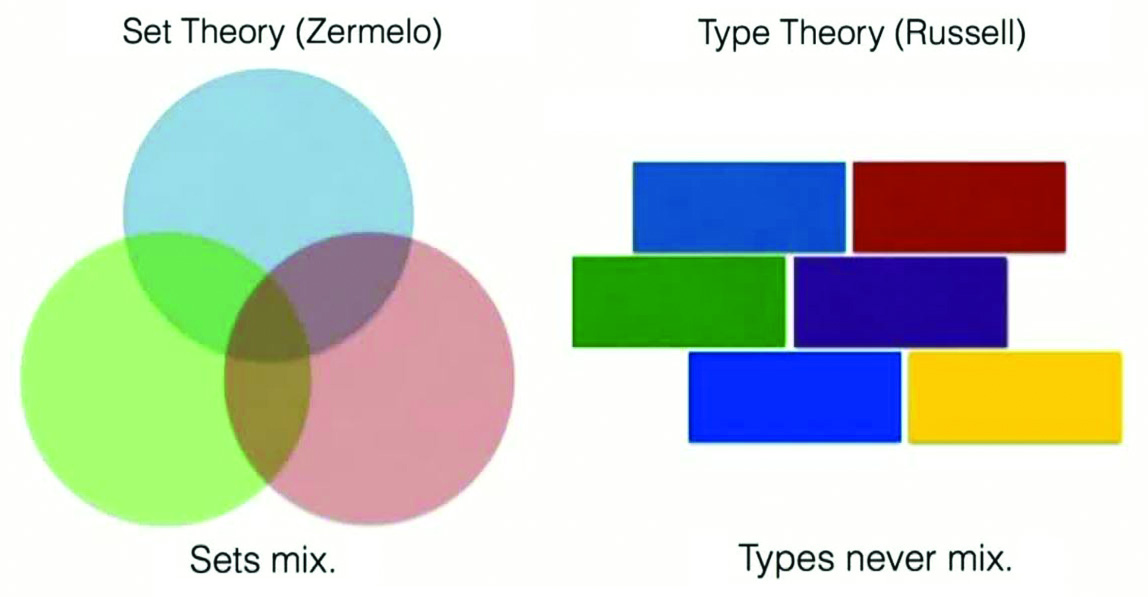
How does this block Russell's Paradox? The paradox involves asking whether a set contains itself (). In type theory, a set's type is one level higher than the type of its elements.
- A set of individuals is a Type 1 object.
- A set of sets of individuals is a Type 2 object.
- In general, a set of Type objects is a Type object.
Therefore, for any set , its type is necessarily higher than the type of its members. The question "Is a member of ?" becomes unaskable, as it would require to be of a lower type than itself. The formula (and ) is simply a piece of syntactic nonsense, like saying "green is a number".
For a more rigorous explanation, we'll turn to the Stanford Encyclopedia of Philosophy.
Type Theory - Stanford Encyclopedia of Philosophy
The following text from the Stanford Encyclopedia of Philosophy entry on 'Type Theory' provides a formal account of how simple type theory is structured and how it blocks the paradox. Your maths background will be very useful here.
Read Section 1, 'Paradoxes and Russell’s Type Theories,' and Section 2, 'Simple Type Theory and the λ-calculus'. In Section 1, focus on the formal reconstruction of the paradox in Frege's system. In Section 2, focus on the description of the type structure (individuals, propositions, relations) and the key sentence: 'This restriction makes it impossible to form a proposition of the form P(P)'. Don't worry if the λ-calculus notation is unfamiliar; focus on the principle it's used to express.
Test your understanding!
Using the hierarchy of the Simple Theory of Types, explain precisely why the phrase "the set of all sets that are not members of themselves" cannot be used to generate a paradox.
Show answer
The phrase "sets that are not members of themselves" presupposes that the statement "a set is a member of itself" is meaningful. In Type Theory, it is not. A set is always of a higher type than its members. Let's say we have sets of individuals (Type 1), sets of sets of individuals (Type 2), etc. A statement of membership, x ∈ y, is only well-formed if the type of y is exactly one level higher than the type of x. Therefore, the statement S ∈ S is ill-formed for any set S, because it would require the type of S to be one level higher than itself. Since the core property used to define the Russell Set is meaningless, the set itself cannot be formed, and the paradox is averted at its root.
3.2 Complications: Ramified Types and the Axiom of Reducibility
The Simple Theory of Types blocks paradoxes like Russell's, which are sometimes called logical paradoxes. However, Russell was also concerned with semantic paradoxes, like the Liar Paradox ("This statement is false"). To block these, he introduced a more complex system called the Ramified Theory of Types.
This theory added a second hierarchy of "orders" within each type. A property's order depended on what it quantified over. For example, the property "Napoleon had all the qualities of a great general" would be of a higher order than a first-order property like "Napoleon was Corsican," because the first one quantifies over all properties.
This ramified hierarchy successfully blocked semantic paradoxes, but it made mathematics unworkably complex. It led to the existence of infinitely many different kinds of natural numbers, real numbers, etc. (a number of order 1, a number of order 2, and so on), and it became difficult to prove basic theorems that mixed orders.
To fix this, Russell and Whitehead introduced the Axiom of Reducibility. This axiom essentially states that for any higher-order property, there is an equivalent first-order property. This collapsed the ramified hierarchy for all practical purposes, allowing mathematics to be done, but it was widely criticized. Why should one believe this axiom? It seemed like an ad hoc fix, and it certainly didn't seem like a self-evident truth of logic. This undermined the core goal of Logicism.
Because of these problems, most later logicians (following Frank Ramsey) abandoned the complex ramified theory and its controversial axiom, focusing instead on the more elegant Simple Theory of Types we discussed first.
Conclusion
Today we've traced the path from crisis to solution in the logicist project.
- We saw how Russell's Paradox emerged from the intuitive but flawed assumption that any property defines a set, delivering a fatal blow to Frege's foundational system.
- We analyzed Russell's solution, the Theory of Types, which resolves the paradox by introducing a strict hierarchy. This hierarchy makes self-referential statements like syntactically meaningless, preventing the paradox from ever being formed.
- We also touched on the complexities of the Ramified Theory and the controversial Axiom of Reducibility, which highlight a recurring theme: saving the logicist project often required introducing principles that were themselves not obviously logical.
Russell's Theory of Types succeeded in providing a consistent framework for mathematics, allowing the logicist project of Principia Mathematica to proceed. However, the complexity of the system and its reliance on axioms like Reducibility (and the Axiom of Infinity, which is needed to get all the numbers) led many to doubt that Logicism had truly succeeded in reducing mathematics to just logic. It seemed that an irreducible mathematical or set-theoretic component remained.
Preview of the Next Lesson:
The difficulties faced by Logicism motivated alternative approaches. While Russell was trying to fix logic from within, others decided to change the rules of the game entirely. In our next lesson, we will turn to the second great foundational program: Formalism. We will explore David Hilbert's proposal to treat mathematics as a formal game of symbols and his ambitious program to prove its consistency using secure, finite methods.