Recommended resources
The freely available resources this lesson will direct you to.
Hello! Welcome to your next lesson on the foundational programs in mathematics.
In our last session, we explored L.E.J. Brouwer's intuitionism and its radical conclusion: the Law of the Excluded Middle (LEM), a cornerstone of classical logic, cannot be accepted as a universally valid principle. We saw that for an intuitionist, who equates truth with constructive proof, asserting for a statement about an infinite domain is an unsubstantiated claim to have a decision procedure for a problem that may well be unsolvable.
Today, we will broaden this analysis to fulfill our learning outcome: to analyze the philosophical differences between classical and intuitionistic logic. This goes beyond just LEM. We will investigate other logical principles that are lost, see how this plays out in mathematical proofs, and, most importantly, connect this logical schism to a profound philosophical disagreement about the very nature of truth, meaning, and reality.
1. The Domino Effect: What Falls with LEM?
Rejecting the Law of the Excluded Middle is not an isolated change; it has a domino effect across the entire structure of logic. Several other principles of classical logic, which seem obviously true to the classically trained mind, are no longer universally valid.
Double Negation Elimination
The most significant casualty after LEM is the principle of Double Negation Elimination (DNE). Classically, this is the rule that allows you to infer from .
From an intuitionistic viewpoint, this inference is illegitimate. Let's break down why:
- A proof of is a construction that shows how to derive a contradiction from a hypothetical proof of .
- Therefore, a proof of is a construction that shows how to derive a contradiction from a hypothetical proof of .
This means that tells you that the assumption of being false is absurd. It is a proof of non-falsity. However, it is not a direct, constructive proof of itself. It tells you that can't be false, but it doesn't provide the positive construction that, for an intuitionist, constitutes the truth of .
The following video explains this crucial distinction between deriving positive and negative information.
Intuitionistic Logic | Attic Philosophy
The 'Intuitionistic Logic' video from Attic Philosophy, which we touched on last time, offers an excellent explanation of why rejecting LEM also means rejecting Double Negation Elimination and classical indirect proofs.
Please watch from 02:42 to 05:31 and from 09:24 to 12:01. The first segment details the consequences of rejecting LEM, like the invalidity of DNE and indirect proof. The second segment provides the philosophical motivation, framing it as the inability to derive 'positive information' (like A) from 'negative information' (like not-not-A).
The Power of Reductio ad Absurdum is Curtailed
As the video mentions, the loss of DNE means that the classical method of proof by contradiction (reductio ad absurdum) is restricted.
- Valid use (proving a negative): To prove , you can still assume and derive a contradiction. This is the very definition of proving a negation.
- Invalid use (proving a positive): You can no longer prove a positive statement by assuming and deriving a contradiction. This move is equivalent to inferring from , which is exactly what DNE does.
This is a massive change. A great deal of classical mathematics relies on this form of non-constructive reasoning. For example, the standard proof of the irrationality of is a proof of a negative statement (" is not rational"), so it remains intuitionistically valid. However, many existence proofs are not.
2. A Tale of Two Proofs: Constructive vs. Non-Constructive
Let's make this concrete with a famous mathematical example. The following video presents a classic proof and explains why an intuitionist would object to it. Your background in mathematics will make the argument here very clear.
Intuitionistic Logic and Constructive Proof | Attic Philosophy
The video 'Intuitionistic Logic and Constructive Proof' from the Attic Philosophy channel demonstrates a beautiful, simple non-constructive proof and pinpoints exactly where the classical and intuitionistic logicians part ways.
Please watch from 01:00 to 06:41. The video proves that there exist two irrational numbers, x and y, such that x^y is rational. Pay very close attention to the pivotal first step in the proof and the narrator's explanation of why a constructive mathematician objects to it.
The crucial step, as the video highlights, is the assumption: "the number is either rational or irrational." This is a direct application of the Law of the Excluded Middle to a specific mathematical statement.
- The classical mathematician sees this as unproblematic. The number has this property or it doesn't, regardless of our knowledge.
- The intuitionist, however, rejects this move. At the time the proof was formulated, there was no known method to decide if was rational or not. Therefore, asserting the disjunction
(A or not-A)was an unfounded leap.
The proof cleverly shows that in either case, we can find the numbers and . But because it doesn't tell us which case holds, it doesn't actually construct the numbers. It proves their existence non-constructively.
3. The Root of the Disagreement: Realism vs. Anti-Realism
Why do these two schools of thought diverge so sharply on what seems like a basic rule of logic? The difference in logic is a symptom of a much deeper philosophical disagreement about truth and reality. The philosopher Michael Dummett influentially framed this as a debate between realism and anti-realism.
To understand this debate, we'll consult a text summarizing Dummett's influential project.
This chapter on Michael Dummett explains his central thesis: that metaphysical debates, such as realism vs. anti-realism, are best understood as debates about the nature of meaning and truth. It directly connects these philosophical stances to the adoption of either classical or intuitionistic logic.
Please read the introductory section, the section 'What does it mean to say that the truth-conditions of a range of sentences are “realist”?,' and the section 'Anti-realism'. Focus on understanding (1) the idea of 'verification-transcendent truth', (2) how realism embraces this idea while anti-realism rejects it, and (3) how this rejection leads to abandoning the principle of bivalence and adopting intuitionistic logic.
Let's synthesize the core argument presented in the reading:
- Realism (Platonism in mathematics): The realist believes in a mind-independent reality. A mathematical statement is true or false depending on how things are in this abstract realm. Its truth is verification-transcendent—it transcends our ability to prove or disprove it. For the realist, the Principle of Bivalence holds: every statement is determinately true or false. Classical logic, with its Law of the Excluded Middle, is the natural logic for this worldview.
- Anti-Realism (Constructivism/Intuitionism in mathematics): The anti-realist argues that we cannot make sense of a notion of truth that is completely untethered from our ability to recognize it. For the anti-realist, truth is epistemically constrained; it cannot outrun our capacity (in principle) for proof or verification. If we have no method to decide a statement , we have no warrant to assert that it is true, and no warrant to assert that it is false. Therefore, the anti-realist rejects the universal application of the Principle of Bivalence, and consequently rejects LEM. Intuitionistic logic is the logic for this worldview.
The disagreement about logic is therefore not a technical squabble. It is a surface expression of a fundamental conflict over the relationship between truth, knowledge, and reality.
Test your understanding!
A classical logician uses reductio ad absurdum to prove a statement by assuming and deriving a contradiction.
Using the concepts from the Dummett reading, explain philosophically why a realist would be perfectly happy with this proof method, while an anti-realist would object to it.
Show answer
A realist believes in verification-transcendent truth and the principle of bivalence. For them, must be either true or false. By assuming and deriving a contradiction, the logician has shown that cannot be true. Since there are only two options (true or false), the only remaining possibility is that is true. The proof simply eliminates one of the two exhaustive options.
An anti-realist, however, rejects bivalence for undecidable statements. For them, truth is tied to provability. Showing that leads to a contradiction only establishes —that a proof of is impossible. It does not provide a direct, constructive proof of . Since truth cannot outrun proof, and no proof of has been supplied, the anti-realist cannot conclude that is true. They have only ruled out its negation.
4. The Structure of Logical Space
The philosophical differences are also reflected in the very structure of logic. In classical logic, principles like LEM and DNE cause the space of logical propositions to "collapse." For any proposition , complex statements like , , and all become equivalent to simpler forms like , , True, or False.
In intuitionistic logic, these equivalences do not hold. This reveals a much richer and more complex logical structure.
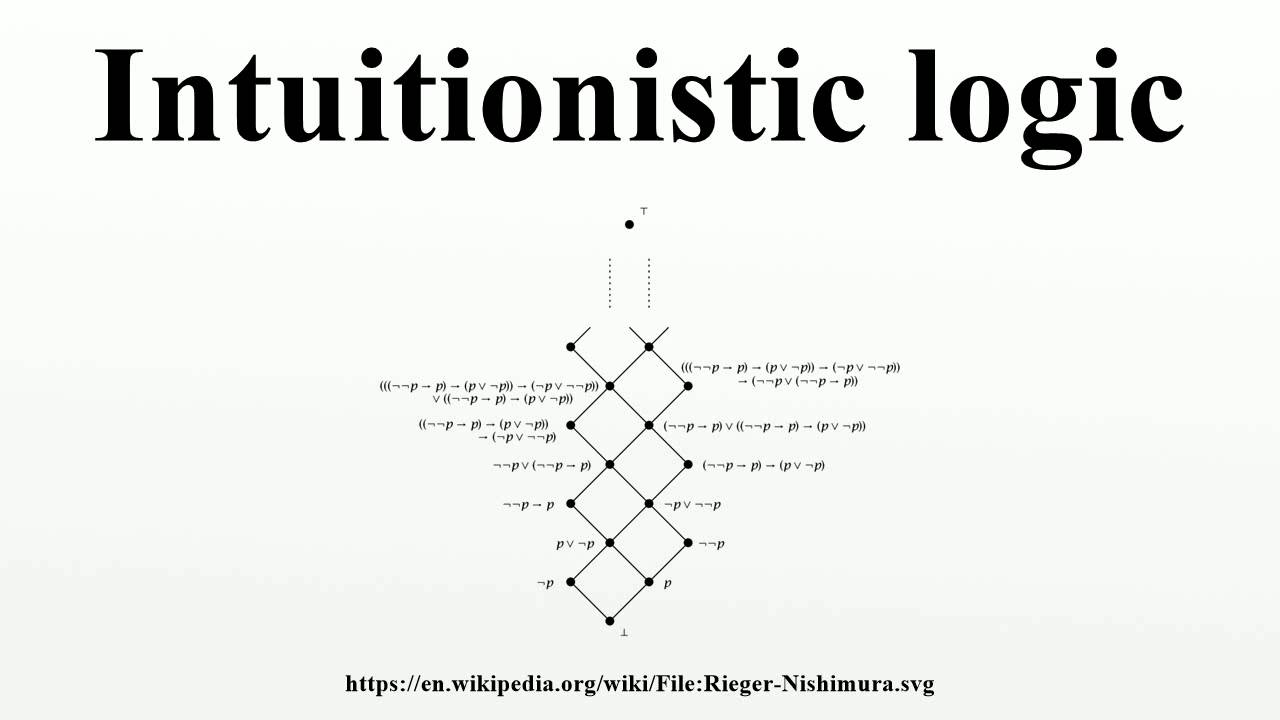
Looking at this lattice, you can see that propositions like , , and all occupy different nodes, signifying they are not equivalent. This is a formal manifestation of the philosophical differences we have been discussing. For instance, the gap between and is the failure of DNE. The fact that is not at the top of the lattice (the universal 'True' node) represents the failure of LEM.
Conclusion
Today we have moved from the specific rejection of LEM to a broader analysis of the deep philosophical rifts between classical and intuitionistic logic.
Here are the key takeaways:
- Logical Differences: Intuitionistic logic rejects not only the Law of the Excluded Middle but also Double Negation Elimination. This curtails the power of proof by contradiction, rendering it valid only for proving negative statements.
- Practical Differences: This logical divide manifests in mathematical practice as the distinction between non-constructive proofs (which rely on classical principles like LEM) and constructive proofs (which are intuitionistically valid).
- Philosophical Bedrock: The core of the disagreement lies in the philosophy of truth and meaning. Classical logic aligns with realism, which accepts verification-transcendent truth and the Principle of Bivalence. Intuitionistic logic aligns with anti-realism, which sees truth as epistemically constrained (tied to proof) and thus rejects bivalence for undecidable statements.
- Structural Richness: Far from being merely a "crippled" version of classical logic, intuitionistic logic reveals a more complex and fine-grained propositional structure, as visualized by the Rieger-Nishimura lattice.
Preview of the Next Lesson:
Having now analyzed the theoretical and philosophical differences, our next step will be to put these ideas into practice. In the next lesson, you will apply constructive reasoning to a simple mathematical proof, seeing firsthand how to build an argument that an intuitionist would accept.