Recommended resources
The freely available resources this lesson will direct you to.
- How to Secure MCP Servers | A Walkthroughwww.youtube.com
- Build ANYTHING With an Advanced MCP Server (Python, Authentication, Databases & More)www.youtube.com
- Dynamic Authorization for AI Agents. A Guide to Fine ...www.cerbos.dev
- MCP security: Implementing robust authentication and authorizationwww.redhat.com
Hello! In our previous lesson, we successfully configured a host application to connect to the MCP server you built, creating a complete, end-to-end system. However, as it stands, anyone could connect to your server and access its data. For any system intended for production—a core part of your goal—this is a critical vulnerability.
Today, we will address this by implementing robust security and access control boundaries. This is the final and perhaps most crucial lesson in our module on MCP, as it transforms our prototype into a blueprint for a secure, production-grade AI application. We will explore the "who" (Authentication) and the "what" (Authorization) of MCP security, ensuring that only the right users can perform the right actions.
By the end of this lesson, you will understand how to design and implement a secure MCP integration using industry-standard protocols and patterns, a skill essential for any AI Engineer building systems that interact with sensitive data or perform powerful actions.
The Landscape of MCP Security
Before we dive into the technical details, let's establish a mental model for securing an MCP-based system. When an AI agent can interact with tools that might delete database records, send emails, or access private files, we need multiple layers of defense. The diagram below shows three common deployment patterns for MCP: cloud, on-premises, and hybrid. Notice that in every case, components like "Permissions & Credentials," "Audit Logging," and "Data Security" are central to the architecture.
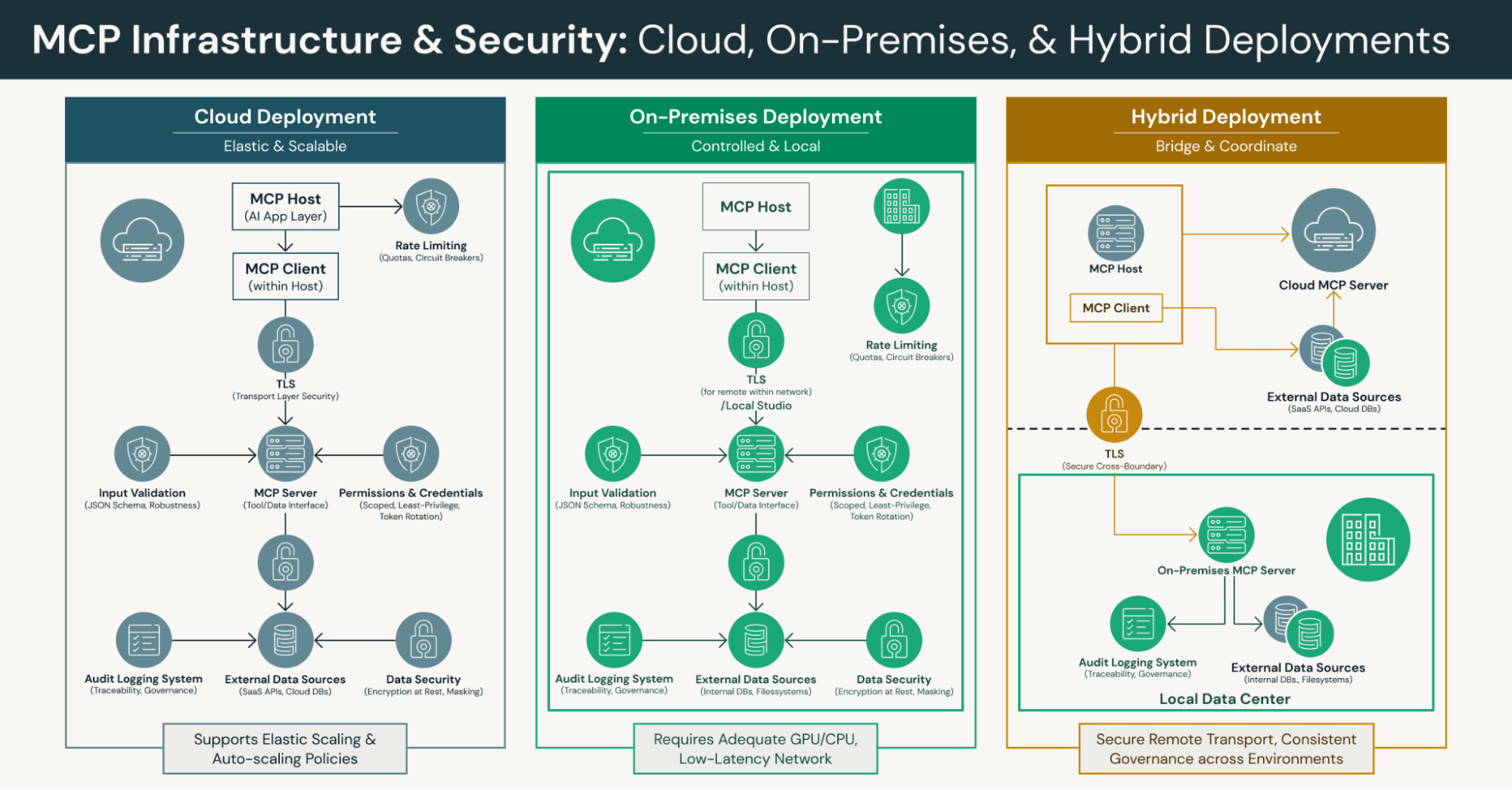
A useful way to think about this is a "defense-in-depth" strategy, as illustrated in the following diagram. While originally for Google Managed MCP Servers, the principle is universal.

Our focus today will be on Layers 2 and 3: establishing who the user is at the application level and enforcing what they are allowed to do at the infrastructure/server level.
Authentication: Verifying Identity with OAuth 2.1
The first question in any secure transaction is, "Who are you?" This is authentication. The modern MCP specification standardizes this process using OAuth 2.1, a familiar protocol for any engineer who has worked with web APIs.
In this model:
- The MCP Server acts as an OAuth 2.1 Resource Server. It protects resources (the tools and data).
- The Host Application (like Cursor or your custom client) acts as an OAuth 2.1 Client. It requests access on behalf of the user.
- An external Authorization Server (like Keycloak, Okta, or Auth0) handles the user login and issues access tokens.
This separation of concerns is a hallmark of scalable, enterprise-grade architecture. Your MCP server shouldn't have to manage user passwords; it should delegate that responsibility to a dedicated identity provider (IdP).
The following article from Red Hat provides an excellent overview of this architecture.
MCP security: Implementing robust authentication and authorization
This article details the modern approach to MCP security, focusing on the roles of authentication and authorization. It's written from an enterprise perspective, which aligns perfectly with your goal of building production systems.
Please read the introduction and the first two main sections of the article. Start with the introduction, which frames the problem. Then, focus on the section Authorization server integration. Pay close attention to the distinction between an embedded and an external authorization server, and why the external approach is preferred. The diagram of the OAuth flow here is key. Finally, read the section on Consent and scoping to understand how OAuth scopes are used to enforce the principle of least privilege.
The key takeaway is that when a client first connects to your secure MCP server, it will receive a 401 Unauthorized error. The server's response will guide the client to the correct authorization server, where the user can log in. After successful login, the client receives an access token (typically a JSON Web Token, or JWT), which it includes in all subsequent requests to the MCP server.
Authorization: Enforcing Permissions with Policies
Once we've authenticated a user and have their access token, we need to answer the second question: "What are you allowed to do?" This is authorization.
A common but brittle approach is to hardcode if/else statements in your server logic (e.g., if user.role == 'admin'). This quickly becomes unmanageable. A much more robust and scalable solution is to decouple authorization logic from your application code using a policy engine.
The following article from Cerbos demonstrates how to build a secure MCP server where tool access is managed by a decoupled, policy-driven authorization service. The examples are in Node.js, which should be very accessible given your JavaScript background.
Dynamic Authorization for AI Agents. A Guide to Fine ...
This guide provides a practical, step-by-step implementation of a policy-driven MCP server. It's a masterclass in building decoupled, secure systems.
First, read the section The challenge to understand the problem with hardcoded permissions. Next, read The solution, which introduces the core concept of a policy engine that dynamically enables or disables tools. Then, study the implementation guide in Step 1 (<tf start="Step 1: Declarative policy authoring" end="roles: ["admin"] ">Declarative policy authoring) and Step 3 (<tf start="Step 3: Integrating the MCP server" end="app.listen(3000, () => console.log("MCP Server running on port 3000"));">Integrating the MCP server). In the policy file, notice how different roles are granted different actions (tools). In the server code, see how cerbos.checkResource is used to get a list of allowed actions, which are then used to enable or disable the corresponding tools. Finally, review the section on the power of ABAC to see how this pattern extends beyond simple roles to attribute-based rules, like allowing a manager to approve expenses only up to a certain amount.
A Practical Walkthrough
Let's see how these concepts play out in practice. The following video walks through building an advanced MCP server in Python, focusing heavily on authentication and database integration. While the language is different, the architectural patterns are identical.
Build ANYTHING With an Advanced MCP Server (Python, Authentication, Databases & More)
This video provides a complete tutorial on building a secure, stateful MCP server. We will focus on two critical segments that perfectly illustrate the concepts we've discussed.
First, watch the segment showing the OAuth authentication flow from a user's perspective, from initial failure to the server identifying the need for authentication. Then watch from the login prompt, where the client opens a browser window for the user to log in. This is the OAuth flow from the Red Hat article in action. Next, and this is crucial, watch the segment from debugging user identity. The creator makes a common but critical mistake: they associate data with the client_id of the application, not the sub (subject) claim of the user from the JWT. This results in all users sharing the same data! The debugging process shows exactly how to parse the JWT to get the correct user identifier. This is an invaluable lesson for building multi-tenant systems.
The video demonstrates the most important step in authorization: correctly identifying the principal (the user) on whose behalf the action is being taken. Once you have the user_id from the JWT's sub claim, you can pass it to your authorization policy engine, as shown in the Cerbos article:
// From the Cerbos article
const authorizedTools = await cerbos.checkResource({
  principal: {
    id: user.id, // This would be the 'sub' from the JWT
    roles: user.roles // Roles can also be included in the JWT
  },
  resource: {
    kind: "mcp::expenses",
    id: sessionId
  },
  actions: toolNames,
});
Advanced Topic: Just-in-Time Access and Auditing
For the most sensitive operations in a production environment, even standard RBAC can be too permissive. A modern pattern is Just-in-Time (JIT) access, where users request elevated privileges for a short duration to perform a specific task. This, combined with comprehensive auditing, provides a very high level of security and accountability.
How to Secure MCP Servers | A Walkthrough
This video from Teleport showcases a security-first approach to MCP, using a proxy to enforce access controls.
First, watch the overview of the concept at RBAC enforcement. Then, watch the demonstration of Just-in-Time access from requesting privileges. A user with read-only access requests temporary admin rights, which must be approved. This is a powerful system design pattern to be aware of for interviews. Finally, see the brief mention of audit logs at audit logs. In any production system, logging every action an agent takes is non-negotiable for security and compliance.
Conclusion
You have now surveyed the entire landscape of MCP security, from foundational protocols to advanced, production-ready patterns. This is a critical skill set that separates prototype builders from production AI engineers.
Key Takeaways:
- Authentication answers "Who are you?" In MCP, this is handled via the OAuth 2.1 protocol, where the server validates a JWT access token issued by a trusted authorization server.
- Authorization answers "What can you do?" This is best handled by a decoupled policy engine using patterns like RBAC and ABAC, which dynamically enables/disables tools based on the authenticated user's permissions.
- User Identity is Paramount: Always derive the user's identity from the
sub(subject) claim in the JWT, not a generic applicationclient_id. - Production-Grade Patterns: For high-stakes environments, consider advanced strategies like Just-in-Time (JIT) access for temporary privileges and maintain comprehensive audit logs of all agent actions.
You have now built a complete, dynamic, and secure framework for providing context to AI models. The next step is to consider how to make these systems performant and scalable. In our next module, we will begin by exploring semantic caching as a technique to reduce API costs and dramatically improve response latency.