Recommended resources
The freely available resources this lesson will direct you to.
Hello! In the previous lesson, you used details from historical sources to work out what they could—and could not—tell you about the past. This final lesson asks a different question: how convincing is someone’s explanation of the past? You will identify the main argument in an interpretation, test it against evidence that supports and challenges it, and reach a judgement. We will use a question from your Industrial Revolution revision: did industrialisation improve working-class life?
What is an interpretation?
A historical source, such as a witness statement or an engraving made at the time, gives us evidence to investigate. A historical interpretation is an argument about what happened or how significant it was. Two people can accept the same facts but give different answers to a question such as “Did working-class life improve?” One might emphasise wages and employment; another might emphasise housing and disease.
When you first read an interpretation, look past individual details and put its main argument in your own words. Ask what it claims, for whom, and over what period. “Life improved” is a much broader claim than “some workers gained jobs later in the nineteenth century.”
How to answer a 16 mark 'Interpretations' Exam Question | Edexcel History GCSE Revision
Watch How to answer a 16 mark ‘Interpretations’ Exam Question, from A long, long time ago..., for its method of finding a main argument and making a judgement. Its example concerns a different historical topic: you do not need to learn those facts or use its particular exam format.
In finding the argument, focus on how the presenter reduces each passage to its overall claim before selecting details. Later, judging agreement shows why a conclusion must say how far the argument convinces you, rather than merely repeat both sides.
Your assessment may provide one interpretation rather than two. The method still works: state its argument, find evidence for it, find evidence that complicates it, and decide how far it holds up.
Two arguments about working-class life
The debate over living standards gives you a useful test case. History Guild describes a critical view associated with Friedrich Engels, who wrote about industrial workers’ lives in the 1840s. It also describes a contrasting argument from economist Robert E. Lucas Jr. about gradual improvements for the poorest people.
Read the “Standards of Living” section of History Guild’s Social Change. It introduces the evidence behind two different interpretations of industrialisation.
Under “Standards of Living”, begin with the opening paragraph introducing Engels’s account of Manchester and other mill towns. Read the living-standards debate through the final paragraph of that section, ending with the discussion of wages and life expectancy in the 1870s. Notice which claims concern the early Industrial Revolution and which concern improvements later in the nineteenth century. Use 1844, not the “1944” printed in an illustration caption, for the year in the title of Engels’s account.
Here are two short teaching versions of the arguments the reading reports. They are paraphrases, not direct quotations from Engels or Lucas:
Interpretation A, summarising Engels’s view: Early industrial workers earned less than their pre-industrial counterparts and lived in less healthy surroundings.
Interpretation B, summarising Lucas’s view: Industrialisation gradually improved living standards for the poorest people.
Notice the key words. A is especially concerned with early industrial workers and compares them with people before industrialisation. B claims gradual improvement; it does not say everyone benefited immediately. If you rewrite B as “Industrialisation instantly made everyone rich,” you have invented an easier argument to attack rather than evaluated the one given.
Test each argument with evidence
Start with evidence that makes A convincing. Factory jobs could offer wages, but rapid urban growth also produced overcrowded housing and poor sanitation. Your knowledge organiser notes that as many as 12 people might live in one room of a back-to-back house. Contaminated water spread cholera, and an outbreak killed more than 50,000 people in the UK in 1832. Children worked in mills and mines, sometimes from a young age and for long hours. These facts support a serious criticism of living conditions, even if they do not by themselves establish that every industrial worker earned less than every pre-industrial worker.
A picture can add a narrower piece of evidence. This 1835 engraving depicts people working beside large textile machines:
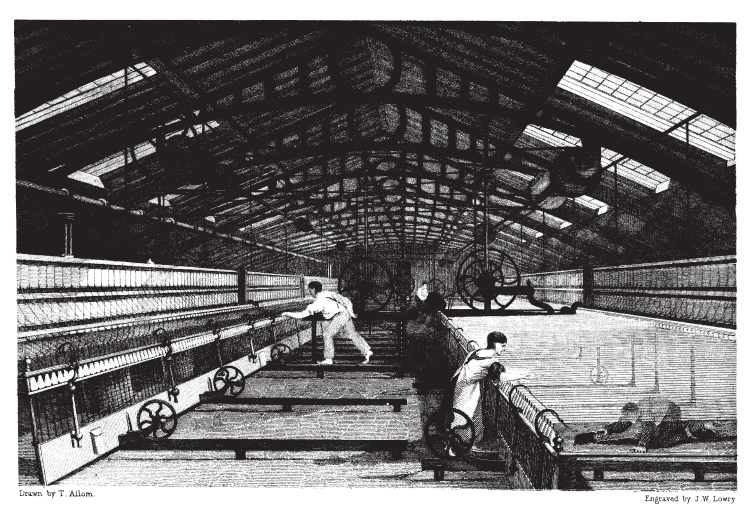
The engraving is a source from the period, not a historian’s interpretation. As you learned previously, use what it actually depicts. It helps you discuss young people’s presence in mills; it cannot prove A’s claim about incomes or settle the overall living-standards debate.
Now consider evidence that makes B plausible. Factories created employment, and a steady wage could help a household. Industrial production increased the supply of goods, while railways improved the movement of goods and people. Improvements were also possible within the industrial period: the Public Health Act of 1875 aimed to improve living conditions. History Guild notes that Engels himself acknowledged substantial improvements in many of the conditions he had described earlier.
The crucial word is gradually. Later improvements do not erase the overcrowding or disease experienced earlier. Equally, evidence of terrible conditions in the 1830s does not show that nothing improved by the late nineteenth century. A strong evaluation keeps track of when, for whom, and which aspect of life each piece of evidence describes. A job, a higher income, safer water and better housing are related, but they are not the same measure of living standards.
Turn your comparison into an assessment answer
You do not need a long list of facts. Choose a few precise examples and explain how they affect the argument. If the question asks, “How convincing is Interpretation B?”, an answer could begin like this:
Interpretation B is convincing to some extent because industrialisation created factory jobs, and later reforms aimed to improve urban life. For example, the Public Health Act of 1875 sought to improve living conditions. This supports the idea of gradual improvement rather than an immediate benefit for everyone. However, the interpretation gives an incomplete picture of early industrial life: overcrowded housing and contaminated water helped cholera spread, and more than 50,000 people died in the UK outbreak of 1832. Overall, B is more convincing as an account of change over the longer term than as a description of what early working-class families experienced.
The answer identifies B’s argument, tests it both ways, and makes a judgement about its scope. It does not just attach “I agree” and “I disagree” to two unrelated facts. Each example explains why the claim becomes stronger or weaker.
If an assessment gives you information about an interpretation’s writer or date, use it when it helps explain the argument. A writer focusing on the 1840s and one examining changes across the whole nineteenth century might reach different conclusions partly because they are asking about different stretches of time. Do not invent a writer’s motives or assume that a later interpretation must automatically be better. The evidence and the precise claim remain central.
Key takeaways
To evaluate an interpretation, first state its main argument accurately in your own words. Then use specific historical knowledge to show what supports it and what gives a different picture. Finish with a judgement that explains how far it is convincing, paying attention to time period, group and measure of change.
This completes the course. For the assessment, remember the distinction: with a source, investigate what its details and origin allow you to infer; with an interpretation, test an argument about the past against evidence on both sides.