Recommended resources
The freely available resources this lesson will direct you to.
Welcome back. In our previous lesson, you learned to determine a company's final annual corporate tax liability (IS Dû) by comparing the profit-based tax (IS Brut) with the revenue-based minimum tax (Cotisation Minimale). This gave us the total tax amount for a given year.
However, companies do not pay this entire amount in one lump sum after the year ends. The tax administration requires businesses to pay their corporate tax in installments throughout the year. This lesson focuses on the practical process of making these payments.
Our learning objective is to calculate and prepare the quarterly IS prepayment declarations (acomptes provisionnels). Mastering this will equip you with a key operational skill required in any Moroccan accounting department, ensuring the company meets its tax obligations on time.
1. The Concept and Timing of Acomptes Provisionnels
Acomptes provisionnels, or provisional prepayments, are advance payments of the corporate income tax due for the current fiscal year. Their purpose is to spread the tax burden over the year for the company and ensure a steady flow of revenue for the state.
Generally, a company makes four quarterly prepayments. The amount of these prepayments is based on the tax liability of the previous year.
To understand the concept, let's start with a basic definition.
Comptabilité marocaine : Comptabilisation de l’impôt sur les sociétés
This article from NSE-MA provides a straightforward definition of provisional prepayments. Focus on the core idea of what they are and why they exist.
Read the section under the heading 'Comptabilisation de l’IS : Comptabilisation des acomptes provisionnels'. Note the basic principle that prepayments are based on the previous year's tax.
Due Dates
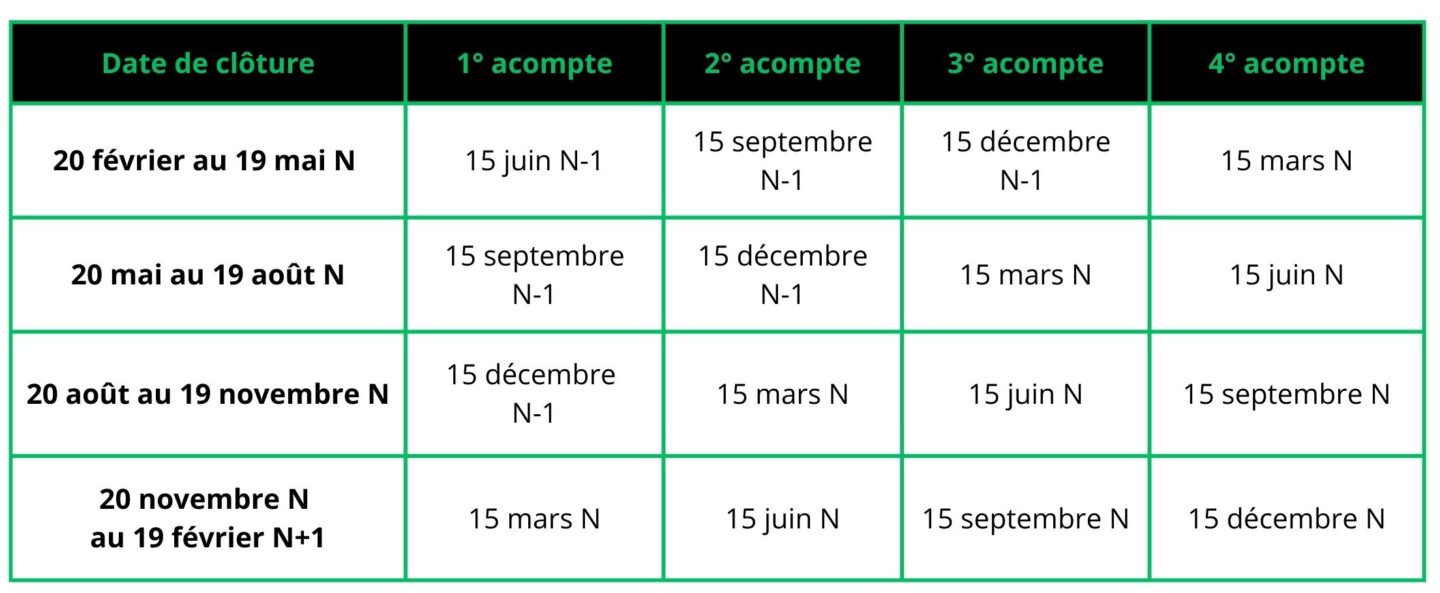
These four prepayments must be made before the end of the 3rd, 6th, 9th, and 12th months following the start of the current fiscal year. For a company whose fiscal year aligns with the calendar year (closing on December 31st), the deadlines are:
- 1st Prepayment: Before March 31st
- 2nd Prepayment: Before June 30th
- 3rd Prepayment: Before September 30th
- 4th Prepayment: Before December 31st
The following calendar provides a comprehensive view of the deadlines for companies with different year-end closing dates.
2. The Calculation Method: A Crucial Update
Traditionally, the rule was simple: each prepayment was 25% of the final tax paid for the previous year (IS Dû de l'exercice N-1).
However, the 2023 Finance Law initiated a multi-year reform to gradually change the corporate tax rates. Because the applicable IS rate for a company might now be different each year between 2023 and 2026, the calculation method for prepayments has been adjusted to reflect this transition.
The New Rule: For exercises opened between Jan 1, 2023, and Dec 31, 2026, provisional prepayments are calculated based on the previous year's profit, but by applying the tax rate of the current year.
Let's formalize this with the official text from the tax authority (DGI).
NOTE CIRCULAIRE N° 733 RELATIVE AUX ...
This section of the DGI's official circular note confirms the new rule for calculating prepayments during the transitional period.
Read section 'C- Calcul des acomptes provisionnels' to see the official language stating that prepayments are calculated using the IS rates applicable to the current fiscal year.
This leads to a two-step process:
- Determine the tax reference amount (
impôt de référence): This is the tax liability from the previous year (N-1). - Calculate the theoretical tax (
IS théorique): This involves taking the taxable profit from year N-1 and applying the IS rate of the current year (N). - Calculate the prepayment: Each of the four prepayments will be 25% of this
IS théorique.
Amount of each Acompte = (Bénéfice Fiscal N-1 × Taux IS de N) / 4
3. Practical Example: Step-by-Step Calculation
Let's walk through an official example from the DGI to solidify your understanding. This illustrates the process for a small Moroccan SME.
NOTE CIRCULAIRE N° 733 RELATIVE AUX ...
This detailed example from the DGI circular note will guide you through the complete calculation of prepayments for 2023 and 2024, showing the impact of the changing tax rates.
Carefully study 'Exemple n° 1'. Pay close attention to the section 'Calcul des acomptes provisionnels à verser au cours de l’exercice 2023'. Notice how they calculate an 'IS théorique' using the 2023 rate (12.50%) on the 2022 profit.
Let's break down the calculation for the 2023 prepayments from that example:
Data from Year N-1 (2022):
- Company: "Société Z"
- Taxable Profit (
Bénéfice Net Fiscal): 250,000 DH - IS rate for 2022 (pre-reform): 10%
IS Dûfor 2022: 250,000 × 10% = 25,000 DH.
Calculation of Prepayments for Year N (2023):
-
Identify the Base Profit: We use the taxable profit from 2022, which is 250,000 DH.
-
Identify the Current Year's Rate: For 2023, the IS rate for companies with a profit < 300,000 DH was 12.5%. (Note: this is different from the 10% rate used in 2022).
-
Calculate the
IS Théorique:IS Théorique= Base Profit (2022) × IS Rate (2023)IS Théorique= 250,000 DH × 12.5% = 31,250 DH
-
Calculate the Amount of Each Prepayment:
- Amount =
IS Théorique/ 4 - Amount = 31,250 DH / 4 = 7,813 DH
- Amount =
Therefore, Société Z must declare and pay 7,813 DH before March 31, June 30, September 30, and December 31, 2023.
4. Preparing the Declaration and Recording the Entries
The Declaration Form
In practice, these declarations are filed electronically via the DGI's portal, SIMPL-IS. However, it is useful to see what the physical form looks like to understand the information required.

Accounting Entries (Écritures Comptables)
The payment of these prepayments and their reconciliation at year-end follow a specific accounting process.
Comptabilité marocaine : Comptabilisation de l’impôt sur les sociétés
This section of the NSE-MA article explains which accounts to use for recording the prepayments.
Read the section under the question 'Quel compte utiliser pour comptabiliser les acomptes d’IS ?' to identify the specific account numbers used.
The process involves two main stages:
1. Recording the Payment of Each Prepayment:
When the company pays a quarterly prepayment (e.g., 7,813 DH), the entry records the payment as a claim on the state.
- Debit: Account
3453 - Acomptes sur impôts sur les résultatsfor 7,813 DH. - Credit: Account
5141 - Banque(or another treasury account) for 7,813 DH.
This entry is repeated four times during the year. At the end of the year, account 3453 will have a debit balance of 31,250 DH (4 × 7,813).
2. Year-End Regularization:
At year-end, after calculating the final IS Dû for the current year (N), you must:
- A. Record the total tax expense for year N.
- B. Use the prepayments made to offset this debt.
- C. Determine the final balance to be paid (
reliquat) or the excess paid (excédent).
Continuing our example, let's say the final IS Dû for 2023 for Société Z is calculated to be 35,000 DH.
The entries would be:
- A. Record the tax expense:
- Debit
6701 - Impôts sur les bénéfices: 35,000 DH - Credit
4453 - État, impôts sur les résultats: 35,000 DH
- Debit
- B. Settle the debt with prepayments:
- Debit
4453 - État, impôts sur les résultats: 31,250 DH - Credit
3453 - Acomptes sur impôts sur les résultats: 31,250 DH
- Debit
After these entries, the 4453 account will have a remaining credit balance of 3,750 DH (35,000 - 31,250). This is the reliquat, the final amount of tax that must be paid before March 31 of the following year (N+1).
Test your understanding!
A Moroccan company, "ALPHA SARL," reported the following for year N-1:
Bénéfice Net Fiscal: 1,200,000 DH- The applicable IS rate for year N-1 was 31%.
- The
IS Dûpaid for N-1 was 372,000 DH.
For year N, the Moroccan Finance Law sets the IS rate for this company's profit bracket at 28.25%.
Calculate the amount of each quarterly acompte provisionnel that ALPHA SARL must pay during year N.
Show answer
-
Identify the Base Profit: The
Bénéfice Net Fiscalfrom year N-1 is 1,200,000 DH. -
Identify the Current Year's Rate: The applicable IS rate for year N is 28.25%.
-
Calculate the
IS Théorique:IS Théorique= 1,200,000 DH × 28.25% = 339,000 DH.
(Note: We do not use the 372,000 DH paid last year. We recalculate the tax on last year's profit using this year's rate.)
-
Calculate the Amount of Each Prepayment:
- Amount = 339,000 DH / 4 = 84,750 DH.
ALPHA SARL must pay four quarterly prepayments of 84,750 DH each during year N.
Conclusion
You have now learned the complete mechanism for paying corporate income tax in Morocco, from the conceptual basis to the practical calculation and accounting entries. This is a fundamental and recurring task for any accountant.
Key Takeaways:
Acomptes provisionnelsare four quarterly advance payments of corporate tax.- They are due before the end of the 3rd, 6th, 9th, and 12th months of the fiscal year.
- Due to ongoing tax reforms, the calculation is based on the previous year's profit but using the current year's IS rate.
- Each prepayment is 25% of this recalculated
IS théorique. - Payments are recorded in account
3453 - Acomptes sur impôts sur les résultatsand are settled against the final tax liability at year-end.
Preview of the Next Lesson:
This lesson concludes our module on Corporate Income Tax (IS). You can now follow the entire lifecycle of corporate tax for a year, from adjusting accounting profit to calculating the final tax and managing its quarterly payments.
Our focus will now shift from the taxation of the company to the taxation of individuals. In the next module, we will begin our study of Personal Income Tax (Impôt sur le Revenu - IR), starting with its different categories of application. This is essential for understanding payroll, which is our next major topic.