Welcome back. In our previous lesson, we established the foundational "who" of Corporate Income Tax (IS) by identifying which entities are subject to this tax in Morocco. You learned to distinguish between companies that are obligatorily taxed, those that can opt for IS, and those that are exempt or excluded.
Now that we know who pays the tax, we must determine on what amount the tax is calculated. It is a common misconception among beginners that tax is simply paid on the profit shown in the income statement. This is incorrect. The tax administration has its own set of rules, which often differ from accounting rules.
Today's lesson focuses on the central, technical process of calculating the taxable base. Our learning outcome is to explain the process of reconciling accounting profit to taxable profit. This is arguably the most critical step in preparing a corporate tax return, and mastering it is a hallmark of a proficient accountant.
1. Accounting Profit vs. Taxable Profit: Two Different Worlds
First, we must understand why a reconciliation is necessary. The reason lies in the different objectives of accounting and tax law.
-
Accounting Profit (
Résultat Comptable): This is the profit calculated according to accounting principles (as per the MoroccanCode Général de la Normalisation Comptable- CGNC). Its primary goal is to provide a true and fair view (image fidèle) of a company's financial performance for its stakeholders: investors, creditors, and management. It is found at the bottom of the Income Statement (Compte de Produits et Charges- CPC). -
Taxable Profit (
Résultat Fiscal): This is the profit calculated according to the rules of the tax code (Code Général des Impôts- CGI). Its sole purpose is to serve as the base for calculating the amount of corporate income tax owed to the state. The tax law is influenced by budget needs, economic policy, and social objectives.
For example, an accounting rule might allow for a certain provision for risk, but the tax law might not consider that provision a deductible expense until the loss is certain. This creates a divergence between the two results, which we must bridge.
2. The Reconciliation Formula: The "Passage"
The process of moving from accounting profit to taxable profit is called the reconciliation or, in French professional practice, the "passage du résultat comptable au résultat fiscal". This is done using a standard formula:
Taxable Profit = Accounting Profit + Reintegrations - Deductions
Let's break down each component.
The image below shows a standard professional template for this calculation. It provides the complete structure we will follow.

As you can see from the template, the process involves two main steps:
- Adjusting the accounting result with reintegrations and deductions to get the Gross Taxable Profit (
Résultat Fiscal Brut). - Deducting any eligible past losses to arrive at the Net Taxable Profit (
Résultat Fiscal Net), which is the final amount upon which the tax rate is applied.
a) Accounting Profit (Résultat Comptable)
This is our starting point. It's the pre-tax profit or loss from the company's approved financial statements (the CPC). If it's a profit, we start with a positive number. If it's a loss, we start with a negative number.
b) Reintegrations (Réintégrations Fiscales)
Reintegrations are items that must be added back to the accounting profit. They primarily consist of non-deductible expenses (charges non déductibles).
These are expenses that were correctly subtracted to calculate the accounting profit, but the tax law does not allow them as deductions. Since they lowered the accounting profit, we must add them back to increase the taxable profit.
The following document provides excellent examples of common non-deductible charges.
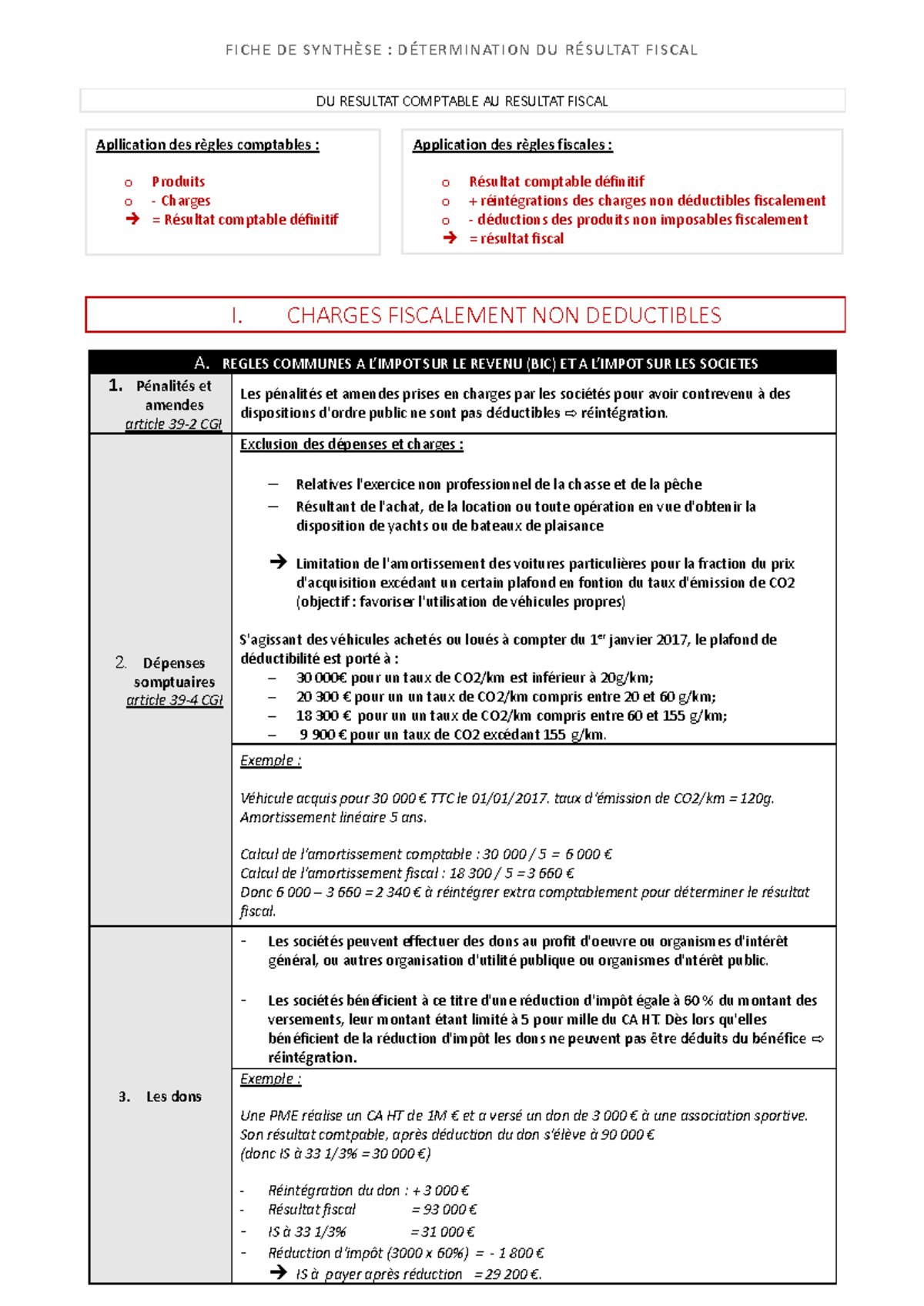
Common examples of reintegrations include:
- Fines and Penalties (
Amendes et Pénalités): The state does not permit a company to reduce its tax liability by deducting penalties for breaking the law (e.g., traffic fines, tax penalties). - Donations and Liberalities (
Dons et Libéralités): Donations are only deductible under very specific conditions set by the tax code. Any donation not meeting these criteria must be reintegrated. - Sumptuary Expenses (
Dépenses Somptuaires): These are considered luxury expenses and are generally not deductible (e.g., costs related to leisure hunting or fishing). - Excess Depreciation (
Amortissements non déductibles): Tax law limits the depreciable value of passenger vehicles. Any depreciation calculated on the value exceeding this limit must be added back.
c) Deductions (Déductions Fiscales)
Deductions are items that can be subtracted from the accounting profit. They typically fall into two categories:
- Non-taxable Revenues (
Produits non imposables): These are revenues that were correctly included in the accounting profit but are exempt from corporate income tax by law. For instance, dividends received from another Moroccan company that has already paid IS on its profits are often exempt to avoid double taxation. - Tax-allowed Deductions not in Accounting: In rarer cases, the tax law may allow for a deduction that has no equivalent in the accounting records.
Since these revenues increased the accounting profit, we subtract them to arrive at the lower, correct taxable profit.
3. From Gross Profit to Net Taxable Profit
After applying the formula Résultat Comptable + Réintégrations - Déductions, we arrive at the Gross Taxable Profit (Résultat Fiscal Brut).
The final step, as shown in the "PASSAGE DU RESULTAT NET COMPTABLE AU RESULTAT NET FISCAL" template, is to account for any past losses.
- Tax Loss Carry-forward (
Report Déficitaire): If a company had a taxable loss (déficit fiscal) in previous years, the tax code allows it to deduct this loss from the current year's taxable profit. This is a crucial mechanism that helps companies recover from difficult periods. This deduction is limited in time (generally, a loss can be carried forward for a few years).
The final formula is:
Net Taxable Profit = Gross Taxable Profit - Prior-Year Taxable Losses Carried Forward
This Net Taxable Profit (Résultat Fiscal Net) is the final base on which the IS rate is applied to calculate the tax due. The entire reconciliation is formalized in a document called the "Tableau de passage", which is a mandatory part of the annual tax filing (liasse fiscale).
Test your understanding!
A Moroccan SME, "ALPHA Services SARL," has an accounting profit before tax of 250,000 DH for the year N.
During your review of their accounts, you identify the following items:
- A late payment penalty paid to the CNSS for 5,000 DH.
- A dividend received from a Moroccan subsidiary for 20,000 DH, which is 100% exempt from IS.
- The company has a taxable loss from year N-1 of 30,000 DH that can be carried forward.
Calculate the Net Taxable Profit (Résultat Fiscal Net) for ALPHA Services for year N.
Show answer
Here is the step-by-step calculation:
-
Start with the Accounting Profit:
Résultat Comptable= 250,000 DH
-
Identify and Sum Reintegrations:
- The CNSS penalty is a non-deductible expense.
- Total
Réintégrations= 5,000 DH
-
Identify and Sum Deductions:
- The exempt dividend is a non-taxable revenue.
- Total
Déductions= 20,000 DH
-
Calculate the Gross Taxable Profit:
Résultat Fiscal Brut=Résultat Comptable+Réintégrations-DéductionsRésultat Fiscal Brut= 250,000 + 5,000 - 20,000 = 235,000 DH
-
Calculate the Net Taxable Profit:
- Subtract the prior-year loss.
Résultat Fiscal Net=Résultat Fiscal Brut-Report DéficitaireRésultat Fiscal Net= 235,000 - 30,000 = 205,000 DH
The Net Taxable Profit, which is the base for calculating the corporate income tax, is 205,000 DH.
Conclusion
In this lesson, you have learned the fundamental mechanism for determining a company's taxable base. This reconciliation process is at the heart of corporate tax compliance.
Key Takeaways:
- Accounting profit and taxable profit serve different purposes and are rarely identical.
- The reconciliation process bridges the gap between them using the formula: Taxable Profit = Accounting Profit + Reintegrations - Deductions.
- Reintegrations are typically non-deductible expenses (like fines) that are added back.
- Deductions are typically non-taxable revenues (like certain dividends) that are subtracted.
- The final Net Taxable Profit is obtained after deducting any allowable prior-year losses (
déficits reportables). - This entire process is documented in the mandatory
Tableau de passage.
Preview of the Next Lesson:
Understanding the process is the first step. The next step is mastering the details. The key to accurate reconciliation is correctly identifying which items to reintegrate or deduct. In our next lesson, we will begin a deep dive into the specific rules for these adjustments. We will start by focusing on permanent differences, such as the fines and penalties we briefly discussed today, to understand why they are permanently non-deductible.