Recommended resources
The freely available resources this lesson will direct you to.
Welcome back. In our previous lessons, we've navigated the essential adjustments needed to transform a company's accounting profit into its taxable profit (Résultat Fiscal). You've learned to identify and treat permanent differences, temporary differences arising from provisions, and, most recently, the crucial adjustments related to depreciation.
Now that we have successfully established the taxable base, we are ready for the pivotal next step. This lesson will focus on applying Morocco's corporate tax rates to this taxable profit. Our learning outcome is to apply the progressive IS rates to the taxable profit to calculate the gross corporate tax. This calculated amount, known as l'Impôt sur les Sociétés brut (gross corporate tax), is the fundamental measure of a company's tax liability for the year, before considering other elements like the minimum tax, which we will cover next.
1. The Progressive Tax System (Barème Progressif)
Morocco applies a progressive tax system for Corporate Income Tax (IS). This means that instead of a single flat rate, the tax rate increases as the profit increases. The taxable profit is divided into slices, or tranches, and a different tax rate is applied to each tranche.
Think of it like filling buckets of different sizes, each with its own tax label. You fill the first, smallest bucket (the first tranche) completely, and that amount is taxed at the lowest rate. Then you pour the rest of your profit into the second bucket, and that portion is taxed at the next rate, and so on, until all your profit is accounted for. The total tax is the sum of the tax from each bucket.
This is a fundamental concept in taxation, contrasting with a "flat tax" system where the entire profit would be taxed at a single rate.
2. Morocco's Corporate Income Tax Rates
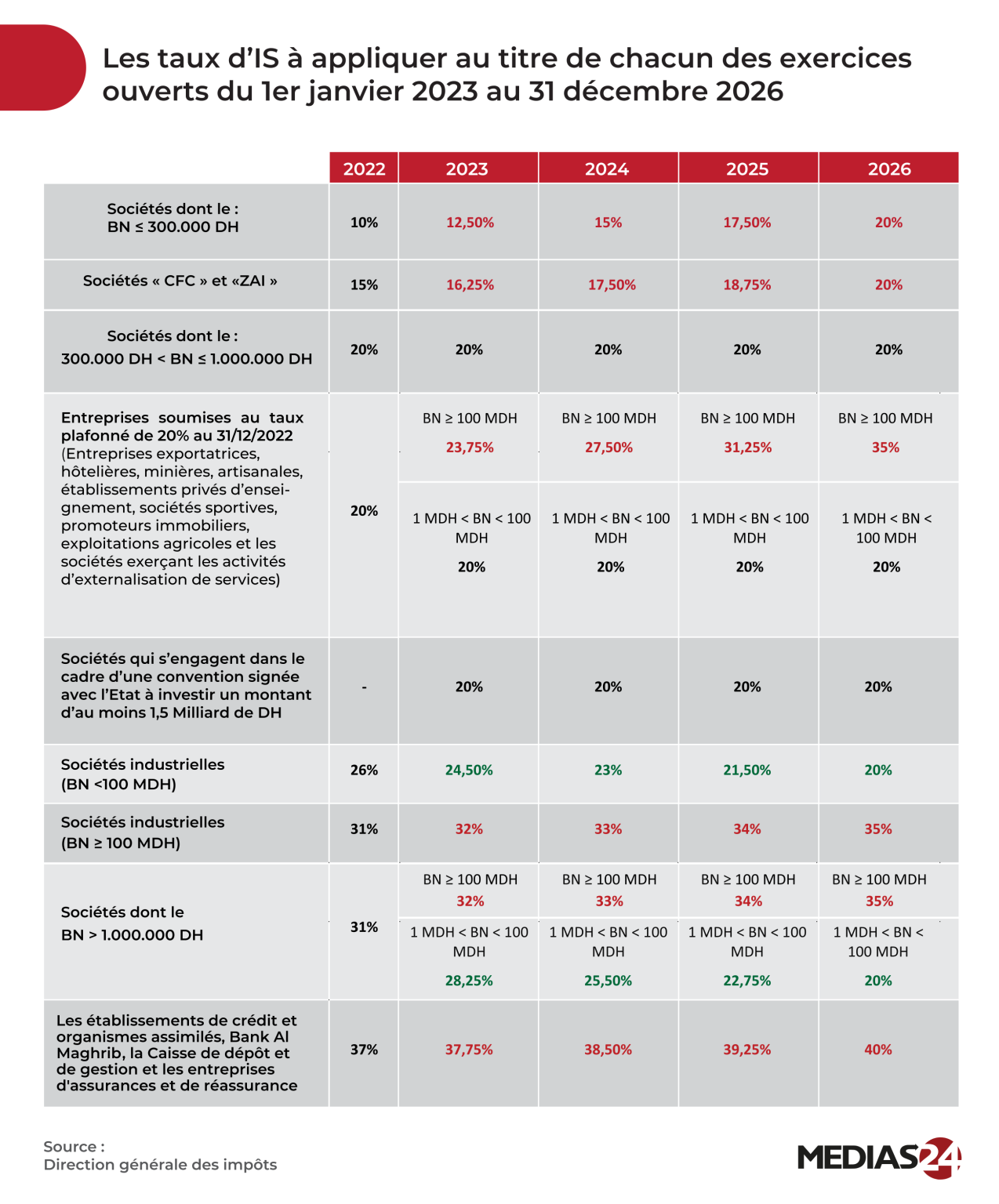
The Moroccan government is in the process of a tax reform (spanning 2023-2026) aimed at gradually standardizing the main corporate tax rate. For now, we operate within a transitional system with several brackets.
To understand these rates, please review the following resource. It provides a clear overview of the rates applicable for standard companies based on their profit levels.
Morocco corporate tax - guide for international expansion
This guide from Wise.com clearly outlines the progressive corporate tax system and the rates that apply to different profit levels for the year 2025. It will give you a quick and direct look at the numbers we'll be working with.
Read the section titled 'Morocco Corporate tax rate in 2025'. Focus on the bulleted list that details the specific tax rates for each profit bracket. Note the different thresholds: MAD 300,000, MAD 1,000,000, and MAD 100,000,000.
Based on this, here is a summary of the standard progressive scale (barème progressif) for IS calculation for a typical SME:
Taxable Profit (Résultat Fiscal) Tranche |
Tax Rate |
|---|---|
| Up to 300,000 DH | 17.5%* |
| From 300,001 DH to 1,000,000 DH | 20% |
| From 1,000,001 DH to 100,000,000 DH | 22.75%* |
| Above 100,000,000 DH | 34%* |
*These rates are part of the transitional phase. The DGI table below shows how they are scheduled to change.
For a more comprehensive and official view, the following image from the Direction Générale des Impôts (DGI) shows the rate evolution from 2023 to 2026 for different types of companies. It confirms the rates above and illustrates the government's goal of converging the main rates to 20% by 2026.
3. Calculating the Gross Corporate Tax (IS Brut)
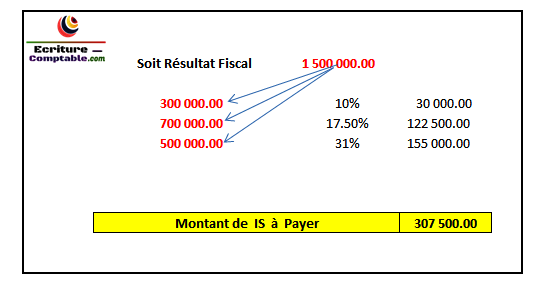
Now, let's apply these rates. The key is to calculate the tax for each tranche separately and then sum the results.
The following image provides a perfect illustration of the method. Crucially, the rates in this image are outdated. We will follow its step-by-step logic but apply the current rates we just learned.
Worked Example
Let's calculate the gross IS for a Moroccan SME with a Résultat Fiscal of 1,500,000 DH.
Step 1: Decompose the taxable profit into the applicable tranches.
- Tranche 1: The first 300,000 DH.
- Tranche 2: The portion between 300,001 DH and 1,000,000 DH.
- Amount in this tranche: 1,000,000 - 300,000 = 700,000 DH.
- Tranche 3: The portion above 1,000,000 DH.
- Amount in this tranche: 1,500,000 - 1,000,000 = 500,000 DH.
Step 2: Apply the correct tax rate to each tranche.
- Tax for Tranche 1: 300,000 DH × 17.5% = 52,500 DH
- Tax for Tranche 2: 700,000 DH × 20% = 140,000 DH
- Tax for Tranche 3: 500,000 DH × 22.75% = 113,750 DH
Step 3: Sum the tax amounts to find the gross corporate tax.
IS Brut= 52,500 + 140,000 + 113,750 = 306,250 DH
So, for a taxable profit of 1,500,000 DH, the gross corporate tax due is 306,250 DH.
Notice the mistake one could make: simply applying the 22.75% rate to the full 1,500,000 DH would give an incorrect result (341,250 DH). The progressive method is essential.
Test your understanding!
A consulting firm, "CONSEIL-PLUS SARL," has finalized its tax adjustments and determined a Résultat Fiscal of 850,000 DH for the year.
Calculate the IS Brut (gross corporate tax) for the company.
Show answer
Step 1: Decompose the profit into tranches.
The profit of 850,000 DH falls into two tranches.
- Tranche 1: The first 300,000 DH.
- Tranche 2: The portion between 300,001 and 850,000 DH.
- Amount in this tranche: 850,000 - 300,000 = 550,000 DH.
Step 2: Apply the rates.
- Tax for Tranche 1: 300,000 DH × 17.5% = 52,500 DH.
- Tax for Tranche 2: 550,000 DH × 20% = 110,000 DH.
Step 3: Sum the results.
IS Brut= 52,500 + 110,000 = 162,500 DH.
Conclusion
In this lesson, you have learned how to take the Résultat Fiscal—the culmination of our previous work on tax adjustments—and calculate the gross corporate tax. This is a non-negotiable skill for any accountant.
Key Takeaways:
- Morocco uses a progressive tax scale (
barème progressif), where higher profit brackets are taxed at higher rates. - The calculation is done by tranches: the taxable profit is broken down into slices, the appropriate rate is applied to each slice, and the results are summed.
- The result of this calculation is the
IS Brut(gross corporate tax), a foundational figure in determining the final tax liability. - The current tax rates are part of a transitional phase, with a general trend towards a unified 20% rate for most SMEs by 2026.
Preview of the Next Lesson:
Is the IS Brut the final amount the company will pay? Not necessarily. Moroccan tax law requires companies to pay at least a minimum amount of tax, regardless of their profit—or even if they make a loss. This is called the Cotisation Minimale (CM), or Minimum Tax.
In our next lesson, we will learn how to calculate the Cotisation Minimale and compare it to the IS Brut we just calculated to determine the final tax due. This comparison is the final step in establishing the definitive corporate tax expense for the year.