Recommended resources
The freely available resources this lesson will direct you to.
- What are KPIs and Metrics? | Data Fundamental for Beginnerswww.youtube.com
- Steps To Define Key Performance Indicators(KPI's) for Data Analystwww.youtube.com
- Key Performance Indicators - Learn How to Set and Measure KPIscorporatefinanceinstitute.com
- How to Analyze a Dataset: 6 Steps - HBS Onlineonline.hbs.edu
Hello, and welcome to the course. We’ll begin with a skill that comes before spreadsheets, SQL, or charts: deciding exactly what a business question asks you to measure. A clear objective gives an analysis a purpose and helps you avoid producing numbers that look useful but do not answer the question.
In this lesson, you’ll turn a finance-related question into one measurable analysis objective. We’ll use a spending example, but the approach also works for revenue, profit, and other business measures. Allow about 35–40 minutes, including the short video and readings.
Start with the decision, not the dashboard
Suppose a manager asks, “Are we spending too much?” It is a reasonable concern, but it is not yet a question you can calculate an answer to. We might mean the whole company or one department. Spending might include every payment or only operating expenses. And too much requires a comparison: too much relative to a budget, a previous period, or something else?
A dashboard can display many numbers without resolving those choices.
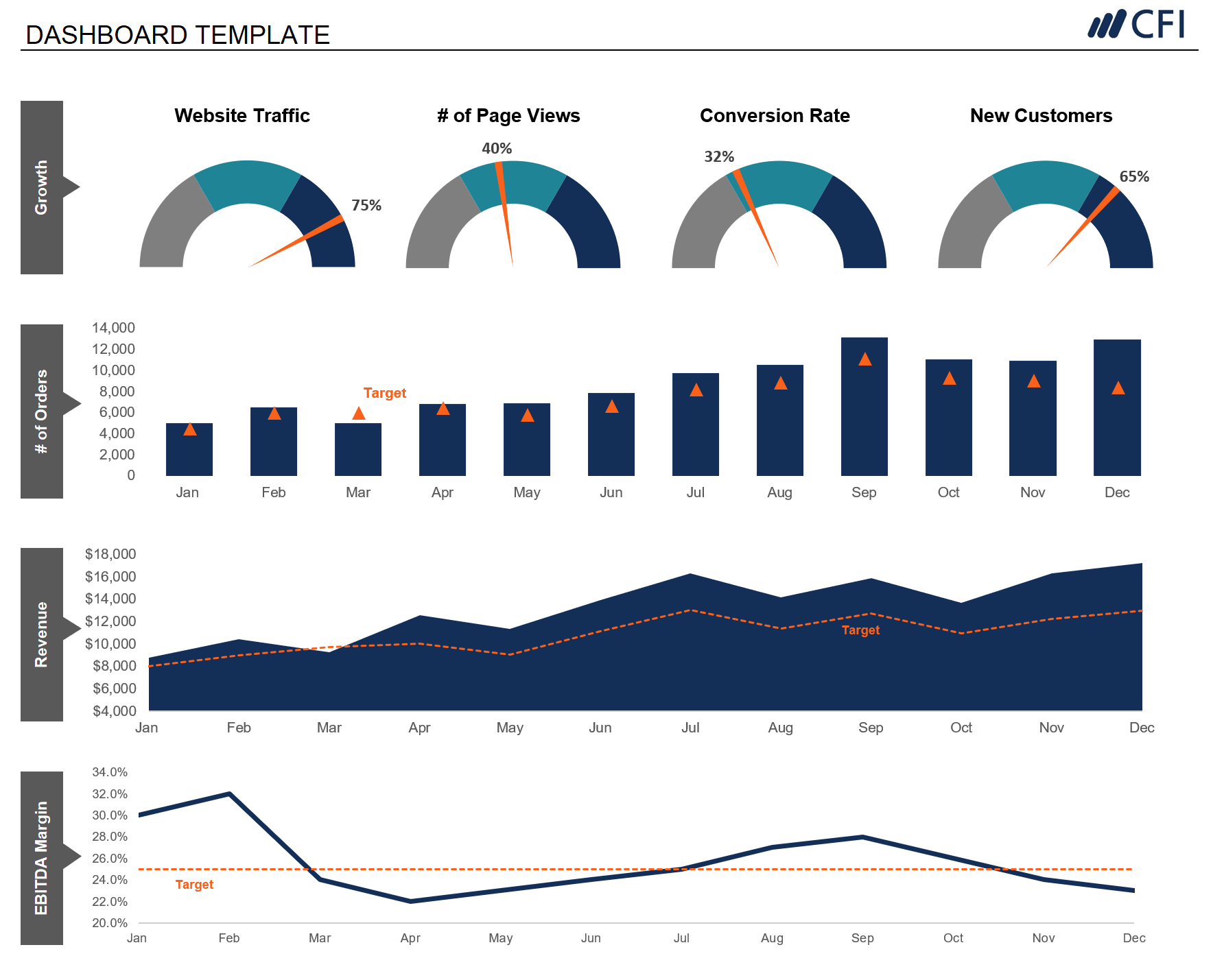
A metric is a quantity you measure, such as monthly revenue. A key performance indicator (KPI) is a metric selected because it tracks progress toward an important goal. The distinction matters here: you do not need to analyze every available metric. You need to select the one that answers the question at hand.
What are KPIs and Metrics? | Data Fundamental for Beginners
Watch What are KPIs and Metrics? | Data Fundamental for Beginners by Alex The Analyst for a beginner-friendly distinction between measurements and goal-related indicators.
Watch metrics for the basic definition and examples, then KPIs for how a metric relates to a goal. Finish with choosing a KPI; focus on why an available measurement is not automatically the right one for a particular objective.
One more distinction will guide the rest of the lesson. A business goal describes what an organization wants to achieve, such as staying within its expense budget. An analysis objective describes the specific measurement you will produce to assess a question about that goal. A target is a value used to judge performance; in our example, the approved budget provides the comparison. Setting a goal and measuring what happened are related, but they are not the same task.
Narrow the question until it can be answered
Harvard Business School Online emphasizes choosing questions that are measurable and tied to a specific business problem. If a request comes from a business team, the analyst should also establish what the team hopes to learn and how it will use the answer.
How to Analyze a Dataset: 6 Steps - HBS Online
Read the section “Identify the Right Questions” in How to Analyze a Dataset: 6 Steps from HBS Online. It explains why a useful analysis question is both measurable and connected to a decision.
Go to “6 Steps to Analyze a Dataset,” then subsection “2. Identify the Right Questions.” Read the two paragraphs, from the instruction to identify important questions through the sentence about deciding which questions take priority. Focus on what you would need to clarify with the person requesting the analysis.
To narrow “Are we spending too much?”, pin down five elements:
- Measure: What exactly counts as spending—operating expenses, for example?
- Scope: Which part of the business—the Sales department, perhaps?
- Period: When—such as January through March 2025?
- Comparison: Too much relative to what—the approved budget for that same period?
- Decision use: What will the answer inform—whether to investigate a budget overrun?
These are not five separate analyses. They are the boundaries of one analysis. Without them, two analysts could answer the manager’s question correctly according to different interpretations and still produce incompatible results.
Write one measurable objective
The Corporate Finance Institute’s guide to KPIs moves from a broad goal toward a defined measure, emphasizing a numerical comparison and a time frame. Those features also make an analysis objective precise.
Key Performance Indicators - Learn How to Set and Measure KPIs
Read the opening steps of Key Performance Indicators - Learn How to Set and Measure KPIs from the Corporate Finance Institute. Pay particular attention to its contrast between a broad ambition and a goal with a number and deadline.
Under “Steps in Developing Actionable KPIs,” read “Step 1: Establish goals” and “Step 2: Establish Critical Success Factors.” The relevant passage starts with establishing goals and ends with the example explaining why “increasing revenues” alone is not specific enough. Focus on the roles of the target number and time frame, rather than memorizing the guide’s terminology.
Here is a workable translation of our manager’s request:
Business question: “Are we spending too much?”
Analysis objective: “Calculate the Sales department’s operating-expense variance from its approved budget, as a percentage of budget, for January–March 2025, to determine whether spending exceeded plan.”
The objective names one primary result: percentage variance from budget. It also specifies whose expenses count, which expenses count, the time period, the comparison, and why the result matters.
For expenses, define the calculation as:
Suppose the Sales department’s approved operating-expense budget for those three months was ₹10 lakh, and its actual operating expense was ₹11 lakh. The variance is:
Under this definition, a positive result means expense was above budget. The answer is therefore: actual operating expense exceeded the approved budget by 10% for the stated scope and period.
That finding supports a decision to investigate the overrun. It does not, by itself, explain why spending was higher or prove that it was wasteful. The approved budget must also be greater than zero for this percentage calculation to work; otherwise, the analyst would need a different way to report the difference.
Check whether the objective is answerable
Writing a precise sentence is only part of the job. Before calculating, check whether the necessary information could be obtained and compared fairly. Our objective needs actual expenses and approved budget figures that refer to the same department, expense definition, currency, and months. Comparing Sales expenses for January–March with a company-wide annual budget would produce a number, but not a meaningful answer to this question.
The word approved also matters. If several budget versions exist, the team needs to agree which one represents the plan. You do not have to solve every data-quality issue while framing the objective; you do need to notice definitions that could change the answer.
A useful final check is to see whether your objective can be completed as a sentence: “For this scope and this period, calculate this measure against this comparison, so that this decision can be informed.” If a blank remains, clarify it before building a report. If the sentence asks for several unrelated measures, choose the one that most directly addresses the immediate business question.
Takeaway
A finance question becomes measurable when you specify one result, its scope, time period, comparison, and decision use. In our example, “Are we spending too much?” became a defined percentage variance for one department and one quarter—not a request for every number on a dashboard.
Next, you’ll look at dataset fields and classify them as identifiers, categories, numbers, or dates. That will help you recognize which fields can supply the measure, scope, and period you have just defined.