Recommended resources
The freely available resources this lesson will direct you to.
Guten Tag! In the last lesson, you practised adjective endings by making the case decision first and then choosing the article–adjective pattern. We now move from accuracy inside noun phrases to accuracy across the whole main clause.
This lesson focuses on a central German word-order pattern: the Satzklammer (“sentence bracket”). You will place the finite verb correctly in position 2 and put the remaining verb element at the end of the main clause. This is essential for clear university emails, seminar discussions, and the language-accuracy tasks in telc C1.
The core principle: finite verb in position 2
A finite verb is the verb form that changes according to person, number, tense, or mood:
- ich muss
- wir müssen
- sie hat
- die Studierenden reichen ... ein
In a normal German main-clause statement, the finite verb takes position 2. Crucially, position 1 is not necessarily one word. It is one sentence element: a subject, a time phrase, an object, or a place phrase.
| Position 1 | Position 2: finite verb | Rest of clause |
|---|---|---|
| Die Studierenden | reichen | den Antrag heute ein. |
| Heute | reichen | die Studierenden den Antrag ein. |
| Den Antrag | reichen | die Studierenden heute ein. |
| Nach dem Seminar | reichen | die Studierenden den Antrag ein. |
Compare the first two sentences carefully:
- Die Studierenden reichen den Antrag heute ein.
- Heute reichen die Studierenden den Antrag ein.
When heute moves to the beginning, the finite verb still stays in position 2. The subject moves behind it. This is ordinary German word order, not a special stylistic inversion.
Read the opening sections of Dartmouth German Studies’ “German Word Order in Main Clauses” for the underlying rule and the idea of a multi-part predicate.
German Word Order in Main Clauses (Hauptsätze)
Read the sections “I.a. The Position of the Finite Verb” and “I.b. Verb Complements.” They establish the two outer points of the German main-clause frame: the finite verb in second position and any additional verb material at the end.
In Section I.a, read from the core V2 explanation. Focus on why Den Hund can stand first without changing the position of the verb. Then read Section I.b from the paragraph beginning “But the predicate can also have more complex structures” through the examples of separable verbs, perfect tense, and modal auxiliaries. Notice that the resource calls the split structure the Satzklammer, and compare each example’s finite verb with its final verb element.
The Satzklammer: a stable verbal frame
When the predicate contains more than one part, German places it around the rest of the clause:
| Left bracket | Middle field | Right bracket |
|---|---|---|
| finite verb in position 2 | subjects, objects, adverbials | final verb element |
For academic German, this pattern is particularly useful:
| Position 1 | Left bracket | Middle field | Right bracket |
|---|---|---|---|
| Die Fakultät | muss | die Frist klar kommunizieren | . |
| Die Fakultät | hat | die Frist klar | kommuniziert. |
| Die Fakultät | gibt | die Ergebnisse morgen | bekannt. |
The middle field can become long. The frame remains reliable:
Am Ende des Semesters müssen die Studierenden ihre vollständigen Unterlagen fristgerecht einreichen.
Even with a long phrase at the beginning, müssen is in position 2 and einreichen closes the clause.
The visual below shows the same frame in several common verb constructions. For this lesson, focus on the first three rows: separable verbs, modal verbs, and Perfekt. The later rows are useful reference material but are not today’s target.
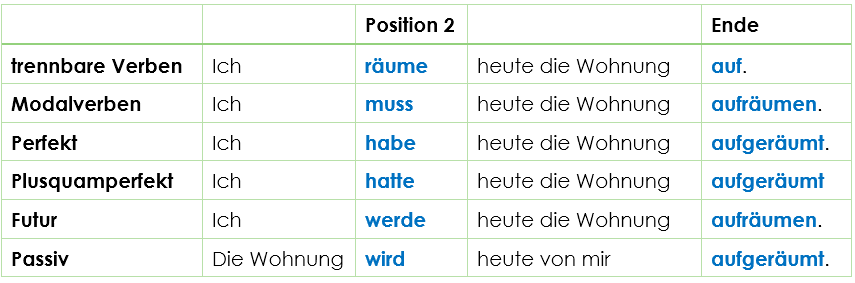
1. Separable verbs: the prefix goes to the end
Many common verbs have a separable prefix:
- anmelden
- einreichen
- vorstellen
- teilnehmen
- aufbauen
- nachfragen
In a simple present or simple past main clause, the conjugated verb stem is finite and goes to position 2. Its separable prefix goes at the end.
| Infinitive | Main clause |
|---|---|
| anmelden | Ich melde mich heute für den Kurs an. |
| einreichen | Die Studierenden reichen ihre Unterlagen ein. |
| vorstellen | Die Dozentin stellt die neue Methode vor. |
| teilnehmen | Viele Erstsemester nehmen an der Einführung teil. |
Treat the two parts as a pair. If you see einreichen, expect reiche ... ein, reichst ... ein, reicht ... ein, and so on.
A frequent error is to keep the infinitive together in a simple main clause:
- Incorrect: Die Studierenden einreichen die Unterlagen.
- Correct: Die Studierenden reichen die Unterlagen ein.
Another frequent error is to put the prefix too early:
- Incorrect: Die Studierenden ein reichen die Unterlagen.
- Correct: Die Studierenden reichen die Unterlagen ein.
The prefix at the end is not an optional extra. It completes the verb’s meaning: reichen and einreichen are not the same verb.
Changing the first position
The same verb frame stays intact when you emphasize time or an object:
- Morgen reichen die Studierenden ihre Unterlagen ein.
- Ihre Unterlagen reichen die Studierenden morgen ein.
- An der Einführung nehmen viele neue Studierende teil.
In each example, find the finite verb first. It is always the second constituent, even though the subject is sometimes later.
2. Modal verbs: modal in position 2, infinitive at the end
Modal verbs include:
- können
- müssen
- sollen
- wollen
- dürfen
- möchten
In the present tense, the modal verb is the finite verb. It therefore takes position 2. The main verb remains in the infinitive and goes at the end.
| Position 1 | Finite modal | Middle field | Infinitive |
|---|---|---|---|
| Ich | muss | die Anmeldung heute | abschicken. |
| Heute | kann | ich die Dozentin nicht | erreichen. |
| Die Studierenden | sollen | die Quellen kritisch | prüfen. |
| Für das Seminar | möchten | wir uns rechtzeitig | anmelden. |
Notice the last example:
Für das Seminar möchten wir uns rechtzeitig anmelden.
The verb anmelden has a separable prefix, but it does not split here. Why? It is an infinitive after möchten, and infinitives remain whole at the right edge of the clause.
Compare these two forms:
- Simple present: Wir melden uns rechtzeitig an.
- With a modal: Wir möchten uns rechtzeitig anmelden.
This contrast is worth memorising as a complete pattern:
| Verb construction | Correct form |
|---|---|
| finite separable verb | Ich melde mich an. |
| modal plus infinitive | Ich muss mich anmelden. |
Do not produce a mixture such as Ich muss mich anmelde an. After a modal verb, use one full infinitive at the end.
Watch this short part of “Basic Word Order in German” by mugridge language. It gives a visual explanation of position 2, then applies the sentence bracket to modal, perfect, and future constructions. Keep your attention on the modal and perfect examples; the future example is simply another illustration of the same frame.
Watch “Basic Word Order in German” by mugridge language to reinforce the two visual anchors: the finite verb in the second slot and the additional verb element at the clause end.
Begin with position 2, where the speaker shows why a multiword phrase such as am Samstag still counts as one first-position element. Then watch the final verb for the basic sentence-bracket pattern. Continue with worked examples. Listen especially for the modal construction and the perfect-tense construction; pause after each example and identify the left and right sides of its verbal frame.
3. Perfect tense: auxiliary in position 2, participle at the end
In the Perfekt, German uses a finite auxiliary, usually haben or sein, plus a Partizip II:
- Ich habe die Nachricht gelesen.
- Die Ergebnisse sind angekommen.
The auxiliary is finite, so it stands in position 2. The past participle goes at the end.
| Position 1 | Finite auxiliary | Middle field | Partizip II |
|---|---|---|---|
| Die Verwaltung | hat | die Anfrage gestern | beantwortet. |
| Gestern | haben | wir die Ergebnisse | besprochen. |
| Die neuen Zugangsdaten | sind | am Montag | angekommen. |
| Nach dem Gespräch | habe | ich den Antrag | eingereicht. |
The final participle is especially important when the middle field is long:
Nach der ausführlichen Beratung hat die Studieninteressierte alle erforderlichen Unterlagen fristgerecht eingereicht.
A useful editing habit is to locate the auxiliary first:
- hat tells you that a past participle should appear later.
- sind tells you that a past participle should appear later.
- The participle normally completes the main clause’s verbal frame.
Separable verbs in the perfect tense
With separable verbs, the prefix reunites with the verb in the past participle:
| Infinitive | Simple present | Perfekt |
|---|---|---|
| einreichen | Sie reicht den Antrag ein. | Sie hat den Antrag eingereicht. |
| anmelden | Er meldet sich an. | Er hat sich angemeldet. |
| vorstellen | Die Gruppe stellt das Projekt vor. | Die Gruppe hat das Projekt vorgestellt. |
So distinguish these three forms of the same separable verb:
- Infinitive: einreichen
- Finite simple-present form: reicht ... ein
- Past participle: eingereicht
In the participle, ge- usually stands between the separable prefix and the verb stem: an-ge-meldet, ein-ge-reicht, vor-ge-stellt.
For a focused explanation of word order in the perfect tense, use the final portion of YourGermanTeacher’s “German Perfect Tense | Das Perfekt mit ‘haben’.”
German Perfect Tense | Das Perfekt mit "haben" | German Tenses
Watch this segment from YourGermanTeacher for a direct walkthrough of perfect-tense word order in statements and questions. It is useful because it separates the task of choosing the auxiliary from the task of placing the past participle.
Watch perfect word order. Focus on the repeated frame: conjugated auxiliary in position 2 in a statement, information in the middle, and the participle in the final position. The question forms are optional review; your priority is accurate main-clause statements.
A practical method for producing correct main clauses
When you formulate a sentence, build the verb frame before filling the middle. This is faster than translating word by word from English.
Step 1: Decide what is finite
Ask: Which verb changes for the subject?
- Die Studierenden müssen ... einreichen.
- Die Studierenden haben ... eingereicht.
- Die Studierenden reichen ... ein.
Step 2: Put one complete element in position 1
Choose what you want to foreground:
- subject: Die Studierenden ...
- time: Heute ...
- object: Die Unterlagen ...
- place: In der Sprechstunde ...
Step 3: Put the finite verb immediately after it
- Heute müssen ...
- Die Unterlagen haben ...
- In der Sprechstunde stellt ...
Step 4: Reserve the final position for the matching verb element
| If the construction contains ... | Put at the end ... |
|---|---|
| a separable finite verb | its prefix: stellt ... vor |
| a modal verb | the infinitive: muss ... vorbereiten |
| haben or sein in Perfekt | the past participle: hat ... vorbereitet |
For example, start with the idea “The students submit the documents today.”
- The verb is einreichen.
- In a simple present main clause, reichen is finite.
- Put Die Studierenden first.
- Put reichen second and ein at the end.
Die Studierenden reichen die Unterlagen heute ein.
Now make the sentence perfect:
- The auxiliary haben becomes finite.
- The participle is eingereicht.
- The participle must close the clause.
Die Studierenden haben die Unterlagen heute eingereicht.
Now add a modal:
- The modal müssen becomes finite.
- The full infinitive einreichen goes at the end.
Die Studierenden müssen die Unterlagen heute einreichen.
The content barely changes; the grammatical frame does.
Common errors to catch in your own writing
These errors are common around B1 and remain costly in formal writing because they make a sentence harder to process.
| Intended meaning | Incorrect | Correct | Reason |
|---|---|---|---|
| Modal verb | Heute ich muss den Antrag einreichen. | Heute muss ich den Antrag einreichen. | The finite modal must be in position 2. |
| Separable verb | Die Universität bekanntgibt die Frist. | Die Universität gibt die Frist bekannt. | The prefix goes to the end when the verb is finite. |
| Perfect | Wir haben gestern besprochen das Thema. | Wir haben das Thema gestern besprochen. | The participle closes the normal main clause. |
| Modal plus separable verb | Wir müssen uns morgen an melden. | Wir müssen uns morgen anmelden. | The infinitive remains whole at the end. |
| Perfect of a separable verb | Ich habe den Antrag ein gereicht. | Ich habe den Antrag eingereicht. | The participle is one word. |
For real-life practice, use short messages you might genuinely send or say in Germany. Transform one message through all three patterns:
- Ich melde mich für den Workshop an.
- Ich möchte mich für den Workshop anmelden.
- Ich habe mich für den Workshop angemeldet.
Say each sentence aloud once with a time expression first:
- Heute melde ich mich ...
- Heute möchte ich mich ...
- Heute habe ich mich ...
This trains the crucial movement: the subject shifts after the finite verb, while the final verb element stays anchored at the end.
Key takeaways
A German main clause has a dependable verbal frame:
- The finite verb is in position 2.
- Position 1 can be a whole phrase, not just one word.
- If something other than the subject is first, the subject usually follows the finite verb.
- With a separable verb, the prefix stands at the end: Sie stellt das Projekt vor.
- With a modal verb, the infinitive stands at the end: Sie muss das Projekt vorstellen.
- In the Perfekt, the past participle stands at the end: Sie hat das Projekt vorgestellt.
Use the question “What is finite?” before you write. Once that verb is securely in position 2, reserve the right edge of the clause for the remaining verb element.
In the next lesson, you will apply the same idea to subordinate clauses, where the verbal frame changes: the finite verb no longer occupies position 2, and verb groups gather at the end.