Recommended resources
The freely available resources this lesson will direct you to.
Hello! Welcome back to our second module on financing and leverage.
In our last lesson, we mastered the calculation of the monthly mortgage payment, or debt service, which is a key cash outflow for any leveraged real estate investment. Now, we'll answer the question that precedes this: how much can you actually borrow?
This lesson will focus on the Loan-to-Value (LTV) ratio, a fundamental metric that lenders use to decide the maximum loan amount they will offer. By the end of this lesson, you will be able to calculate the LTV ratio and, more importantly, understand its significant implications for financing your investments in the Spanish market.
1. What is the Loan-to-Value (LTV) Ratio?
At its core, the Loan-to-Value ratio is a simple percentage that expresses the relationship between the loan amount and the property's value. It's a primary measure of risk for lenders. A higher LTV indicates that the borrower has less "skin in the game" (equity), which represents a higher risk for the bank.
Loan to Value LTV: How Lenders Decide How Much You Can Borrow
To start, let's watch a quick overview of the LTV concept. This video provides a clear, high-level introduction.
Watch the first 53 seconds of the video. The host explains the basic concept and presents the formula.
The formula for LTV is straightforward:
For example, if you get a €160,000 loan to buy a property valued at €200,000, the LTV is 80%.
As the calculation is a simple ratio, the main complexity, especially in Spain, lies in determining the correct "Value" to use in the denominator.
2. The "Value" in LTV: A Critical Spanish Distinction
When applying for a mortgage in Spain, you will encounter two key figures:
- Valor de Compra (Purchase Price): The price you and the seller agree upon for the property.
- Valor de Tasación (Appraisal Value): An objective value estimated by a professional, independent appraiser (
tasador) hired by the bank. This appraisal considers the property's location, condition, size, and recent sales of comparable properties.
So, which value does the bank use for the LTV calculation? This is a crucial point. In Spain, banks will almost always use the lower of the two values to calculate the maximum loan amount.
Hipoteca sobre valor de tasación o valor de compra
The article 'Hipoteca sobre valor de tasación o valor de compra' from Openbank provides an excellent breakdown of this topic from a Spanish bank's perspective. It explains the scenarios you might face as a buyer.
Please read the sections '¿Cuál es la diferencia entre valor de tasación y valor de mercado?', '¿Qué implica que la tasación esté por encima del valor de compra?', and '¿Qué ocurre cuando la tasación se encuentra por debajo del valor de compra?'. Focus on how the relationship between these two values impacts the financing you can obtain.
Let's illustrate with two scenarios, assuming the bank's policy is to finance a maximum of 80% LTV.
Scenario A: Appraisal Value ≥ Purchase Price (Favorable)
- Purchase Price: €200,000
- Appraisal Value: €210,000
- Lower of the two values: €200,000
- Maximum Loan: 80% of €200,000 = €160,000
- Your Down Payment (
Entrada): €200,000 (price) - €160,000 (loan) = €40,000 (+ transaction costs)
In this case, things go as planned. You secure a loan for 80% of what you paid.
Scenario B: Appraisal Value < Purchase Price (Unfavorable)
- Purchase Price: €200,000
- Appraisal Value: €190,000
- Lower of the two values: €190,000
- Maximum Loan: 80% of €190,000 = €152,000
- Your Down Payment (
Entrada): €200,000 (price) - €152,000 (loan) = €48,000 (+ transaction costs)
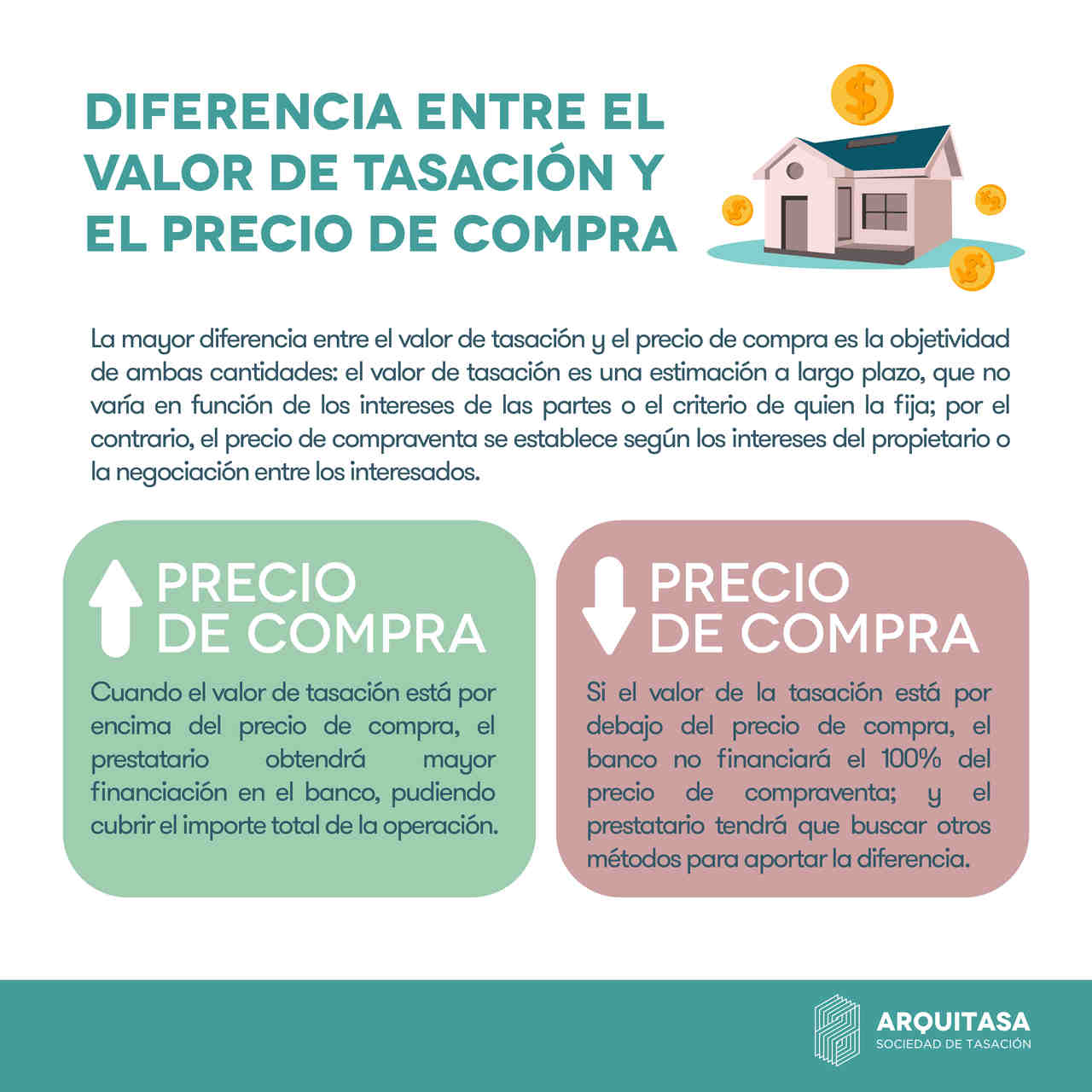
Notice that because the appraisal came in low, the bank lends you less money, and you must contribute an additional €8,000 in cash to complete the purchase. This is a common pitfall for buyers who overpay relative to the market value.
This infographic neatly summarizes the dynamic:
3. Implications of LTV for Your Investment
The LTV ratio is not just a hoop to jump through; it has profound effects on your investment's financial structure and performance.
¿Qué es el 'Loan to Value' o LTV en una hipoteca y cómo ...
This article from Tinsa, a leading Spanish appraisal company, explains why LTV is so important to banks and mentions the typical LTV levels you can expect in Spain.
Read the sections '¿Qué es el LTV en una hipoteca?' and '¿Por qué es tan importante el LTV para el banco?'. Pay attention to the typical LTV percentages for first and second homes and the reference to the Bank of Spain.
As the Tinsa article highlights, you can generally expect:
- Primary Residence: Up to 80% LTV is common.
- Second Home / Investment Property: LTV is typically lower, often in the 60% - 70% range, as banks view these as higher-risk loans.
Here’s how LTV directly impacts your investment:
- Required Capital: A lower LTV means the bank lends less, so you must provide a larger down payment. This directly affects how much capital you need to enter a deal.
- Loan Conditions: A higher LTV is riskier for the bank. To compensate, they may charge a higher interest rate (TIN). Conversely, offering a larger down payment (lower LTV) can sometimes help you negotiate better loan terms.
- Cash Flow: A smaller loan means a smaller monthly mortgage payment. This has a powerful, positive effect on your property's monthly cash flow.
The following table demonstrates this relationship clearly. Assume you buy a property for €150,000 that generates €750/month in Net Operating Income (NOI).

As you can see, the investor with a 50% LTV has a monthly cash flow of €389, while the highly-leveraged investor at 80% LTV only cash flows €128 per month. This is the fundamental trade-off of leverage: a higher LTV requires less initial cash but increases risk and squeezes cash flow.
Test your understanding!
You are analyzing an investment property in Spain.
- Agreed Purchase Price: €300,000
- Bank's Appraisal Value (
Tasación): €285,000 - Bank's Policy: Maximum 70% LTV for investment properties.
How much is the maximum loan the bank will offer, and what is the minimum down payment you must provide (excluding transaction costs)?
Show answer
-
Determine the value basis: The bank uses the lower of the purchase price (€300,000) and the appraisal value (€285,000). So, the basis for the LTV calculation is €285,000.
-
Calculate the maximum loan amount: 70% of €285,000 = €199,500.
-
Calculate the minimum down payment: This is the difference between the purchase price and the loan. €300,000 - €199,500 = €100,500.
Even though the bank's policy is 70% LTV, in this scenario you are effectively making a down payment of €100,500 / €300,000 = 33.5% of the purchase price.
4. Modeling LTV in Python
The calculation is simple, but we can create a small function to keep it consistent with our modeling approach. This function will incorporate the Spanish market rule we've discussed.
def calculate_loan_details_es(purchase_price: float, appraisal_value: float, max_ltv_policy: float) -> dict:
    """
    Calculates maximum loan and required down payment based on Spanish lending rules.

    Args:
        purchase_price (float): The agreed purchase price of the property.
        appraisal_value (float): The bank's official appraisal value.
        max_ltv_policy (float): The bank's maximum LTV ratio (e.g., 0.7 for 70%).

    Returns:
        dict: A dictionary with the loan basis, max loan amount, and down payment.
    """
    # In Spain, the loan is based on the lower of the two values
    loan_basis = min(purchase_price, appraisal_value)

    max_loan_amount = loan_basis * max_ltv_policy

    # The down payment is the difference between the price you pay and the loan you get
    down_payment = purchase_price - max_loan_amount

    return {
        "loan_basis_value": loan_basis,
        "max_loan_amount": max_loan_amount,
        "down_payment": down_payment,
        "effective_ltv_on_price": (max_loan_amount / purchase_price)
    }

# --- Using the function with the exercise's data ---
price = 300000
tasacion = 285000
ltv_policy = 0.70

details = calculate_loan_details_es(price, tasacion, ltv_policy)

print("--- LTV & Financing Calculation (Spain) ---")
print(f"Purchase Price:       €{price:,.2f}")
print(f"Appraisal Value:      €{tasacion:,.2f}")
print(f"Bank LTV Policy:      {ltv_policy:.0%}")
print("-------------------------------------------")
print(f"Loan Basis (Lower of):€{details['loan_basis_value']:,.2f}")
print(f"Maximum Loan Amount:  €{details['max_loan_amount']:,.2f}")
print(f"Required Down Payment:€{details['down_payment']:,.2f}")
This function encapsulates the key logic and can be integrated into the larger property analysis model we are gradually building.
Conclusion
Today we've demystified the Loan-to-Value ratio and adapted it to the specific rules of the Spanish real estate market.
Key Takeaways:
- LTV is the ratio of the loan amount to the property's value, used by banks to measure risk.
- In Spain, the "Value" is critically defined as the lower of the purchase price or the official appraisal value (
tasación). - A lower LTV generally means a larger down payment, a smaller mortgage payment, and higher monthly cash flow, but requires more initial capital.
- For investment properties in Spain, expect to secure an LTV in the 60-70% range, requiring a down payment of 30-40% plus transaction costs.
Preview of the Next Lesson:
We have now covered a property's income (NOI), its primary financing cost (debt service), and how the loan amount is determined (LTV). In the next lesson, we will combine these elements to calculate our first key performance metric: Cash Flow After Financing (Pre-Tax Cash Flow). This will give us our first real look at how much money a property puts in our pocket each month.