Recommended resources
The freely available resources this lesson will direct you to.
Hello again. Last lesson ended at the political crisis of : James II fled after William of Orange intervened, beginning the Glorious Revolution. This lesson follows the longer consequences of that moment, from a monarchy increasingly constrained by Parliament to the diverse, democratic United Kingdom of today.
Because you have limited preparation time, treat this as a visual timeline with six layers, rather than as a long list of dates. On paper, draw one line from to the present and use these compact labels:
- CON — constitution, monarchy, and the Union
- VOTE — parliamentary reform and suffrage
- IND — industrialisation
- EMP — empire, Ireland, and Commonwealth
- WAR — world wars
- SOC — social change and modern Britain
For every entry, write only: date — event — why it matters. The final annotation is what turns a fact into an exam answer.
1. to : Parliament, Union, and a changing state
The Glorious Revolution did not abolish the monarchy. Instead, it changed the terms on which a monarch could govern. William III and Mary II became joint monarchs in , and Parliament passed the Bill of Rights that year.
Bill of Rights 1689 - UK Parliament
Read the UK Parliament’s concise explanation of the Bill of Rights. It supplies the core constitutional consequence of the Glorious Revolution: royal power was limited and Parliament’s position was strengthened.
In the section “Bill of Rights 1689,” read from the opening explanation. Focus especially on frequent Parliaments, free elections, freedom of speech in Parliament, taxation requiring Parliament’s agreement, and the right to petition.
For the test, do not claim that the Bill of Rights created full democracy. Most people still had no vote. Its significance is narrower and more precise: the monarch could not suspend laws, raise taxes, or maintain an army without Parliament’s consent. It reinforced the principle that government must operate through law and Parliament.
Add these entries:
| Date | Timeline annotation |
|---|---|
| 1688 | CON — Glorious Revolution: James II was removed; William and Mary were invited to rule. It marked a decisive rejection of unchecked royal power. |
| 1689 | CON — Bill of Rights: strengthened Parliament and limited the monarch’s power over laws, taxation, and elections. |
| 1701 | CON — Act of Settlement: ensured that the monarch would be Protestant. This shaped the succession after Queen Anne. |
| 1707 | CON — Acts of Union: England and Scotland united politically as the Kingdom of Great Britain, with one Parliament at Westminster. Scotland retained its distinct legal and education systems. |
| 1714 | CON — George I: the first Hanoverian king succeeded Queen Anne, under the Protestant succession rules. |
| c. 1721 | CON — Robert Walpole: generally regarded as Britain’s first Prime Minister. |
A crucial map-and-name distinction:
- From 1707, England and Scotland formed Great Britain.
- In 1801, Great Britain and Ireland formed the United Kingdom of Great Britain and Ireland.
- Most of Ireland left the UK in 1922; Northern Ireland remained. That produced the UK’s modern territorial form.
The eighteenth century also saw Britain become deeply involved in global trade, warfare, colonisation, and the transatlantic slave trade. The wealth and power associated with empire cannot be separated from violence, coercion, and exploitation, including the enslavement of African people.
| Date | Timeline annotation |
|---|---|
| 1776 | EMP — American Declaration of Independence: thirteen colonies declared independence from Britain. |
| 1783 | EMP — American War of Independence ends: Britain recognised the independence of the United States. |
| 1801 | CON / EMP — Act of Union: Ireland joined Great Britain, creating the United Kingdom of Great Britain and Ireland. |
| 1807 | EMP — Slave Trade Act: Parliament abolished the British slave trade. This did not yet abolish slavery across the empire. |
| 1833 | EMP / SOC — Slavery Abolition Act: abolished slavery in most of the British Empire. |
Common test trap: concerns the slave trade; concerns the abolition of slavery in most of the empire.
2. to : industrialisation, empire, and expanding political participation
Industrialisation began in Britain in the late eighteenth century. It was not one invention or one date, but a connected transformation in how goods, energy, transport, and labour were organised. Textile machinery, coal, iron, steam power, canals, and railways enabled production at a far larger scale than home-based craft work.
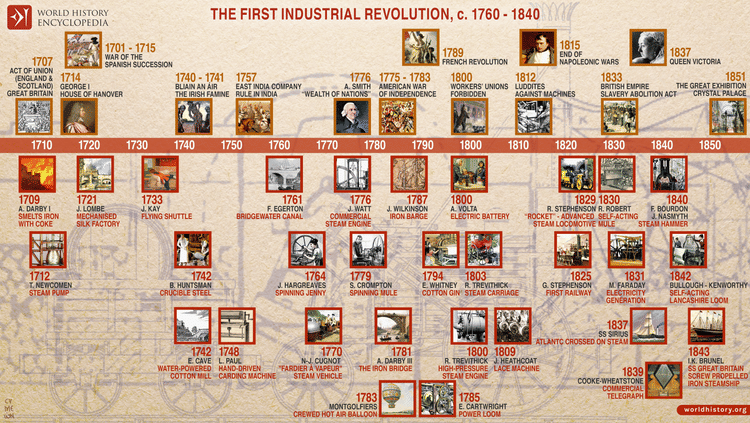
Use the image as a visual cluster rather than attempting to memorise every invention. Notice how industrial change is concentrated from roughly to , while political reform and imperial expansion occur alongside it.
| Date or era | Timeline annotation |
|---|---|
| c. 1760–1840 | IND — Industrial Revolution: factories, steam power, coal, iron, and mechanised textile production transformed Britain. |
| 1770s | IND — James Watt’s steam engine: improvements made steam power far more useful in industry and transport. |
| 1825 | IND — Stockton and Darlington Railway: first public railway to use steam locomotives. |
| 1830 | IND — Liverpool and Manchester Railway: demonstrated the commercial potential of passenger rail travel. |
The Industrial Revolution brought productivity and wealth, but it also produced severe overcrowding, dangerous work, pollution, and child labour. Many people moved from rural areas to rapidly expanding towns and cities. This is why nineteenth-century Britain is often remembered as both an age of invention and an age of stark inequality.
Political reform followed slowly. Before the nineteenth century, parliamentary representation was highly unequal: some “rotten boroughs” had very few voters, while new industrial towns lacked fair representation. The vote was based on property and was limited almost entirely to men.
Read this UK Parliament timeline as a focused reference for the Union, the Reform Acts, Chartism, women’s suffrage, and the voting age. It is especially useful for distinguishing reforms that sound similar.
In the “Key dates” list, start at the 1707 entry, and read through the 1969 voting-age reform. Make two passes: first identify each date; then identify exactly who gained the vote or what changed in elections.
Build this VOTE section of your timeline:
| Date | Timeline annotation |
|---|---|
| 1832 | VOTE — First Reform Act: removed many rotten boroughs, redistributed seats to growing towns, and extended the vote to more men with property. It did not give working-class men or women a general vote. |
| 1838 | VOTE — People’s Charter: Chartists demanded political reform, including votes for all adult men, secret ballots, and equal constituencies. |
| 1867 | VOTE — Second Reform Act: extended the vote to many urban working men. |
| 1872 | VOTE — Ballot Act: introduced the secret ballot, reducing intimidation and bribery. |
| 1884 | VOTE — Third Reform Act: extended the vote to many male householders in rural areas. |
| 1918 | VOTE — Representation of the People Act: gave the vote to all men over and most women over . |
| 1928 | VOTE — Equal Franchise Act: gave women the vote on the same terms as men, at age . |
| 1969 | VOTE — Representation of the People Act: reduced the voting age to . |
The reform story is a gradual widening of political participation, not a single democratic breakthrough. A useful memory sequence is:
- 1832 — property-owning men gain a wider vote.
- 1867 and 1884 — many working-class men gain the vote.
- 1918 and 1928 — women gain first partial, then equal voting rights.
- 1969 — voting age becomes .
Britain’s empire expanded significantly during the nineteenth century. India became particularly central after the Indian Rebellion of , after which the British Crown took direct control from the East India Company. In , Queen Victoria became Empress of India. At its greatest extent after the First World War, the British Empire governed territories across every inhabited continent.
For an exam timeline, use this restrained annotation:
| Date | Timeline annotation |
|---|---|
| 1857–58 | EMP — Indian Rebellion and Crown rule: after rebellion against the East India Company, India came under direct British government control. |
| 1877 | EMP — Victoria becomes Empress of India: symbolised India’s central place in the British Empire. |
| Victorian era, 1837–1901 | IND / EMP / SOC — Victorian Britain: industrial cities, railways, reform, global empire, and major social inequalities developed together. |
3. to : world wars, Ireland, and a changing society
The world wars are high-value test territory because they connect military events, political leadership, women’s roles, Ireland, and the decline of empire.
| Date | Timeline annotation |
|---|---|
| 1914–18 | WAR — First World War: Britain fought with its allies against Germany and its allies. Trench warfare caused immense casualties. |
| 11 November 1918 | WAR — Armistice: fighting stopped; this is commemorated as Remembrance Day. |
| 1922 | EMP / CON — Irish Free State: most of Ireland left the UK. Northern Ireland remained part of the UK. |
| 1926 | SOC — General Strike: workers supported coal miners in a major dispute over pay and conditions. |
| 1939–45 | WAR — Second World War: Britain fought Nazi Germany and its allies. |
| 1940 | WAR — Dunkirk, Battle of Britain, and the Blitz: Britain resisted German attack; Winston Churchill was Prime Minister during much of the war. |
| 1944 | WAR — D-Day: Allied forces landed in Normandy, beginning the liberation of western Europe. |
| 1945 | WAR — Allied victory in Europe: the war in Europe ended in May; the conflict with Japan ended later that year. |
Two distinctions matter:
- The First World War: –, often associated with trenches and the Western Front.
- The Second World War: –, associated with the Blitz, the Battle of Britain, Churchill, D-Day, and the Holocaust.
Women took on a much wider range of paid work during both wars, including roles in factories, transport, agriculture, and public services. This did not single-handedly create women’s suffrage, but it formed part of the broader social transformation that made the pre-war political order increasingly untenable.
The Second World War also accelerated the end of empire. Britain emerged victorious but economically weakened, while independence movements in colonial territories gained momentum.
4. to the present: welfare, immigration, devolution, and constitutional change
Post-war Britain was rebuilt around the idea that government should provide greater social security. The Labour government elected in created major parts of the modern welfare state.
| Date | Timeline annotation |
|---|---|
| 1947 | EMP — India gains independence: a decisive step in the end of the British Empire. |
| 1948 | SOC — National Health Service begins: the NHS provided healthcare funded through taxation and free at the point of use. |
| 1948 | SOC — Empire Windrush arrives: Caribbean passengers arrived in Britain amid post-war labour shortages; this became a major symbol of modern multicultural Britain. |
| 1949 | EMP / CON — Republic of Ireland: Ireland left the Commonwealth; Northern Ireland remained in the UK. |
| 1952 | CON — Elizabeth II becomes Queen: she reigned until her death in . |
| 1973 | CON / ECONOMY — UK joins the European Economic Community: the organisation that later became the European Union. |
| 1979 | SOC / POLITICS — Margaret Thatcher becomes Prime Minister: Britain’s first female Prime Minister. |
| 1997 | POLITICS — Labour landslide: Tony Blair became Prime Minister; devolution was a central reform agenda. |
| 1998 | CON — Good Friday Agreement: supported peace in Northern Ireland and created the basis for devolved institutions there. |
| 1999 | CON — Scottish Parliament and Welsh Assembly begin work: powers were devolved from Westminster. |
| 2016 | CON — EU referendum: a majority voted for the UK to leave the European Union. |
| 2020 | CON — UK leaves the EU: the UK formally left the European Union. |
| 2022 | CON — Elizabeth II dies; Charles III becomes King: the modern monarchy changed reign. |
| 2023 | CON — Coronation of Charles III: formal coronation ceremony took place in Westminster Abbey. |
The post-war timeline has three connected stories.
The welfare state
The NHS, founded in , is the most frequently tested institution from this period. It was created as part of a broader welfare settlement that also included expanded social security, education, and public housing.
Migration and multicultural Britain
Post-war labour shortages encouraged migration from Commonwealth countries. The arrival of HMT Empire Windrush in became an important symbol of this period, though migration involved many communities and continued across later decades. Modern Britain’s cultural, religious, linguistic, and racial diversity is inseparable from these histories of empire, Commonwealth, work, and migration.
Devolution and the UK’s changing structure
Devolution did not break up the UK. It transferred specific powers from the UK Parliament at Westminster to institutions in Scotland, Wales, and Northern Ireland. Parliament at Westminster remains the UK’s sovereign Parliament, while devolved bodies make decisions in areas such as education, health, and transport within their respective nations.
Keep the sequence clear:
| Event | What it changed |
|---|---|
| 1707 Acts of Union | England and Scotland became Great Britain. |
| 1801 Act of Union | Great Britain and Ireland formed the United Kingdom of Great Britain and Ireland. |
| 1922 Irish Free State | Most of Ireland left the UK; Northern Ireland remained. |
| 1998–99 devolution | Scotland, Wales, and Northern Ireland gained devolved institutions and powers. |
| 2016–20 Brexit | The UK voted to leave, then formally left, the European Union. |
Your final one-page timeline
Your completed version does not need every date in this lesson. These are the essential anchors to reproduce from memory:
- 1688 — Glorious Revolution
- 1689 — Bill of Rights
- 1707 — Acts of Union: Great Britain
- 1801 — Ireland joins Great Britain: United Kingdom
- 1807 / 1833 — slave trade abolished / slavery abolished in most of empire
- c. 1760–1840 — Industrial Revolution
- 1832 — First Reform Act
- 1838 — Chartists and People’s Charter
- 1867 / 1884 — further male suffrage reform
- 1872 — secret ballot
- 1914–18 — First World War
- 1918 / 1928 / 1969 — wider suffrage, equal voting rights for women, voting age
- 1922 — Irish Free State; Northern Ireland stays in UK
- 1939–45 — Second World War
- 1948 — NHS and Empire Windrush
- 1947 onward — decolonisation, beginning with Indian independence
- 1998–99 — Good Friday Agreement and devolution
- 2016 / 2020 — EU referendum and departure from the EU
- 2022 / 2023 — Charles III succeeds Elizabeth II and is crowned
For a fast retrieval routine, cover the “why it matters” side of your timeline. Say each event’s significance aloud in one sentence, then uncover it to check. This is more efficient than repeatedly rereading the dates.
Key takeaways
From onward, the history is best understood as several overlapping changes:
- The Bill of Rights strengthened Parliament and limited the monarch.
- The Acts of Union created Great Britain in , while the union with Ireland and Ireland’s later partition explain the UK’s present shape.
- Industrialisation made Britain a manufacturing and urban society, while also creating harsh working and living conditions.
- Electoral reform gradually expanded the vote, culminating in equal voting rights for women and a voting age of .
- The world wars reshaped British society, weakened empire, and helped lead to the post-war welfare state.
- The NHS, Commonwealth migration, devolution, Brexit, and the accession of Charles III are central parts of modern UK history.
Next, you will shift from historical change to the modern facts often tested directly: culture, customs, religions, sport, literature, science, landmarks, and national achievements.