Recommended resources
The freely available resources this lesson will direct you to.
Hello! You have already chosen a challenging activity, broken it into manageable steps, and learned a breathing routine to use before you begin. The next challenge is consistency: a single attempt can feel important, but confidence grows more reliably when you have repeated chances to act and learn.
In this final lesson of the confidence module, you will create a weekly deliberate-practice plan. It will specify what to practise, when to do it, and what to record afterward. The central measure will be attempts made, not flawless performances. Allow about 40 minutes, including time to draft your own plan.
Give each attempt a purpose
Suppose your goal is to explain an idea aloud to another person. “Become a confident speaker” is a useful direction, but it does not tell you what to do on Tuesday. “Practise pausing after my main point during a one-minute explanation” gives you a skill to work on and something observable to notice.
This is the distinction between a product goal—a desired result—and a process goal, which describes an act of practice or performance. The result matters, but it may depend on factors you do not control. You can choose whether to begin an explanation, practise a pause, and review what happened; you cannot guarantee that every listener will respond enthusiastically.
Read the following short passages with that distinction in mind.
Goal setting increases motivation and performance.
Read this Psychology Today article for its distinction between process and product goals, and its guidance on making a practice goal specific and realistic. Its examples come from sport; apply the principles to your own activity.
In the opening, read process and product, ending with the baseball example. Then, under “1. Set specific goals in terms that can be measured,” read specific goals. Under “2. Set difficult but realistic goals,” read realistic challenge. Focus on choosing an action you can repeat, not a result you must achieve every time.
An attempt should have a clear definition. For the speaking example, you might count an attempt whenever you begin the planned explanation and speak for at least 30 seconds. A forgotten point, a shaky voice, or a missed pause does not erase the attempt. If you stop sooner, record that you started but did not reach your chosen minimum. That observation is useful too.
Counting attempts does not mean counting anything as practice. Reading about speaking, preparing notes, and doing paced breathing may support the task, but none is an attempt at speaking under this definition. Define the boundary before the week starts so you do not have to renegotiate it after a difficult session.
Add a manageable stretch and feedback
To make practice deliberate, pick one component that currently challenges you and pay attention to it during each attempt. Repeating an easy script without noticing anything can produce a high attempt count but little information about improvement.
In this video, notice why practice quality, self-review, and feedback belong alongside repetition.
Practice More Efficiently | Deliberate Practice & Skill Improvement
Watch “Practice More Efficiently | Deliberate Practice & Skill Improvement” by Benjamin Keep for a useful caution about judging progress from a single performance, followed by a practical account of focused practice and review.
Watch uneven progress for why a short-term plateau does not necessarily mean practice is failing. Then watch focused practice for the difference between repeating what is easy and working on a challenging component. Finish with review and feedback; notice how looking back at an attempt helps you decide what to change next time.
For the speaking example, the component might be pausing once after the main point. Immediately afterward, you can note where you paused and whether the explanation remained understandable. A recording or a willing listener can offer feedback, but you do not need an expert beside you for every attempt. Keep the review narrow: changing your pace, wording, posture, and entire topic at once makes it hard to tell what helped.
Choose a stretch that you can actually start. If explaining an idea to a listener is the next step on your exposure ladder, recorded explanations may be preparation; a supportive listener may be the later step. If even 30 seconds feels too large, shorten the attempt definition. The point is to make contact with the challenging action, not to prove that you can already do its hardest version.
Put the practice into a week
A weekly plan turns intention into appointments. Short sessions on several days give you opportunities to try something, notice the result, and use that information next time. Leave room for ordinary commitments and recovery rather than filling every empty space.
The worksheet below shows one way to place activities in morning, afternoon, or evening slots. It was designed as a general activity schedule, not as a deliberate-practice tracker. Use its grid for when you will practise, and keep a separate brief record of attempts and feedback.
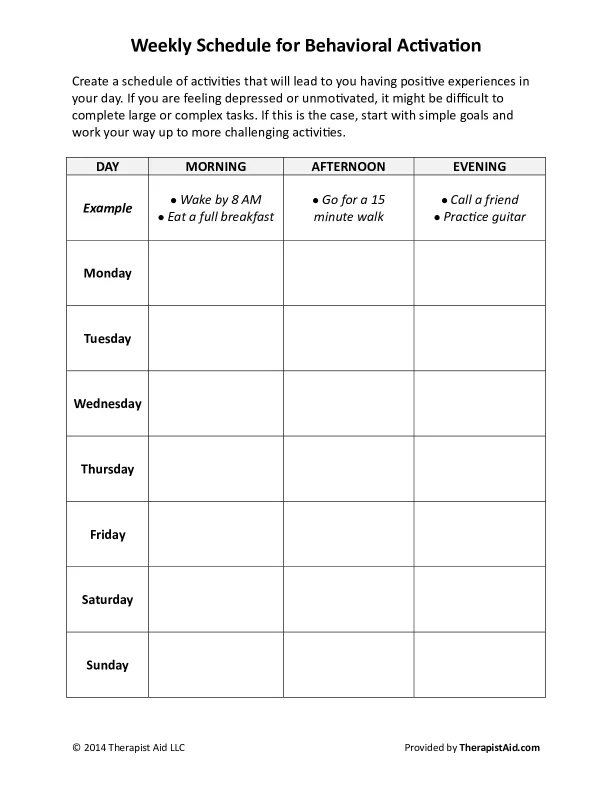
Here is a sample week, continuing the speaking ladder. Each session lasts about 10–15 minutes, including review.
| When | Planned practice | Attempt target | Feedback to note |
|---|---|---|---|
| Tuesday evening | Record a short explanation; listen back; try again | 2 | Did I pause after the main point? |
| Thursday afternoon | Record two explanations, adjusting the pause after the first | 2 | Was the main point understandable? |
| Saturday morning | Explain the idea to a supportive listener | 1 | Did I begin and continue despite any nerves? |
| Sunday evening | Review the attempt log and set next week’s level | — | What small adjustment is warranted? |
The sample has five planned attempts, not five required perfect explanations. Saturday’s listener task is a different ladder step from recording alone. If the listener is unavailable, a recording can be a useful backup, but log it as a recording attempt, not as an attempt with a listener. If Saturday’s step is currently too difficult, schedule another manageable step instead.
Before each session, you may use the brief paced-breathing routine from last lesson if physical arousal is interfering. Then let the routine end and begin the planned action. Some nerves can remain.
Now draft a week for one activity you want to approach, using the worksheet’s time slots or your own calendar. Make the following decisions explicit:
- Activity and component: What will you attempt, and which one skill element will receive attention?
- Attempt rule: What observable action marks an attempt? Set a realistic minimum, even if the performance is imperfect.
- Appointments: On which two or three days, at what times, will you practise? What is a manageable number of attempts per session?
- Feedback source: What will you observe, record, or ask a willing person to comment on?
- Backup: If a session or another person becomes unavailable, what smaller available step can you do—and how will you label it accurately?
A French speaking exchange, a practice business pitch, or an explanation of a simulated trading plan could each provide a suitable focus. For a trading-related skill, count practice or simulation attempts; do not place real trades merely to meet a practice target.
Track action without ignoring learning
Use a log simple enough to complete immediately after each session. For example:
| Day | Planned / made | Step attempted | One observation | Next adjustment |
|---|---|---|---|---|
| Tuesday | 2 / 2 | Recorded explanation | Paused on the second try, though I lost a word | Keep the pause; use shorter notes |
| Thursday | 2 / 1 | Recorded explanation | Began despite nerves; ran out of time for a second try | Reserve a shorter session that fits |
| Saturday | 1 / 1 | Supportive listener | Forgot the pause but completed the explanation | Practise the pause once before the next listener attempt |
The Thursday entry is not “failed”: it records one completed attempt against two planned, plus a scheduling issue you can address. The Saturday entry counts despite the missed pause. That missed pause is feedback about the chosen component, not a verdict on your confidence.
At the end of the week, first compare attempts made with attempts planned, keeping different ladder steps distinguishable. Then look at the observations. Were you practising the component you selected? Did you get feedback you can use? If attempts were rare, make the appointments or steps easier to start. If attempts were frequent but repetitive, improve the feedback or change the component. If the step became comfortably repeatable, consider the next manageable rung.
A single week is too short to demand a smooth improvement curve. The review is a decision about what to practise next, not a trial in which one awkward attempt outweighs everything else you did.
Conclusion
A workable deliberate-practice plan names a specific component, schedules manageable attempts, defines what counts, and makes room for brief feedback. Track imperfect attempts honestly: doing the challenging action is evidence, while the details of how it went tell you what to adjust. You can keep a desired outcome in view without making perfection the price of counting progress.
This completes the confidence-in-action module. Next, you will examine how habits work by identifying the cue, behavior, and consequence in a recurring pattern—a useful way to understand what helps or hinders those scheduled practice sessions.