Recommended resources
The freely available resources this lesson will direct you to.
Introduction
Welcome to your first lesson in the course "I want to debug my learning process." Your goal is to improve how you learn, specifically by tackling procrastination, improving retention, and making your knowledge more applicable. To get there, we'll start with the absolute fundamentals of how your brain processes information.
This first module, "Foundations of Learning and Memory," lays the groundwork for all the strategies we'll discuss later. In this lesson, we'll focus on the first learning outcome: to describe the difference between working memory and long-term memory.
Think of your brain's memory system as having two key components: a temporary mental workspace and a vast, permanent library. Understanding how these two systems work—and how they differ—is the first step toward making your learning more efficient and durable. We'll explore their distinct characteristics, particularly their capacity and how they function.
The Core Idea: The Brain's Workspace and Warehouse
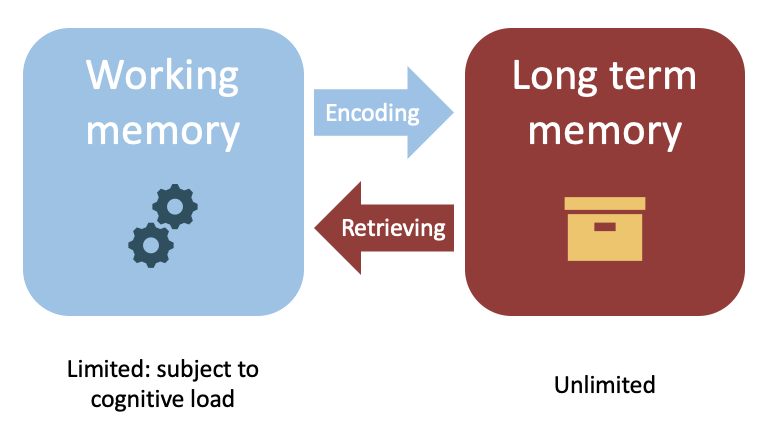
At a high level, psychologists divide memory into a few key systems. For our purposes, the most important distinction is between what's actively on your mind right now and what's stored away for later. We call these working memory and long-term memory.
A useful analogy, especially given your digital design background, is to think of a computer:
- Working Memory is like your computer's RAM (Random Access Memory). It's incredibly fast but has a very limited capacity. It holds the information you are currently working with—the apps you have open, the files you're editing. If you overload it, everything slows down. If the power goes out, its contents are gone.
- Long-Term Memory is like the hard drive. It has a massive, almost limitless capacity to store files, programs, and data for the long haul. Information is stored permanently, but it needs to be actively retrieved (or "opened") to be used by the RAM.
Learning, in this analogy, is the process of saving information from your RAM to your hard drive.
What is Working Memory?
Working memory is your mental "scratchpad." It's not just for holding information, but for working with it. When you're solving a problem, making a decision, or trying to understand a new concept, you are using your working memory.
Its two most critical features are:
- Extremely Limited Capacity: Research shows we can only hold about 4 "chunks" of new information in our working memory at any one time.
- Short Duration: Without actively rehearsing information (like repeating a phone number to yourself), it will fade from working memory in about 15-30 seconds.
To get a better sense of this, let's watch a short video that introduces the classic model of memory and the role of this temporary storage.
How We Make Memories Crash Course Psychology #13
The following clip from CrashCourse Psychology provides a great overview of the memory formation process and introduces the concepts of short-term and long-term memory.
Around the three-minute mark, please watch memory models. Pay close attention to the descriptions of short-term memory's capacity and duration, and how the concept evolved into what we now call 'working memory'.
As the video mentions, psychologists updated the concept of "short-term memory" to "working memory" because the latter better captures the active, processing nature of this system. It isn't just a passive holding bay; it's the engine of conscious thought.
What is Long-Term Memory?
In contrast, long-term memory is the vast warehouse of your accumulated knowledge and experiences. Its capacity is practically limitless, and memories stored there can last for a lifetime.
To explore this further, please read the first section of the following article from Seneca Learning.
Long-Term Memory vs. Working Memory
This article, 'Long-Term Memory vs. Working Memory', gives a clear and concise breakdown of long-term memory and its different types.
In the section titled 'Long-Term Memory' (which appears before the 'Working Memory' section), read long-term memory types. Focus on understanding its capacity, duration, and the distinction between declarative (explicit) and non-declarative (implicit) memory.
As you read, you'll see that long-term memory isn't just one thing. It includes:
- Declarative (Explicit) Memory: Things you can consciously recall and explain, like facts for an exam (semantic memory) or what you did last weekend (episodic memory).
- Non-declarative (Implicit) Memory: Things you know how to do without conscious thought, like riding a bike or using keyboard shortcuts in Figma. This is often called procedural memory.
Working Memory: The Active Processor
The key difference isn't just capacity or duration. It's about function. Short-term memory is an older, more passive concept. Working memory emphasizes active manipulation.
This distinction is crucial for learning. You use your working memory to connect new information to what you already have stored in your long-term memory.
Let's watch a video dedicated to this specific point.
Short-term Memory vs. Working Memory
The Learning Scientists are cognitive psychologists who specialize in making research accessible. This video directly tackles the difference between the older concept of short-term memory and the modern understanding of working memory.
About a minute into the video, watch memory types. Notice how they describe short-term memory as 'static' (like remembering digits) and working memory as 'attentional control' (like listening to a lecture while connecting it to your own experience).
Think about this in the context of your work. When you're sitting in a design critique, you are:
- Listening to the feedback (holding it in working memory).
- Looking at the specific part of the design being discussed (holding it in working memory).
- Connecting the feedback to design principles you already know (retrieving from LTM into WM).
- Formulating a response or a plan to iterate (manipulating all this information in WM).
All of this happens within that tiny, limited workspace of your working memory. This is why complex learning can feel so mentally taxing—it places a heavy demand on this limited resource.
Test your understanding!
Imagine you are learning a new piece of software for creating interactive prototypes. Which of the following activities primarily relies on working memory, and which relies on long-term memory?
- Following a tutorial's step-by-step instructions to create your first animation.
- Understanding that the concept of "components" in this new software is similar to "symbols" in Figma, which you already know well.
- Remembering the brand's primary hex code (#5A48E3) just long enough to type it into the color picker.
- Effortlessly navigating to the "Export" menu without having to search for it.
Show answer
- Working Memory: You are holding the current instruction in your mind just long enough to execute it. This is a classic example of active processing of new information.
- Both: You are retrieving your knowledge of Figma "symbols" from long-term memory and holding it in your working memory to compare it with the new concept of "components." This act of connecting old and new knowledge is a key function of working memory.
- Working Memory: This is a perfect example of using working memory as a temporary buffer. You hold the information for a few seconds and then likely discard it once the task is done.
- Long-Term Memory: This is a form of implicit, procedural memory. You've performed the action so many times that it has become automatic and doesn't require conscious thought or working memory capacity.
Key Takeaways
Let's summarize the crucial differences in a table.
| Feature | Working Memory | Long-Term Memory |
|---|---|---|
| Capacity | Very Limited (~4 items) | Vast (practically unlimited) |
| Duration | Brief (~15-30 seconds without active use) | Potentially a lifetime |
| Function | Active processing & manipulation ("thinking") | Passive storage of knowledge and skills |
| Analogy | Computer RAM (fast, temporary workspace) | Computer Hard Drive (vast, permanent storage) |
The main goal of effective learning is to successfully transfer information from the fragile, limited workspace of working memory into the durable, vast warehouse of long-term memory. The strategies we will cover in this course are all designed to make that transfer process—encoding—more robust and efficient.
Conclusion
In this lesson, you've learned the fundamental distinction between two major memory systems. Working memory is the conscious, active, and severely limited workspace where thinking happens. Long-term memory is the vast, passive archive of everything you know and have experienced.
Recognizing that the bottleneck in learning is almost always the limited capacity of your working memory is the first and most important insight in debugging your learning process.
In our next lesson, we will build directly on this idea. We'll explore the concept of cognitive load, which describes the mental effort imposed on your working memory. You'll learn why you sometimes feel overwhelmed when tackling new topics and how to manage that load to make learning feel less like a struggle and more like a flow.