Recommended resources
The freely available resources this lesson will direct you to.
Hello! Welcome to the first lesson in our module on "Understanding and Overcoming Procrastination."
In our previous module on metacognition, we built a toolkit of strategies for effective learning, culminating in the "predict-test-reflect" cycle to accurately judge your own competence. You now have a solid understanding of what effective learning looks like. However, there's often a gap between knowing what we should do and actually doing it. That gap is where procrastination lives.
This lesson directly addresses one of your key goals: understanding the "why" behind procrastination. We'll tackle the first learning outcome of this module: Identify the emotional and psychological drivers of procrastination, such as task aversion and present bias. We will explore the modern scientific view that procrastination isn't a character flaw or a time management failure, but a deeply human strategy for regulating emotions.
The Real Reason You Procrastinate
For decades, procrastination was framed as a problem of self-control or poor time management. The advice was to get a better planner, use more willpower, or just be more disciplined. While those things can play a role, research in psychology reveals a more fundamental cause.
The central idea is this: Procrastination is an emotion-regulation problem, not a time-management problem. We procrastinate to avoid negative feelings.
Let's start with a short, clear article from the BBC that introduces this perspective.
Why procrastination is about managing emotions, not time - BBC
This article, 'Why procrastination is about managing emotions, not time,' succinctly explains the modern scientific consensus on procrastination, citing key researchers in the field.
Read from the beginning down to the end of the section 'Short-term mood lifters'. Focus on the core argument: we procrastinate to avoid negative feelings associated with a task (like boredom, fear, or frustration) in exchange for a temporary mood boost.
As the article explains, when a task makes us feel bad, our brain's impulse is to stop feeling bad. We do this by avoiding the task and switching to something more pleasant. This is a form of short-term mood repair.
Dr. Timothy Pychyl, one of the leading researchers on procrastination, explains this fundamental idea in the video below.
The Science Behind Why You Procrastinate with Dr. Timothy Pychyl
Listen to Dr. Pychyl's direct explanation of this concept. He emphasizes that procrastination is a 'misregulation of emotion' where we 'give in to feel good' in the short term.
Watch from 06:00 to 09:26. Pay close attention to his distinction between an 'emotion management problem' and a 'time management problem' and his analogy to 'emotional eating' or 'retail therapy'.
Task Aversion and the Procrastination Cycle
The negative feeling that a task provokes is known as task aversion. This is the first key driver. The task itself might be:
- Boring (e.g., reading dense documentation)
- Frustrating (e.g., debugging a piece of code that keeps failing)
- Difficult (e.g., learning a complex statistical concept for data analysis)
- Ambiguous (e.g., a vaguely defined design project)
- Unstructured (e.g., "improve your UX skills")
- Lacking in personal meaning (e.g., a mandatory corporate training)
In your work as a UX designer, you often design products to reduce friction and negative emotions for the user. Procrastination is what happens when we try to do the same for ourselves—avoiding the 'bad UX' of a difficult task.
This process creates a feedback loop, often called the Procrastination Cycle.
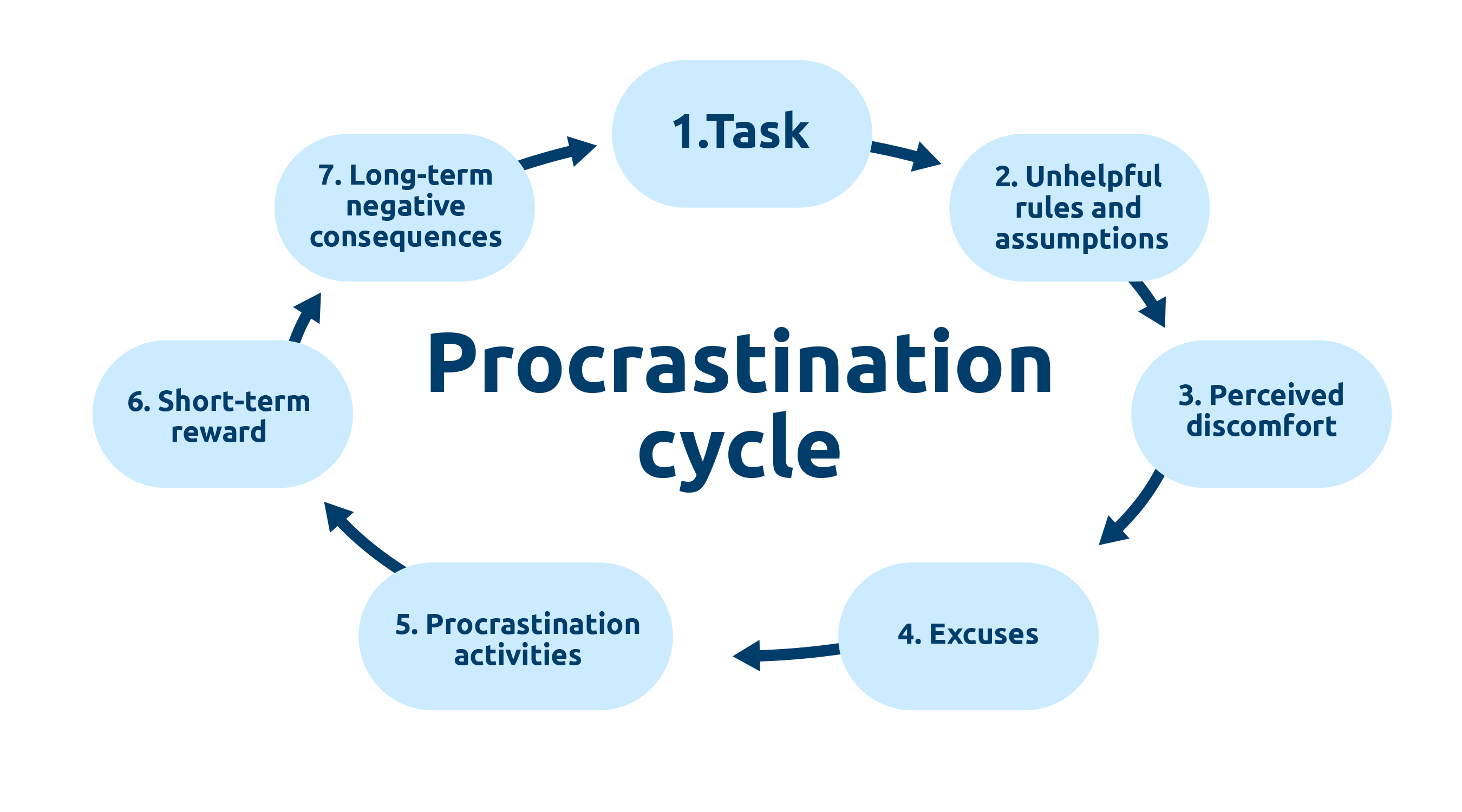
As you can see, the "short-term reward" of feeling better right now is a powerful reinforcer, even if it leads to more stress later. This brings us to the second key driver.
The Power of Now: Present Bias
Why is that short-term reward so compelling, even when we rationally know it will cause problems for our "future self"? The reason is a cognitive bias known as Present Bias (or hyperbolic discounting).
Present Bias is our natural tendency to prioritize smaller, immediate rewards over larger, delayed rewards.
Our brain is essentially wired to value the 'now' much more than the 'later'. The relief you get from watching a YouTube video right now feels more tangible and valuable than the distant satisfaction of having completed a learning module next week.
This comic offers a perfect illustration of Present Bias in action.
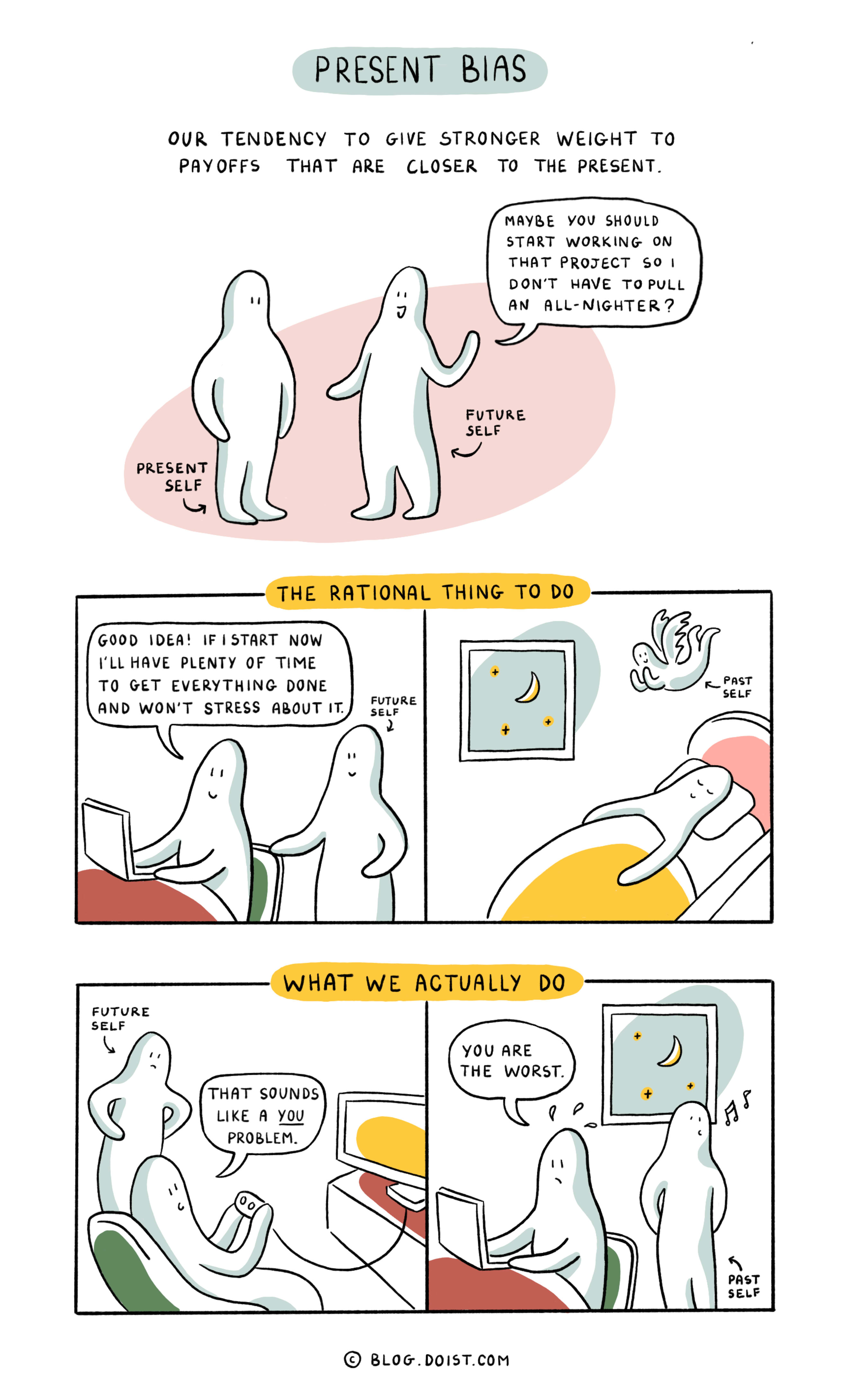
To make this concept even clearer, let's hear Dr. Pychyl explain the psychology behind why we treat our future self like a stranger we don't really care about.
The Science Behind Why You Procrastinate with Dr. Timothy Pychyl
This clip explores the psychological disconnect between our present and future selves, which is at the heart of Present Bias.
Watch from 23:05 to 26:11. Listen for his explanation of how we lack empathy for our 'future self' and how this allows 'present self' to 'give in to feel good'.
The combination is potent:
- Task Aversion makes you want to escape a negative feeling.
- Present Bias provides the justification, making the immediate escape (the procrastination activity) seem more valuable than the long-term goal.
Test your understanding!
Think of a learning task you've been putting off (e.g., starting a tutorial for a new design tool, reading an article on A/B testing, or tackling a coding exercise).
- Identify the Task Aversion: What specific negative emotion does this task trigger for you? Is it boredom, frustration, a feeling of being overwhelmed, or a fear of not understanding?
- Identify the role of Present Bias: What is the immediate reward you get from procrastinating on this task? (e.g., the relief of not having to think about it, the simple pleasure of browsing a familiar website, the satisfaction of completing an easier, different task).
Show answer
Here's an example:
Task: "Learn the basics of SQL for data analysis."
- Task Aversion: The task feels overwhelming and abstract. The negative emotions are anxiety ("I might not be smart enough to get this") and frustration ("The syntax looks confusing and I'll probably make a lot of errors").
- Present Bias: Instead of starting the SQL tutorial, I open Figma to work on a UI component. The immediate reward is a feeling of competence and comfort because Figma is a familiar environment where I'm an expert. This immediate feeling of competence is more attractive than the distant, uncertain reward of knowing SQL.
Putting It All Together
So, we have two main drivers: the emotional push away from an unpleasant task and the psychological pull toward immediate gratification.
Some researchers have tried to combine these factors into a single model. One of the most famous is the "Procrastination Equation," which is part of a framework called Temporal Motivation Theory. The following video explains this model and, crucially, also shows its limitations, bringing us back to the central role of emotions.
The Science Behind Why You Procrastinate
This video breaks down the 'Procrastination Equation' and then explains why such a rational-looking formula isn't enough to understand our often-irrational behavior.
Watch from 01:59 to 06:03. First, understand the four parts of the equation (Expectancy, Value, Impulsiveness, Delay). Then, pay close attention to the critique and how the discussion returns to procrastination being an issue of emotional regulation, not rational calculation.
This is an important point: while models like the Procrastination Equation are useful for identifying what makes a task feel aversive (e.g., low value, long delay), the actual act of procrastinating is an emotional choice to manage that aversion.
Conclusion
In this lesson, we've shifted our understanding of procrastination from a moral or productivity failing to a psychological and emotional coping strategy. By identifying the true drivers, we can begin to address the root cause instead of just treating the symptoms.
Key Takeaways:
- Procrastination is primarily an emotion-regulation strategy, not a time-management problem. It's about avoiding negative feelings.
- The first key driver is Task Aversion, which is the negative emotion (e.g., boredom, fear, frustration) a specific task triggers.
- The second key driver is Present Bias, a cognitive bias that makes us prioritize immediate rewards (like mood repair) over larger, long-term goals.
- This creates a Procrastination Cycle where short-term relief reinforces the avoidance behavior, leading to negative long-term consequences like increased stress and guilt.
What's Next?
We have established the general "why" of procrastination. The next logical step is to turn this knowledge inward. In our next lesson, we will focus on recognizing your personal procrastination triggers within your learning routine. You'll learn how to identify the specific situations, tasks, and feelings that send you into the procrastination cycle, moving from general theory to personal diagnosis.