Welcome back. In our previous lesson, we established a solid foundation by learning to construct and play movable 7th chords. You learned how these voicings are built and how to derive different chord qualities by systematically altering notes—a process not unlike modifying parameters in a function to get a different output.
Today, we're going to build on that foundation to explore the richer, more colorful sounds that are central to the modern guitar style you're aiming for. We will be constructing 9th, 11th, and 13th chord voicings. These are the "upper extensions" that add complexity and sophistication to harmony. Crucially, we will focus on how to voice them for maximum clarity on the higher strings of your 7-string guitar, specifically within the context of a low Drop F tuning. This is where the theoretical meets the practical, a challenge that requires a systematic approach.
From 7ths to Extensions: The Theory
A 7th chord contains four notes: the root, 3rd, 5th, and 7th. To create extended chords, we simply continue stacking thirds on top of the 7th.
- Stack another third on top of the 7th, and you get the 9th.
- Stack a third on top of the 9th, and you get the 11th.
- Stack a third on top of the 11th, and you get the 13th.
For example, a full C Major 13th chord would theoretically contain all seven notes of the C major scale: C (Root), E (3rd), G (5th), B (7th), D (9th), F (11th), and A (13th).
Playing all seven notes at once on a guitar is impractical and often sounds dense and muddy. The art of modern harmony lies in selective omission. To create clear, punchy, and playable voicings, we must choose which notes to keep and which to discard.
The rules for this process are logical:
- Keep the color tones: The 3rd and 7th are essential as they define the chord's basic quality (major, minor, dominant). The extensions (9th, 11th, 13th) are the primary reason we're playing the chord, so they should be included.
- Omit the structural tones:
- The 5th is almost always the first note to go. It adds very little harmonic color and its omission frees up a finger for a more interesting extension.
- The Root is also frequently omitted, especially when playing with a bass player who will cover that note. This creates "rootless" voicings that are a hallmark of modern jazz and fusion styles.
This process allows us to create four-note voicings of complex chords like a Cmaj13 by, for instance, playing just the 3rd, 7th, 9th, and 13th (E, B, D, A).
The Challenge of Drop F Tuning
Before we build shapes, we must define our canvas: the fretboard in Drop F tuning. There isn't one single "standard" Drop F, so for our purposes, we will define it by taking a standard 7-string tuning (B-E-A-D-G-B-E) and tuning every string down by 5 semitones (a diminished fourth). This gives us:
- 7th string: F
- 6th string: A#
- 5th string: D#
- 4th string: G#
- 3rd string: C#
- 2nd string: F
- 1st string: A#
The key takeaway here is that the entire instrument is pitched much lower. This means that intervals in the lower register, particularly close intervals like minor seconds and major seconds, can sound dissonant and "muddy." This is why today's outcome specifies using the higher strings (we'll focus on strings 1-4: G#-C#-F-A#) to ensure the notes in our complex chords have space to ring out clearly.
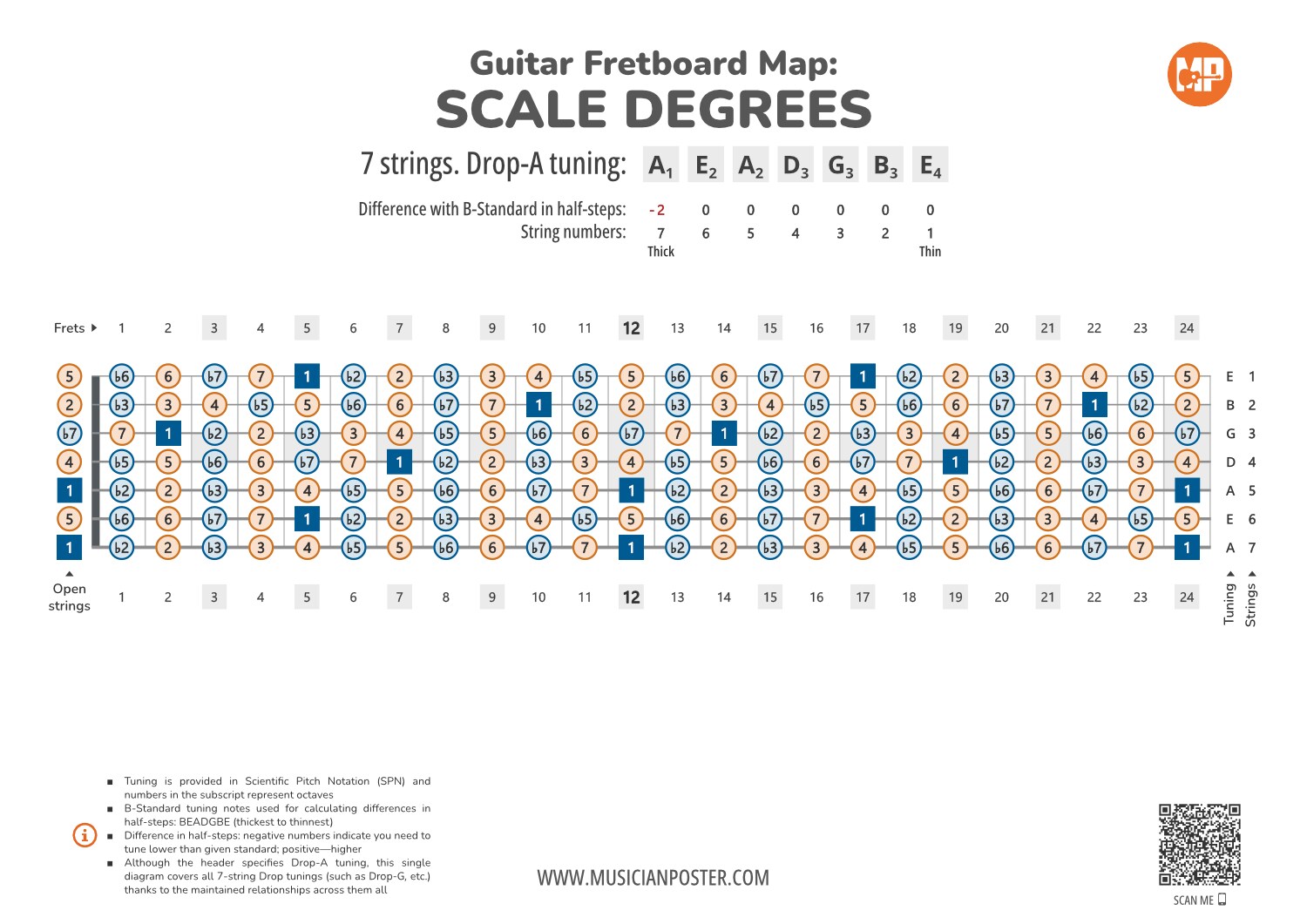
While our tuning is Drop F, the general concept of interval relationships is universal. The diagram below shows a fretboard mapped with scale degrees for Drop A tuning. Don't worry about the specific note names; focus on the numbers. This illustrates how intervals (2, 3, 4, 5, 6, 7) are laid out relative to any given root note (1). This "interval map" is what you'll use to find the notes for your chords, even though the underlying tuning on your guitar is different.
Constructing Extended Voicings
Let's apply our "omission" rules to build some voicings. We will build everything from a root note, R.
1. 9th Chords (Maj9, m9, 9)
A 9th chord adds the 9th to a 7th chord. We will typically omit the 5th.
- Major 9 (Maj9): R - 3 - 7 - 9
- Minor 9 (m9): R - b3 - b7 - 9
- Dominant 9 (9): R - 3 - b7 - 9
Here is a set of practical, movable voicings for the top four strings. Let's base them around a root on the 4th string (G# string). For an A9 chord, the root R would be at the 2nd fret of the G# string.
- Amaj9 Voicing: Play the root
Ron the 4th string. The major 7th is one fret belowRon the 3rd string. The major 3rd is on the same fret asRon the 2nd string. The 9th is two frets aboveRon the 1st string. - Am9 Voicing: From the Amaj9 shape, flat the 7th (move it down one fret) and flat the 3rd (move it down one fret).
- A9 (Dominant) Voicing: From the Amaj9 shape, just flat the 7th.
Try playing the Amaj9 voicing with the root at the 2nd fret of your G# string. You are playing an A#maj9. Now, slide that whole shape up two frets. You are now playing a Cmaj9.
2. 11th and 13th Chords: Color and Avoidance
When we get to 11ths and 13ths, things get more interesting.
The "Avoid Note"
A natural 11th creates a harsh dissonance (a minor 9th interval) when played against the major 3rd of a major or dominant chord. For this reason, in these chords, the 11th is almost always sharpened to a #11. In minor chords, the natural 11th works perfectly well.
13th Chords
13th chords contain the most notes, so omission is key. A very common and effective 13th chord voicing contains just the 3rd, b7th, 9th, and 13th. Notice the root and 5th are both gone. This is a classic rootless voicing that is all color.
Let's look at a concrete example of a sophisticated, modern voicing that combines these concepts.
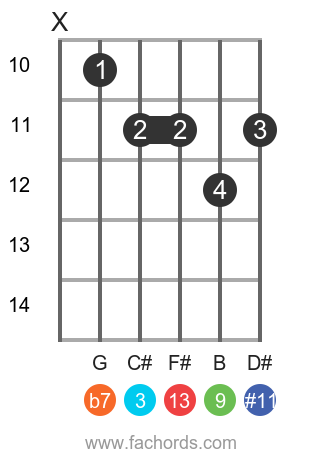
This voicing is a perfect case study. It's an A chord, but the note A isn't even played! It prioritizes all the interesting extensions: the 9th, the #11th, and the 13th, along with the essential 3rd and b7th that define it as a dominant chord. While this specific fingering is shown for standard tuning, the collection of intervals (3, b7, 9, #11, 13) is what you should aim to find on your own fretboard.
Building Your Own Voicings
Let's try to build one of these from scratch in your Drop F tuning.
- Goal: A C13(#11) voicing on the top four strings (G#-C#-F-A#).
- Chord Tones:
- Root: C
- 3rd: E
- b7th: A# (same note as Bb)
- 9th: D
- #11th: F#
- 13th: A
- Select Notes for a 4-Note Voicing: Let's use a common rootless choice: 3, b7, 9, 13. So we need to find E, A#, D, and A.
- Find them on the fretboard (strings G#-C#-F-A#):
- Find an E on the 4th string (9th fret).
- Find an A# on the 3rd string (8th fret).
- Find a D on the 2nd string (10th fret).
- Find an A on the 1st string (11th fret).
- Result: This fingering (9-8-10-11 on the top four strings) is a playable, clear, rootless C13 voicing. If you add a C in the bass (e.g., 8th fret on the A# string), you will hear the full chord.
This is the "algorithm" for constructing modern voicings. It's a system you can apply to any chord, in any key, on any tuning.
Your Task
- Practice the 9th chord shapes: Take the Maj9, m9, and Dominant 9 voicings from the diagram above and move them up and down the neck. Start with the root on your 4th string (G#) and call out the name of the chord you are playing (e.g., "A#m9", "Cm9", "Dm9").
- Deconstruct and Reconstruct: Take the C13 voicing we built (9-8-10-11). Play it. Now, try to build a G13 voicing using the same set of intervals (3, b7, 9, 13). Where would you play it?
- Experiment with a Progression: Take a simple ii-V-I progression. In the key of A#, that would be Cm9 - F9 - A#maj9. First, play it with the 9th chord voicings you learned. Then, try substituting more colorful chords. For example, play Cm11 (try building a voicing!) - F13(#11) - A#maj13. Experiment with different voicings and listen to how the harmonic complexity changes.
Conclusion
Today you've moved beyond basic 7th chords into the world of upper extensions. You've learned the systematic process for building these complex harmonies and, more importantly, how to voice them for clarity—a critical skill for modern guitar, especially in low tunings.
Key Takeaways:
- Extended chords (9ths, 11ths, 13ths) are built by stacking thirds on top of a 7th chord.
- Clarity in voicings is achieved by strategically omitting notes, typically the root and 5th, to prioritize the chord's "color tones" (3rd, 7th, and extensions).
- The natural 11th is often an "avoid note" over major and dominant chords; it is typically sharpened to a #11.
- Rootless voicings are a powerful tool for playing harmonically rich chords without creating mud.
In our next lesson, we will explore a completely different way of building chords. We'll move away from stacking thirds (tertian harmony) and into the world of quartal and quintal harmony—chords built from 4ths and 5ths. This will add another essential and distinctly modern sound to your harmonic vocabulary.