Recommended resources
The freely available resources this lesson will direct you to.
- Stanford CS224N NLP with Deep Learning | 2023 | Lecture 9 - Pretrainingwww.youtube.com
- Talks # 12: Thomas Wolf; An Introduction To Transfer Learning In NLP and HuggingFacewww.youtube.com
- Transfer Learning: Pre-training and Fine-tuning for NLP - Interactivembrenndoerfer.com
- [PDF] Learning Mechanism Underlying NLP Pre-Training and Fine-Tuningarxiv.org
Introduction
In our previous lesson, we completed our deep dive into the Transformer architecture by dissecting its fundamental building block. We analyzed how multi-head attention, feed-forward networks, residual connections, and layer normalization work in concert to create a powerful and stable deep learning model. We now understand what a modern language model is made of. The crucial next question is: how are these massive models trained to acquire their remarkable abilities?
Today, we will answer that question by exploring the dominant training methodology in modern Natural Language Processing (NLP). Our goal is to explain the pre-training and fine-tuning paradigm and its significance for transfer learning in modern NLP. This two-stage process is the conceptual and practical linchpin that has unlocked the potential of large-scale models like BERT and GPT, fundamentally changing how we approach and solve language-related tasks. We will examine the theoretical justification for this paradigm, the mechanics of each stage, and its transformative impact on the field.
The Principle of Transfer Learning
Before diving into the specifics of the pre-training/fine-tuning process, it's essential to understand the underlying principle: transfer learning. At its core, transfer learning is the practice of leveraging knowledge gained from solving one problem to improve performance on a different, but related, problem. This stands in stark contrast to the traditional machine learning approach, where each new task requires training a new model from scratch, discarding all prior knowledge. Humans do not learn this way; we continuously apply past knowledge to learn new skills more efficiently. Transfer learning aims to bring this same efficiency to machine learning.
The following video provides an excellent high-level introduction to this concept and its application in NLP.
Talks # 12: Thomas Wolf; An Introduction To Transfer Learning In NLP and HuggingFace
This video, featuring Thomas Wolf (a co-creator of the Hugging Face Transformers library), introduces the core concepts of transfer learning in NLP.
Please watch the segment from the introduction. Focus on the contrast between traditional ML training and transfer learning, and how the two-step process of pre-training and fine-tuning (or adaptation) is structured.
As the video explains, this paradigm leads to two major advantages:
- Data Efficiency: We can achieve high performance on a new task with significantly less task-specific data.
- Higher Performance: The final model often reaches a higher performance ceiling because it starts with a rich foundation of knowledge rather than a blank slate.
This idea first proved its power in computer vision, where models pre-trained on the massive ImageNet dataset were successfully adapted to a wide range of other visual tasks. The NLP community sought to replicate this success, leading to the development of the pre-training and fine-tuning paradigm we will now examine in detail.
The Pre-training and Fine-tuning Paradigm
Modern transfer learning in NLP is almost universally implemented as a two-stage process. This separation is based on the insight that understanding the general structure of language is a different and more foundational problem than applying that understanding to a specific task.

Let's dissect each stage.
Stage 1: Pre-training
The goal of pre-training is to build a model that possesses a deep, general-purpose understanding of language. This includes knowledge of syntax, semantics, contextual nuance, and even a significant amount of "world knowledge" embedded in the text.
- Data: This stage uses colossal amounts of unlabeled text data, such as the entirety of Wikipedia, a vast collection of books, or a significant portion of the public internet (e.g., the Common Crawl dataset). The scale can be on the order of terabytes of text, containing trillions of words.
- Objective: The model is trained on a self-supervised task. This is a crucial concept: the model learns without human-provided labels. Instead, the labels are generated automatically from the input data itself. The two most common self-supervised objectives, which we have touched on before, are:
- Masked Language Modeling (MLM): Used by encoder-style models like BERT. A certain percentage of words in a sentence are randomly hidden (or "masked"), and the model's objective is to predict the original words based on the surrounding bi-directional context.
- Causal Language Modeling (CLM): Used by decoder-style models like GPT. The model's objective is to predict the next word in a sequence, given all the preceding words.
To succeed at these tasks, the model cannot simply memorize patterns. It is forced to develop rich internal representations of language. For instance, to correctly predict the masked word in "The capital of France is [MASK]," the model must learn the relationship between "France" and "capital" and have some representation of the fact that Paris is the answer.
The following article offers a clear and comprehensive explanation of this two-stage process.
Transfer Learning: Pre-training and Fine-tuning for NLP - Interactive
This article by Michael Brenndoerfer provides an excellent, detailed breakdown of the paradigm.
Please read the section titled The Paradigm. Pay close attention to the descriptions of Stage 1 and Stage 2, the scale difference between the data used in each, and the different roles they play.
From a more theoretical standpoint, as described in the academic paper "Learning Mechanism Underlying NLP Pre-Training and Fine-Tuning," this process can be seen as breaking the initial symmetry among tokens. During pre-training, the model learns to group tokens into meaningful clusters based on their semantic and syntactic relationships. This is a more formal way of saying it learns the structure of language.
[PDF] Learning Mechanism Underlying NLP Pre-Training and Fine-Tuning
This research paper provides a formal description of the pre-training and fine-tuning process. Given your background, you may find this perspective illuminating.
In the Introduction section, please read the passage that describes the two learning processes. This text formally defines the purpose of each stage and states the key outcome: the pre-trained model substantially improves accuracy compared to one initialized with random weights.
Stage 2: Fine-tuning
Once pre-training is complete, we have a powerful base model. However, it doesn't know how to perform any specific task yet. The fine-tuning stage adapts this general model to a particular downstream task.
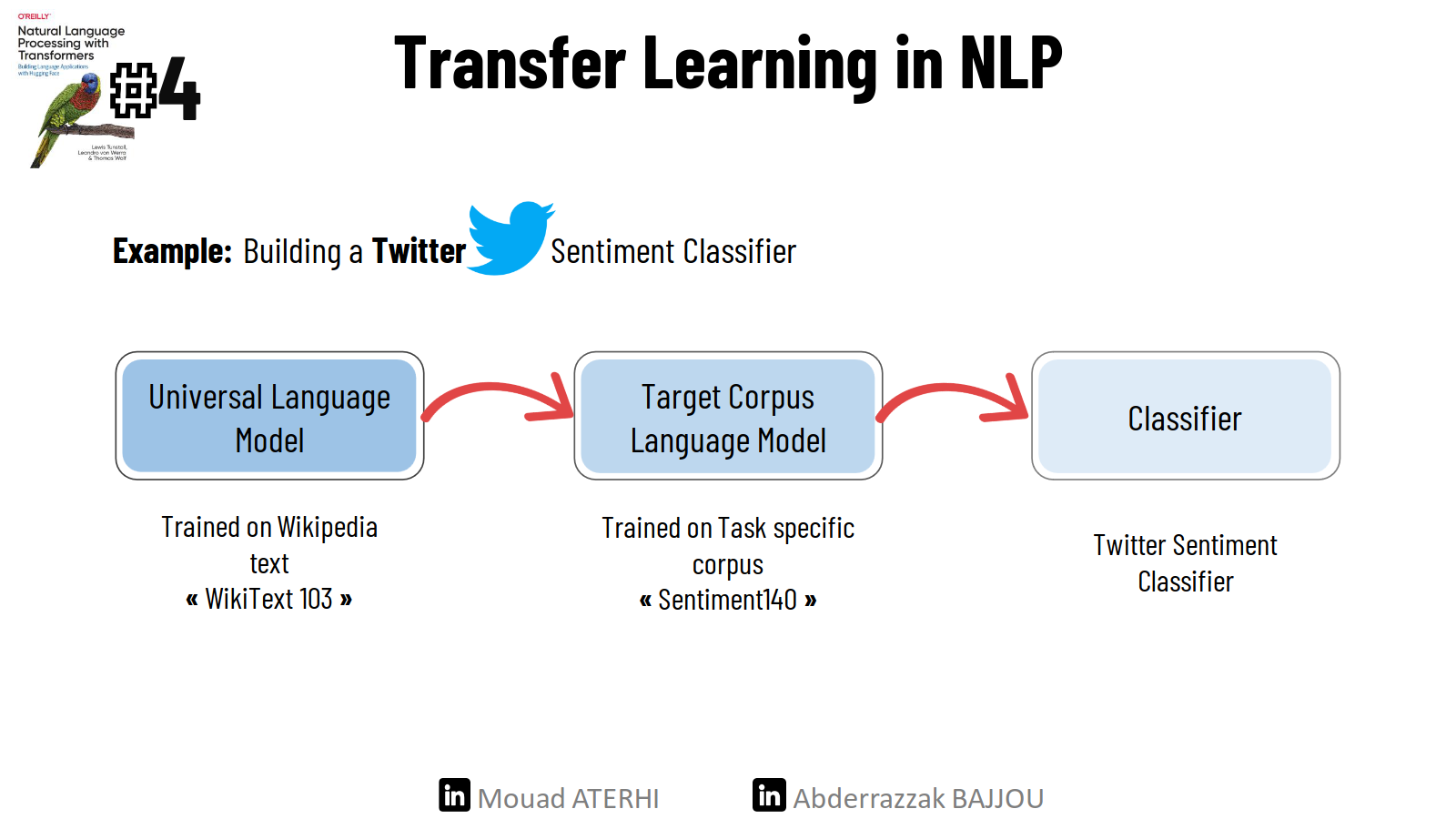
- Data: This stage uses a much smaller, labeled dataset that is specific to the target task. This might be a few thousand customer reviews labeled as positive or negative, a set of questions paired with correct answers, or sentences with named entities tagged.
- Objective: The model is trained via standard supervised learning to solve the specific task. The process involves a key architectural modification:
- The original "head" of the model, which was used for the pre-training task (e.g., predicting masked words), is removed.
- A new, task-specific head is added. For sentiment analysis, this might be a simple linear classifier that outputs probabilities for "positive" and "negative" classes.
- Training: The entire model (the pre-trained body and the new head) is then trained on the labeled data. A crucial detail is the use of a very low learning rate, typically 10 to 100 times smaller than the one used for pre-training. This prevents the model from drastically altering the valuable weights learned during pre-training, a phenomenon known as catastrophic forgetting. The goal is to gently "steer" the existing representations toward the new task, not to overwrite them.
The following video from Stanford's CS224N course provides a superb conceptual explanation of this entire pipeline and why it's so effective.
Stanford CS224N NLP with Deep Learning | 2023 | Lecture 9 - Pretraining
This lecture from Stanford's Deep Learning for NLP course gives an academic perspective on pre-training and fine-tuning.
First, watch the segment from pre-training the entire network, which contrasts this modern approach with the older method of only pre-training word embeddings. Then, watch the detailed explanation of the pre-training/fine-tuning paradigm. The lecturer addresses several key questions, including why this works better than just using more data for fine-tuning, and how the model's focus shifts from the pre-training data to the fine-tuning data.
The Significance: Why Does This Work?
The incredible success of this paradigm stems from several converging factors, moving from the practical to the theoretical:
-
Economic and Practical Efficiency: Pre-training is immensely expensive, costing millions of dollars in compute for a single large model. However, this cost is paid only once. The resulting model can then be fine-tuned cheaply and quickly by thousands of researchers and developers for countless applications. This has democratized access to state-of-the-art NLP.
-
Sample Efficiency: Fine-tuning requires orders of magnitude less labeled data. Before this paradigm, achieving decent performance on a task like sentiment analysis might have required tens of thousands of labeled examples. With a pre-trained model, comparable or better results can often be achieved with just a few hundred or a thousand examples.
-
Superior Representation: A model trained from scratch on a small, task-specific dataset can only learn the surface-level statistical patterns present in that data. It has no broader understanding of language. A pre-trained model, having processed a vast swath of human text, has learned a rich, hierarchical model of language. Fine-tuning simply learns a shallow mapping from this powerful representation space to the desired task output.
-
Optimization Landscape: From a theoretical optimization perspective, the parameter space of a large neural network is a highly complex, non-convex landscape filled with countless local minima. Training from a random initialization is a difficult search problem. Pre-training can be viewed as an effective method for finding a "good region" of this landscape. The fine-tuning process then starts its search from this advantageous position, making it much more likely to converge to a high-performing solution for the downstream task.
To place this paradigm in its proper intellectual context, it's helpful to see it as the culmination of a decade of research.
Transfer Learning: Pre-training and Fine-tuning for NLP - Interactive
Let's return to the Brenndoerfer article one last time.
Please read the section Historical Perspective. This traces the evolution of transfer learning in NLP, from the static Word2Vec embeddings to the contextual ELMo models, and finally to the BERT and GPT models that established the current paradigm.
Conclusion
In this lesson, we have demystified the training process behind modern large language models. We have established that the pre-training and fine-tuning paradigm is the core engine of progress in contemporary NLP.
Here are the key takeaways:
- Transfer Learning is the principle of applying knowledge from a source task to a target task, enabling more data-efficient and high-performance learning.
- The paradigm consists of two stages: pre-training on massive, unlabeled datasets with a self-supervised objective to learn general language representations, followed by fine-tuning on small, labeled datasets to adapt the model to a specific task.
- Pre-training provides a powerful "head start" by learning rich representations of syntax, semantics, and world knowledge, and by positioning the model in a favorable region of the parameter space.
- Fine-tuning specializes these general representations for a downstream task by adding a task-specific head and training with a low learning rate to preserve the pre-trained knowledge.
- This approach has revolutionized NLP by dramatically improving sample efficiency and overall performance, while also creating an ecosystem where the high cost of pre-training can be amortized across unlimited applications.
Now that you understand the general methodology used to train these models, we can delve into the specifics of the two most influential architectural families that embody this paradigm. In our next lesson, we will contrast the architectures of BERT (encoder-only) and GPT (decoder-only) and their respective pre-training objectives, examining how their structural differences make them suited for different kinds of tasks.