Recommended resources
The freely available resources this lesson will direct you to.
- A friendly introduction to distributed training (ML Tech Talks)www.youtube.com
- Stanford CS231N | Spring 2025 | Lecture 11: Large Scale Distributed Trainingwww.youtube.com
- [PDF] Lecture 23: Distributed Machine Learning and the Parameter Serverwww.cs.cornell.edu
- Parameter Servers and AllReduce | Random Notesxzhu0027.gitbook.io
Introduction
In our previous lessons, we've focused on the dominant paradigm for distributed training in modern deep learning: decentralized, synchronous data parallelism. We saw how techniques like gradient accumulation, gradient compression, and communication-computation overlap are used to optimize this model, which relies on an AllReduce collective operation to synchronize gradients among all workers.
Today, we will explore a fundamentally different approach: the parameter server (PS) architecture. This is a centralized, client-server model that was a cornerstone of early large-scale machine learning systems and continues to have relevance in specific scenarios.
This lesson will:
- Describe the components and workflow of the parameter server architecture.
- Explain the difference between synchronous and asynchronous training within the PS model, focusing on the implications of asynchronous updates and "stale gradients."
- Directly contrast the centralized parameter server approach with the decentralized AllReduce-based approach, analyzing their respective trade-offs in communication, fault tolerance, and hardware suitability.
By the end of this lesson, you will have a clear understanding of these two primary architectures for distributed training, enabling you to reason about which is better suited for different large-scale AI systems.
A Quick Review: The Decentralized AllReduce Model
Before diving into the parameter server, let's briefly formalize the decentralized model we've been working with. In this peer-to-peer setup:
- Each of the workers holds a complete, identical copy of the model parameters.
- Each worker processes a unique shard of the data mini-batch and computes its local gradients.
- An
AllReduceoperation is performed. This collective communication step sums the gradients from all workers and distributes the final averaged result back to every worker. - Each worker independently applies the identical gradient update to its local copy of the model.
The key characteristic is that there is no central orchestrator; all workers are peers, and they collectively synchronize at each step. This is the model implemented by popular frameworks like PyTorch's DistributedDataParallel (DDP) and Horovod.
[PDF] Lecture 23: Distributed Machine Learning and the Parameter Server
For a concise, formal description of this process, please review the following section from a set of lecture notes from Cornell University.
Please read the section titled 'Running SGD with all-reduce' (page 1). Focus on Algorithm 1, which clearly lays out the parallel execution flow, the all-reduce step, and the local model update.
The Parameter Server Architecture
The parameter server model inverts this decentralized design. Instead of every worker managing its own full copy of the model, the responsibility for maintaining the "master" copy of the parameters is centralized.
The architecture consists of two main roles:
- Parameter Servers: One or more nodes whose sole job is to store and update the model parameters. If the model is very large, its parameters can be sharded (partitioned) across multiple server nodes.
- Workers: The nodes that perform the training computation. They do not own the master parameters.
The workflow follows a classic client-server pattern:
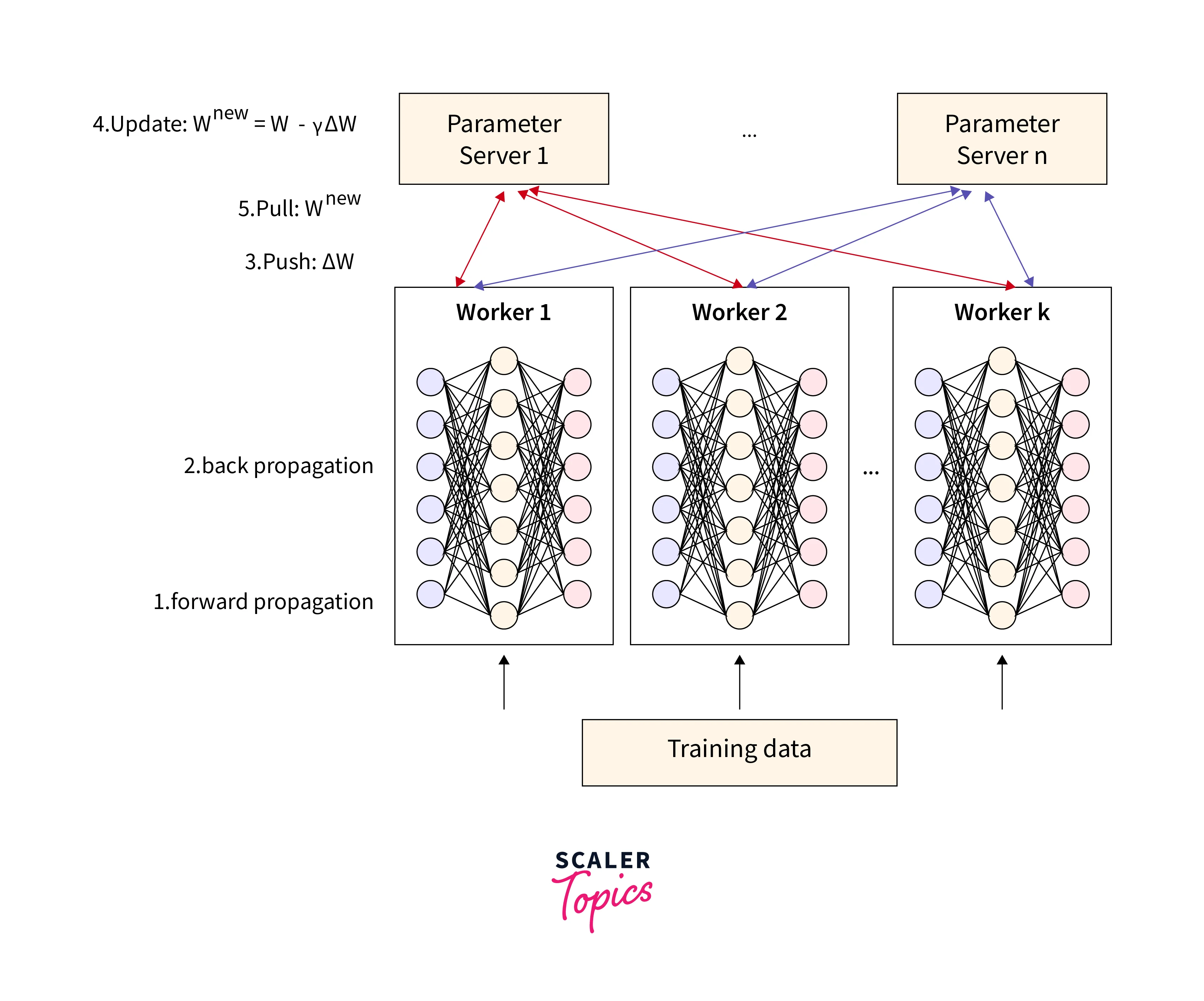
Let's watch a video that walks through this process.
A friendly introduction to distributed training (ML Tech Talks)
This segment from a TensorFlow talk provides a clear, animated explanation of parameter server training, contrasting it with the synchronous methods we've already seen.
Please watch the segment from 18:25 to 22:09. Pay attention to: The distinct roles of the workers, parameter servers, and the coordinator. The independent 'pull-compute-push' loop that each worker executes. The concept of asynchronous updates and its potential downside: stale gradients.
Consistency Models: The Problem of Staleness
As the video highlighted, the most common implementation of the parameter server architecture is asynchronous. Workers do not wait for each other. This has a major advantage: a slow worker (a "straggler") or a failing worker does not halt the progress of the entire training cluster. This makes the system more robust and can increase overall throughput, as faster workers are not left idle.
However, this introduces a critical challenge known as the stale gradient problem. By the time a worker calculates its gradient and pushes it to the server, the master parameters may have already been updated by one or more faster workers. The pushed gradient is therefore "stale" because it was computed based on an outdated version of the model.
This leads to a fundamental trade-off between system efficiency and statistical efficiency. We can categorize the consistency models for parameter servers as follows:
- Bulk Synchronous Parallel (BSP): All workers synchronize at each step. A worker computes its gradient and waits until all other workers have also finished. The server then aggregates all gradients, performs a single update, and broadcasts the new parameters. This avoids stale gradients but reintroduces the straggler problem. It is statistically efficient but can be system-inefficient.
- Asynchronous Parallel (ASP): This is the model described in the video. Workers operate fully independently, without synchronization. This maximizes system throughput but can lead to significant gradient staleness, which may harm or slow down model convergence.
- Stale Synchronous Parallel (SSP): A compromise between the two extremes. This model allows workers to be out-of-sync up to a user-defined staleness threshold, . The fastest worker is forced to wait if it gets more than iterations ahead of the slowest worker. This bounds the "age" of the gradients, attempting to retain most of the system benefits of asynchrony while mitigating the worst effects of staleness on convergence.
Parameter Servers and AllReduce | Random Notes
This blog post provides a good overview of these consistency models and the trade-offs involved.
Please read the sections 'Consistency model' and 'Stale Synchronous Parallel'. This will give you a more formal understanding of the BSP, TAP (Total Asynchronous Parallel), and SSP models.
Parameter Server vs. AllReduce: A Direct Comparison
We now have two distinct architectures for distributing the training computation. Let's contrast them directly.

Here is a summary of the key differences and trade-offs:
| Feature | Parameter Server (Centralized) | AllReduce (Decentralized) |
|---|---|---|
| Architecture | Client-Server. Dedicated server nodes manage parameters; worker nodes perform computation. | Peer-to-Peer. All nodes are workers and hold a complete copy of the model parameters. |
| Typical Sync Model | Asynchronous. Workers update independently, leading to stale gradients. | Synchronous. All workers synchronize gradients at every step. |
| Communication Pattern | Push/Pull. Each worker communicates directly with the parameter server(s). | Collective (e.g., Ring). Communication is distributed among all peers. |
| Network Bottleneck | The parameter server(s) can become a bottleneck, as all communication flows through them. | Bandwidth is distributed across the interconnects. The bottleneck is the slowest link in the ring/tree. |
| Fault Tolerance | High (in async mode). The system can tolerate worker failures without halting. | Low. The failure of a single worker typically stalls the entire training job. |
| Hardware Suitability | Better for heterogeneous or unreliable hardware (e.g., preemptible VMs) and very large-scale clusters where stragglers are common. | Best for homogeneous, tightly-coupled clusters with high-speed interconnects (e.g., GPU servers with NVLink). |
| Convergence | Can be less stable or slower due to stale gradients. Difficult to debug and reproduce. | Statistically equivalent to large-batch SGD. Deterministic and easier to reason about. |
| Ease of Use | Can be more complex to configure and tune (e.g., number of servers, consistency model). | Often simpler to implement with modern frameworks like PyTorch DDP or Horovod. |
The TensorFlow video you watched earlier provides a concise summary of these differences.
A friendly introduction to distributed training (ML Tech Talks)
To reinforce the comparison, please re-watch the final recap of the same video.
Watch the recap from 22:09 to 23:41. It directly contrasts the variable storage and gradient synchronization methods of the Mirrored (AllReduce) and Parameter Server strategies.
Ultimately, the choice between these architectures depends on the specific requirements of the system. For most high-performance deep learning on modern GPU clusters, the synchronous AllReduce approach has become the de facto standard due to its statistical stability and high efficiency on well-provisioned hardware. However, the parameter server architecture remains a valuable tool for massive-scale systems or those built on less reliable infrastructure.
Conclusion
In this lesson, we dissected the parameter server architecture and contrasted it with the decentralized AllReduce model. You now understand the two primary schools of thought for managing model updates in distributed training.
Key Takeaways:
- The Parameter Server (PS) architecture is a centralized model where dedicated servers maintain the model parameters, and workers push/pull updates.
- It is most commonly implemented asynchronously, which provides high system throughput and fault tolerance but introduces stale gradients, a trade-off managed by different consistency models (BSP, ASP, SSP).
- The AllReduce model is a decentralized, peer-to-peer approach that is typically synchronous. It is highly efficient on modern GPU clusters but is sensitive to stragglers and node failures.
- The choice between PS and AllReduce depends on trade-offs between hardware reliability, network topology, desired statistical efficiency, and scale.
Preview of the Next Lesson:
Both the Parameter Server and AllReduce approaches primarily address the problem of communicating updates. However, as models grow into the hundreds of billions of parameters, a different bottleneck becomes critical: the enormous memory footprint required on each GPU to store not just the parameters, but also their gradients and optimizer states (like momentum and variance).
In our next lesson, we will investigate a powerful set of techniques designed to solve this memory crisis: the ZeRO (Zero Redundancy Optimizer). We will see how ZeRO partitions the model and optimizer states across GPUs, drastically reducing the per-device memory consumption and enabling the training of truly massive models.