Recommended resources
The freely available resources this lesson will direct you to.
Hello! In our last two lessons, we explored sorting algorithms that have a time complexity of O(n²), namely Bubble Sort and Selection Sort. You learned how they use different strategies—repeatedly swapping adjacent elements versus finding the minimum—to sort an array.
Today, we will dive into our third fundamental sorting algorithm: Insertion Sort. The goal of this lesson is to understand its logic and implement it in C. You'll see that Insertion Sort works by building up a sorted portion of the array one element at a time, much like how you might arrange a hand of playing cards. This intuitive approach has some interesting performance characteristics that we will begin to touch on.
1. The Insertion Sort Concept
Like Selection Sort, Insertion Sort conceptually divides the array into two parts: a sorted subarray and an unsorted subarray. However, its method is quite different.
The algorithm iterates through the array, starting with the second element. In each iteration, it takes one element from the unsorted part and "inserts" it into its correct position within the already sorted part. The sorted part grows by one element in each pass.
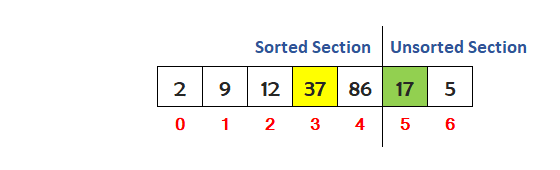
The most common analogy is sorting a hand of playing cards. Imagine you pick up cards one by one. Each new card you pick up, you insert into its correct position in the hand you are already holding, which is always kept sorted.
Let's watch a video that explains this card analogy and the general logic of Insertion Sort.
The video "Insertion sort algorithm" from the mycodeschool channel provides an excellent conceptual foundation for this algorithm.
First, watch the section explaining the card-sorting analogy. This will give you an intuitive feel for the process. Then, continue watching as the video demonstrates the algorithm on an array, introducing the helpful concept of a "hole" to visualize how elements are shifted. Watch from the array example.
As you saw, the key operations are:
- Select the next unsorted element.
- Shift all elements in the sorted part that are greater than the selected element one position to the right.
- Insert the selected element into the newly created "hole".
2. The Algorithm and Pseudocode
Now that you have a visual understanding, let's formalize the logic. The algorithm uses a nested structure:
- An outer loop iterates from the second element (
i = 1) to the end of the array. The element atarray[i]is the one we want to insert into the sorted portion. - An inner loop (often a
whileloop) moves backward from positioni-1. It compares the element to be inserted (let's call itkey) with the elements in the sorted portion. If an element is greater thankey, it's shifted one position to the right. This continues until we find an element smaller than or equal tokey, or we reach the beginning of the array. - Finally,
keyis placed in the correct position.
The same video you just watched provides a clear walkthrough of the pseudocode that captures this logic.
Let's continue with the mycodeschool video to see this logic expressed as pseudocode.
Watch the final part of the video, from the pseudocode section. Pay attention to how the while loop handles the shifting of elements.
3. Implementing Insertion Sort in C
With the logic and pseudocode clear, we can now implement Insertion Sort in C. The C code will closely follow the structure we just reviewed.
We will use another video for a guided implementation walkthrough. This one is specifically focused on C programming.
Insertion Sort | C Programming Example
The video "Insertion Sort | C Programming Example" by Portfolio Courses will walk you through the C implementation from start to finish.
First, watch the quick conceptual animation as a refresher. Then, follow along with the main part of the video, the C implementation, where the presenter codes the insertionSort function. Notice how the variables key and j are used to implement the shifting and insertion logic from the pseudocode.
The key piece of C code that implements the "shift and insert" logic is the while loop nested inside the for loop:
// 'i' is the index of the element being inserted
// 'key' holds the value of that element
int key = array[i];
int j = i - 1;

// Move elements of array[0..i-1], that are
// greater than key, to one position ahead
// of their current position
while (j >= 0 && array[j] > key) {
    array[j + 1] = array[j];
    j = j - 1;
}
array[j + 1] = key; // Insert the key into the 'hole'
4. Practice and Review
It's time to get hands-on with the code. The following resource provides a complete, clean C program for Insertion Sort.
Insertion Sort (With Code in Python/C++/Java/C)
The article "Insertion Sort" on Programiz provides a concise and well-structured C implementation.
Find the code block for the C implementation. Read through the insertionSort function and the main function to see how it all fits together.
Here is the complete program from the resource for you to work with:
#include <stdio.h>

// Function to print an array
void printArray(int array[], int size) {
    for (int i = 0; i < size; i++) {
        printf("%d ", array[i]);
    }
    printf("\n");
}

void insertionSort(int array[], int size) {
    for (int step = 1; step < size; step++) {
        int key = array[step];
        int j = step - 1;

        // Compare key with each element on the left of it until an element
        // smaller than it is found.
        // For descending order, change key < array[j] to key > array[j].
        while (j >= 0 && key < array[j]) {
            array[j + 1] = array[j];
            --j;
        }

        // Place key after the element just smaller than it.
        array[j + 1] = key;
    }
}

// Driver code
int main() {
    int data[] = {9, 5, 1, 4, 3};
    int size = sizeof(data) / sizeof(data[0]);

    printf("Unsorted array:\n");
    printArray(data, size);

    insertionSort(data, size);

    printf("Sorted array in ascending order:\n");
    printArray(data, size);
}
Your Task:
- Compile and run this code to verify that it correctly sorts the
dataarray. - Modify the
insertionSortfunction to sort the array in descending order (from largest to smallest). The comment in the code gives you a direct hint on how to do this. This simple change will test your understanding of the comparison at the heart of the algorithm.
Conclusion
In this lesson, you have successfully learned about and implemented Insertion Sort. We've seen how its strategy of building a sorted subarray by inserting elements one by one provides an intuitive way to sort data.
Key Takeaways:
- Insertion Sort works by dividing the array into a sorted and an unsorted part.
- It iterates through the unsorted part, picking one element at a time and inserting it into its correct position in the sorted part.
- The core of the implementation involves an outer loop to select an element (
key) and an innerwhileloop to shift larger elements to the right to make space for thekey.
Preview of the Next Lesson:
We've now implemented three O(n²) sorting algorithms. But is Insertion Sort always O(n²)? What happens if you run it on an array that is already sorted? In the next lesson, we will analyze the time complexity of Insertion Sort, where you'll discover its unique advantage: a best-case time complexity of O(n). This makes it surprisingly effective for nearly-sorted datasets.