Recommended resources
The freely available resources this lesson will direct you to.
Hello! Welcome to the first lesson in our new module, "Reference, Meaning, and Modality."
In the last module, we explored how Ordinary Language Philosophy, under the influence of the later Wittgenstein, shifted analytic philosophy's focus towards the use of language in everyday contexts. The goal was often therapeutic: to dissolve philosophical problems by clarifying linguistic confusions. Today, we take a turn back towards a more formal and systematic approach to meaning, one that your background in mathematics will equip you to handle with precision.
This lesson addresses the learning outcome: Explain the use of possible worlds semantics to analyze statements of necessity and possibility. We are going to build a formal framework to make sense of modal claims—that is, claims about what must be true and what could be true. This tool, known as possible worlds semantics, is one of the most powerful and influential developments in late 20th-century analytic philosophy, and it lays the groundwork for much of the work in metaphysics and philosophy of language we will study next.
1. What are Necessity and Possibility?
In philosophy, the study of necessity and possibility is called modality. We make modal claims all the time:
- "It's impossible to draw a three-sided square." (A statement of impossibility)
- "It is necessary that if Socrates is a man, then Socrates is mortal." (A statement of necessity)
- "You could have been a doctor instead of a philosopher." (A statement of possibility)
- "It is contingent that the sky is blue." (It is true, but it could have been otherwise).
Philosophers distinguish between several kinds of necessity and possibility. The following video offers a clear guide to these distinctions.
Modal Concepts and Possible Worlds
The video 'Modal Concepts and Possible Worlds' from the channel Thinking illustrated provides a great introduction to the different types of modality that philosophers discuss.
Please watch from the beginning to 06:06. Pay close attention to the distinctions between: Logical possibility (what is not a contradiction) Metaphysical possibility (how things genuinely could have been) Nomological (or physical) possibility (what is compatible with the laws of nature) Epistemic possibility (what is possible for all we know)
Understanding these different "flavors" of modality is crucial. A statement can be possible in one sense but impossible in another. For example, traveling faster than light is nomologically impossible (it violates our laws of physics), but it is arguably metaphysically possible (the laws of physics could have been different). For much of this module, we will be concerned with metaphysical necessity and possibility.
2. The Limits of Classical Logic: The Problem of Intensionality
Why do we need a special tool for modality? The reason is that modal operators like "necessarily" and "possibly" create contexts that are intensional, not extensional.
As you know from your background, the logic of connectives like 'and' (∧) and 'not' (¬) is extensional. The truth value of P ∧ Q is determined solely by the truth values of P and Q. You can substitute any true sentence for P without changing the truth value of a larger sentence, ¬P for example.
This doesn't work for modality. Consider the operators for necessity (□) and possibility (◇). The truth of □P ("Necessarily P") is not determined by the truth of P in our world.
To see this clearly, let's read a short section from the Stanford Encyclopedia of Philosophy.
Possible Worlds - Stanford Encyclopedia of Philosophy
The article 'Possible Worlds' from the Stanford Encyclopedia of Philosophy (SEP) expertly lays out the problem that possible worlds semantics was designed to solve. This section will feel familiar, as it deals with the principles of formal logic.
Please read Section 1.1, 'Extensionality Lost'. This section explains why modal logic is 'intensional' and breaks the substitutivity principles of classical logic. The example comparing sentences (1) and (5) is particularly illustrative.
The SEP article makes the point elegantly:
- "All John's dogs are mammals" is true.
- "Necessarily, all John's dogs are mammals" is true (assuming 'dog' implies 'mammal').
- "All John's pets are mammals" might happen to be true (if he only has dogs as pets).
- But "Necessarily, all John's pets are mammals" is false (he could have gotten a lizard).
Even though sentences 1 and 3 have the same truth value (they are co-extensional), we cannot substitute one for the other within a "Necessarily..." context without changing the truth value of the whole sentence. Classical semantics can't account for this. We need a richer semantic theory.
3. The Solution: Quantifying Over Possible Worlds
The brilliant idea, developed most famously by Saul Kripke in the 1960s, was to analyze modal operators as quantifiers over possible worlds.
- A possible world is a complete and consistent way the world could have been. In one possible world, you are studying this lesson. In another, you are a professional mathematician. In a third, dinosaurs never went extinct.
Using this concept, we can give a simple, intuitive semantics for necessity and possibility:
□P(Necessarily P) is true if and only if P is true in all possible worlds.◇P(Possibly P) is true if and only if P is true in at least one possible world.
This simple move transforms an intensional problem into an extensional one. We are no longer trying to determine the truth of □P from P alone; instead, we are checking the truth of P across a whole set of worlds.
Let's watch a video that explains this core idea and begins to formalize it.
The video 'Possible worlds semantics' from Attic Philosophy provides a clear bridge from the informal idea to the formal machinery. It explains how possible worlds do the work that truth-table valuations did in propositional logic, but for a much richer language.
Please watch from 00:30 to 09:48. This covers: The basic idea of semantics as a theory of truth conditions. The concept of a possible world as a 'way things could have turned out'. The crucial introduction of accessibility relations (the arrows between worlds).
4. Formalizing Possible Worlds Semantics: Kripke Models
As the video introduced, to make this framework precise, we use a formal structure called a Kripke model. Given your background, you can think of this as a directed graph where each node is a world.
A Kripke Model, M, consists of three components: M = <W, R, V>
- W: A non-empty set of possible worlds.
- R: An accessibility relation on W. This is a binary relation that tells us which worlds are "possible relative to" which other worlds.
w1 R w2meansw2is accessible fromw1. - V: A valuation function that assigns a truth value (true or false) to each atomic proposition (
p,q,r, ...) at each worldwinW.
The accessibility relation R is the key innovation. It allows for flexibility. Instead of quantifying over all worlds, we quantify over all accessible worlds.
The formal truth conditions are now:
M, w ⊨ □P(The formula□Pis true at worldwin modelM) if and only if for all worldsw'such thatw R w',M, w' ⊨ P.
In English: "Necessarily P" is true at a worldwif and only ifPis true in every world thatwcan "see" or access.M, w ⊨ ◇Pif and only if there exists at least one worldw'such thatw R w'andM, w' ⊨ P.
In English: "Possibly P" is true at a worldwif and only ifPis true in at least one world thatwcan "see" or access.
Let's see this in action with a concrete example.
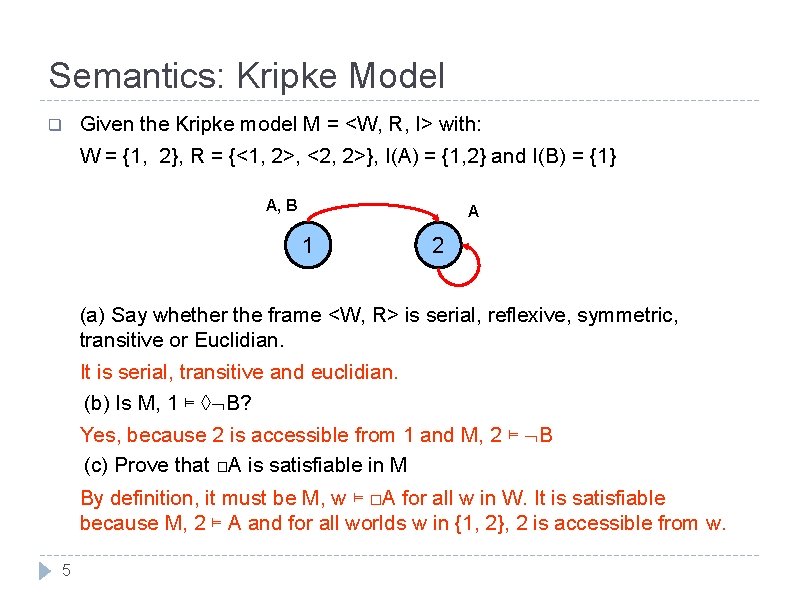
Let's analyze the question from the image: Is M, 1 ⊨ ◇B? (Is "Possibly B" true at world 1?)
- Recall the definition:
◇Bis true at world 1 if there is at least one worldw'accessible from 1 whereBis true. - Check the accessibility relation: The arrow shows that world 1 accesses world 2 (i.e.,
1 R 2). - Check the valuation at the accessible world: At world 2, is
Btrue? The diagram shows thatI(2, B) = true. - Conclusion: Yes, there is an accessible world (world 2) where
Bis true. Therefore,M, 1 ⊨ ◇Bis true.
Test your understanding!
Using the same Kripke model in the image above, determine if the following statement is true or false: M, 2 ⊨ □A ("Necessarily A" is true at world 2). Explain your reasoning step-by-step.
Show answer
The statement M, 2 ⊨ □A is false.
- Recall the definition:
□Ais true at world 2 ifAis true in all worlds accessible from 2. - Check the accessibility relation from world 2: The model shows an arrow from 2 to itself (
2 R 2). So, the only world accessible from world 2 is world 2 itself. - Check the valuation at all accessible worlds: We only need to check the truth of
Aat world 2. The diagram statesI(2, A) = false. - Conclusion: Since
Ais not true at all worlds accessible from 2 (because it's false at world 2), the statement□Ais false at world 2.
5. Accessibility Relations and Different Modal Logics
The power of this framework comes from the fact that by placing different constraints on the accessibility relation R, we can model different kinds of necessity. This creates different systems of modal logic.
This modal logic primer by Robert Trueman provides a concise and formal explanation of how different properties of the accessibility relation correspond to different logical systems.
Please read the following sections: '4.1 Interpretations of ML' (just the part on accessibility relations, from 'We can do this by introducing...' to the end), '4.3 A Semantics for System T', '4.4 A Semantics for S4', and '4.5 A Semantics for S5'. Focus on the property of the accessibility relation introduced in each section and the kind of reasoning it validates.
Here is a summary of the key correspondences:
| Property of R | Description | Validates Axiom... | System | Intuitive Idea |
|---|---|---|---|---|
| Reflexive | Every world accesses itself (∀w (w R w)) |
□P → P |
T | If something is necessary, it must be true. |
| Transitive | If w1 sees w2 and w2 sees w3, then w1 sees w3. | □P → □□P |
S4 | If P is necessary, it's necessarily necessary. |
| Symmetric | If w1 sees w2, then w2 sees w1. | ◇□P → □P |
B | If it is possibly necessary, then it's necessary. |
| Equivalence Relation | Reflexive, Symmetric, and Transitive. | (All of the above) | S5 | Every world is possible relative to every other world. |
For logical and metaphysical necessity, philosophers typically use system S5. In S5, the accessibility relation is an equivalence relation, which partitions the set of worlds into "islands" where every world on an island can see every other world on that island. Often, it's simplified to a single island where every world can see every other world. This brings us back to our original simple intuition: "necessary" means "true in all possible worlds".
Conclusion
Today we've built a powerful formal tool for analyzing modal claims. You've learned how to use possible worlds semantics to give a rigorous meaning to statements of necessity and possibility, moving from an intuitive idea to a formal Kripke model.
Key Takeaways:
- Modal statements concern what is necessary, possible, and contingent.
- Classical logic fails to handle these statements due to the problem of intensionality.
- Possible worlds semantics solves this by treating modal operators (
□,◇) as quantifiers over a set of possible worlds. - A Kripke model (
W,R,V) provides the formal structure, where the accessibility relationRis key. □Pis true atwiffPis true in all worlds accessible fromw.◇Pis true atwiffPis true in at least one world accessible fromw.- Different constraints on the accessibility relation (reflexivity, transitivity, etc.) produce different modal logics (T, S4, S5), suitable for modeling different kinds of necessity.
Preview of the Next Lesson:
Now that we have this framework for talking about what is true across different possible worlds, we can ask a new set of fascinating questions. How do our words, particularly proper names, hook onto things across these worlds? When I talk about "Aristotle," am I talking about the same person in every possible world? In our next lesson, we will dive into Saul Kripke's revolutionary work on this topic, where you will learn to define 'rigid designator' and distinguish it from 'non-rigid designator' using Kripke's examples. This will be our first major application of the possible worlds apparatus.