Hello. In the previous lesson, you used one newly learned idea to make a small, private attempt. Sometimes that attempt works; sometimes it reveals a specific point where you cannot continue. Today’s lesson is about what to do at that point, without buying another course or searching for every possible explanation.
You will use a define–hypothesize–test–review loop to investigate one blocked task or technical problem. Allow about 35–40 minutes, including the short resource visits and an optional private attempt. The aim is not to solve every problem in one sitting. It is to leave with a clearer next step.
Begin with what you can observe
“I can’t do this” describes how a blockage feels, but it does not yet tell you what to investigate. A useful definition names the task, the point of failure, and what happened.
For example, “I cannot summarize articles” is broad. “I have marked four details in this article, but I have not written a sentence stating its main point” is observable. You could look at the notes and check whether that description is accurate. It also gives you a manageable place to start.
A hypothesis is a possible explanation, not a verdict. In this case: “Perhaps I am treating each supporting detail as a separate main point.” That may be wrong. Its value is that you can design a small test that might support or challenge it.
The following video introduces a closely related cycle used in problem-solving. The presenter calls it Plan–Do–Check–Act; you may also see Plan–Do–Study–Act. For this lesson, defining the blockage and forming a hypothesis belong in Plan, the small test belongs in Do, and comparing the result with your prediction belongs in Check/Study. Act means deciding what to keep, change, or try next.
PDCA (PLAN – DO – CHECK -ACT) CYCLE | PDSA Cycle | Problem Solving!
In “PDCA (PLAN – DO – CHECK – ACT) CYCLE | PDSA Cycle | Problem Solving!”, CQE Academy explains how to investigate a problem rather than immediately commit to a fix. Watch only the short passages below; the industrial examples and statistical tools are not needed here.
Watch define the problem for why the starting description matters. Then watch plan and test, compare results, and choose what follows. Focus on the prediction and the comparison between expected and observed results, not on the specialist terminology.
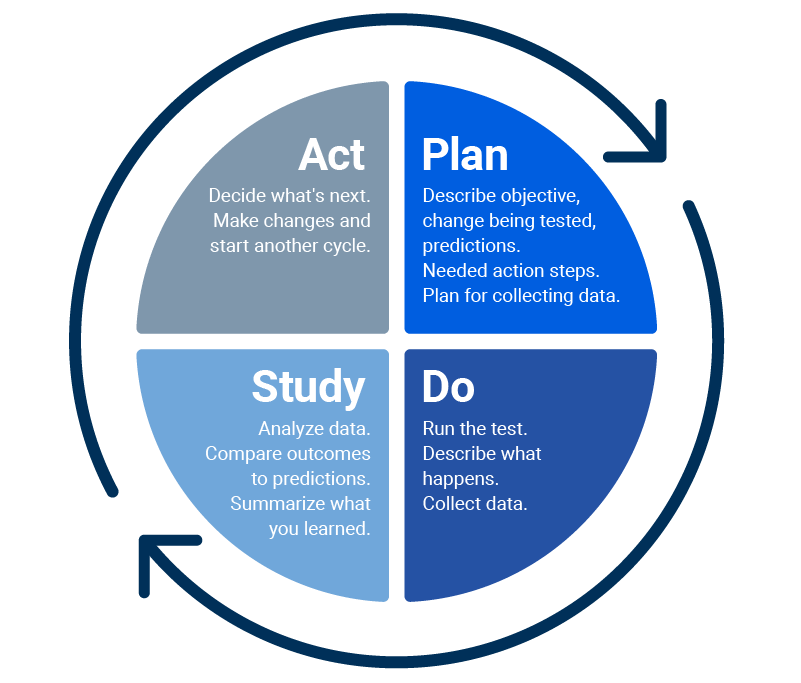
The circle in the image does not mean you must keep working indefinitely. One small test can end with “I learned enough for today.” If the task is blocked because you are ill or exhausted, resting may be the appropriate decision; your health is not a technical fault to debug.
Make a prediction before you try a fix
A useful hypothesis connects an explanation to an observable result: “If I try this small change, I expect to see this result, because…” The explanation helps you choose a test; the expected result tells you what to look for.
Return to the article example. Suppose your notes contain details about old maps showing gardens, newer maps showing shops, and residents describing more commercial activity, but you have no main-point sentence. You might write:
Hypothesis: I am treating the maps and interviews as separate main points. If I first ask what change all three describe, I expect to write one main-point sentence within eight minutes.
This is different from “I need to study writing from the beginning.” It uses information already in front of you, makes a prediction, and sets a limit. It is also kinder and more accurate than turning a single difficulty into a claim about your ability.
Test one change at a time when you can. If you open five guides, switch articles, and rewrite all your notes at once, you may produce a sentence but not know what helped. Here, the test is simply to use the existing notes to identify their shared change.
The Institute for Healthcare Improvement discusses this principle in the context of improving services. You do not need its healthcare example; the useful parts are its advice to shrink a test and learn from its result.
How to Improve: Model for Improvement: Testing Changes | Institute for Healthcare Improvement
The Institute for Healthcare Improvement’s “Testing Changes” guide shows why a small test can be more useful than a large, irreversible fix. Read two short parts of “Tips for Testing Changes.”
Under “Tips for Testing Changes,” find the bullet “Scale down the size of the test.” Read the small-test advice, from its example of reducing the number of people or the duration through the end of that bullet. Then find “Collect useful quantitative and/or qualitative data during each test.” Start at its advice about avoiding new software and read the reflection advice through the end of the “Reflect on the results of every change” bullet. Focus on how to record what happened even when the change did not work.
Test, then review what the result actually says
For the article blockage, a test could be: set aside the guides, look only at the existing notes, and spend up to eight minutes writing the change that the maps and interviews describe. Record the sentence, or record that no sentence emerged. Either is a result.
Imagine you write, “The neighborhood became more commercial over time.” Your prediction was met for this paragraph. That suggests the “shared change” prompt was useful, but it does not prove you have found the only cause of the blockage or mastered every kind of summary. Your next decision might be to use that sentence as the opening of your private summary, or simply stop for the morning.
If no sentence emerges, the test still narrows the problem. Perhaps you cannot tell whether the article is making a claim or merely describing events. That is a much smaller learning question than “How do I learn to write?” You could take it to one suitable source on another morning, using the search limit from earlier lessons.
The same reasoning works for a technical problem. Suppose an article link does not open. “My internet is broken” is one hypothesis, not a fact. A small test is to try a website you already know normally works in the same browser, then try the article link once more. If the familiar site opens but the article still does not, that challenges the idea that all connectivity has failed. It does not prove the link itself is broken: the article’s site may be unavailable or require access. Record the visible error message privately, then choose the next narrow check only if you need one. There is no reason to reset your computer, install a tool, or share private information for this first test.
Review therefore has two parts: compare prediction with observation, then decide what the evidence warrants. “It worked once,” “it did not work,” and “the result is unclear” are all legitimate outcomes. None is a judgment about you.
A compact note can hold the whole loop:
Define: What specific task is blocked, and what did I observe?
Hypothesize: What is one possible explanation? What result would I expect from one small change?
Test: What safe, reversible action will I try, and when will I stop?
Review: What happened? What will I keep, change, ask, or leave for another day?
If you have an ordinary-energy morning, you can use this note on one real blockage, with a short limit for the test. On a low-energy morning, defining the blockage and writing one possible hypothesis is enough. After an interruption, return to the note as it stands; there is no backlog of tests to repay.
Closing perspective
A blockage becomes easier to investigate when you describe it precisely, propose a tentative explanation, run a small safe test, and compare what happened with what you predicted. The result may be a fix, a better question, or a sensible stopping point. All three are progress in understanding the task.
This completes the module on just-enough learning and structured problem-solving. Next, you will begin an evidence inventory of things you have already tried and made—from language learning to websites and creative work—without treating any one attempt as a final judgment about your strengths.