Introduction
Hello! Welcome back to our course on debugging your learning process.
In our last lesson, we established the crucial difference between working memory and long-term memory. We used the analogy of a computer's RAM (fast, active, but very limited) and its hard drive (vast, stable storage). You learned that the primary bottleneck in learning is the limited capacity of your working memory.
Today, we'll dive deep into that bottleneck. This lesson addresses the learning outcome: Explain how cognitive load affects your capacity to learn new information.
We'll explore "Cognitive Load Theory," which is the formal name for the strain you feel when trying to process new information. You'll learn why tackling a new topic can sometimes feel overwhelming and, more importantly, what you can do about it. Understanding cognitive load is like understanding the performance limits of your brain's "RAM" so you can manage it for optimal learning.
What is Cognitive Load?
Cognitive load is the total amount of mental effort being used in your working memory at any given moment. When this load exceeds your working memory's capacity, you experience cognitive overload. Information becomes difficult to process, you get frustrated, and learning stops.
Think back to our RAM analogy: if you try to run a demanding video editing application, a complex 3D rendering program, and 50 browser tabs all at once on a computer with limited RAM, it will slow to a crawl or crash. Your brain works in a similar way.
To get a formal introduction to this idea, let's watch a brief explainer video.
Cognitive Load Theory: A brief explainer
This video from the Education Endowment Foundation provides a clear and concise introduction to Cognitive Load Theory and its two primary components.
Please watch from the beginning to 02:48. Focus on the definitions of cognitive load, intrinsic load, and extraneous load, and how they combine to potentially overwhelm working memory.
The Three Types of Cognitive Load
As the video explained, not all mental effort is the same. Cognitive psychologists have refined the theory to distinguish between three types of load. As a UX designer, you'll find these distinctions particularly intuitive, as they mirror the challenges of designing a user-friendly experience.
The goal isn't to eliminate all cognitive load, but to manage it effectively. The goal is to reduce the "bad" load to make room for the "good" load, where real learning happens.
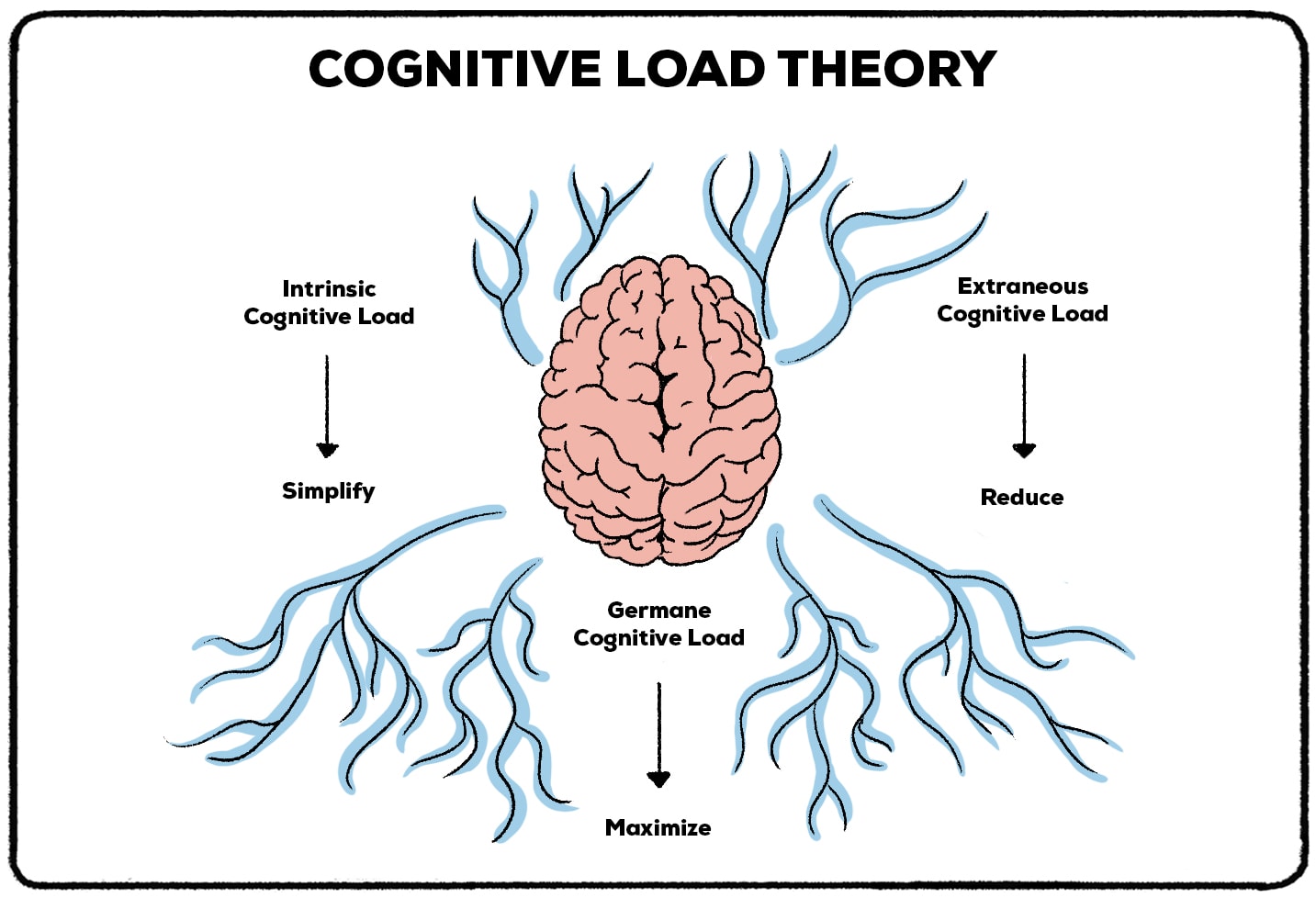
Let's break them down:
- Intrinsic Load: This is the inherent difficulty and complexity of the material you are trying to learn. Learning the basic structure of an HTML page has a low intrinsic load. Learning asynchronous JavaScript and concepts like Promises has a much higher intrinsic load because it involves more interacting elements. This is the necessary cost of learning the topic.
- Extraneous Load: This is the unnecessary mental work created by the way information is presented. It's the "bad" load because it consumes working memory without contributing to learning. Examples include a cluttered textbook page, a video with distracting background music, or a poorly structured tutorial.
- Germane Load: This is the "good" or "effective" load. It's the desirable mental effort you spend on processing new information, making sense of it, and connecting it to what you already know (building mental models, or "schemas"). This is where deep learning occurs.
Your total cognitive load is, roughly speaking, the sum of these three.
Since your working memory capacity is fixed, if intrinsic and extraneous loads are too high, there's no mental capacity left for germane load. Learning stalls.
This short video provides a great summary of how these three types fit together.
Cognitive Load Theory 3 - intrinsic, extraneous, germane.
This '3 Minute Ed Theory' video offers a quick but comprehensive look at all three types of cognitive load, emphasizing the role of germane load in the learning process.
Watch the entire video (it's short!). Pay special attention to the definition of germane load and how it represents the actual process of understanding.
Managing Cognitive Load: Designing Your Own Learning Experience
As a UI/UX designer, you are already an expert in managing cognitive load for users. You strive to create interfaces that are clear, intuitive, and free of distractions. You reduce the effort needed to find information or complete a task so the user can focus on their goal.
You can apply the exact same principles to your own learning. Think of it as designing a "learning user interface" for your own brain. Your goal is to minimize extraneous load so you have maximum working memory capacity available for intrinsic and germane processing.
The following article is written for instructional designers, but you'll find the concepts directly applicable to your work and your learning goals.
What Is Cognitive Load Theory? Instructional Design and ...
The article 'What Is Cognitive Load Theory?' from Articulate connects CLT directly to the world of design. It provides excellent, practical advice on managing all three types of load.
Please read two sections: 'Applying cognitive load theory in e-learning design' and 'Common mistakes that increase cognitive load in e-learning'. As you read, reflect on how these 'bad design patterns' for learning are similar to bad UX/UI design patterns you already know.
Key Design Patterns to Avoid in Learning
Let's highlight two classic "bad design patterns" that increase extraneous cognitive load, drawn from principles in the article you just read and broader cognitive science research.
-
The Split-Attention Effect: This occurs when you have to mentally integrate multiple sources of information that are separated physically or in time. For example, reading a diagram on one page of a book while the explanatory text is on the next page. A good UX designer would never place a button label far away from the button itself. Likewise, you should seek or create learning materials that place all related information together.
-
The Redundancy Effect: This happens when the same information is presented simultaneously in multiple forms, forcing your brain to process both. A common example is a presentation slide that has a full paragraph of text while the presenter reads that exact same paragraph aloud. Your brain can't help but try to process both the visual text and the auditory narration, which is an unnecessary burden. This is why effective presentations often use visuals to complement the spoken word, not duplicate it.
Test your understanding!
You're trying to learn a new prototyping tool by watching a video tutorial. Analyze the following scenario and identify the sources of intrinsic, extraneous, and germane cognitive load.
The tutorial is about creating a complex, multi-state interactive component. The concepts of states, variants, and conditional logic are new to you. The video creator has loud electronic music playing in the background, uses a very cluttered interface with dozens of open panels, and their mouse cursor is almost invisible. However, halfway through, they pause and say, "Notice how this logic is similar to the 'if-then' statements we use in programming. It's just a visual way of controlling which screen appears next."
Show answer
- Intrinsic Load: The inherent complexity of understanding multi-state components, variants, and conditional logic for the first time. This load is unavoidable if you want to learn the topic.
- Extraneous Load: This comes from multiple sources: the loud background music, the cluttered on-screen interface, and the hard-to-see mouse cursor. All of these force your brain to work harder for reasons that have nothing to do with learning the prototyping tool.
- Germane Load: This happens when you process the creator's prompt to connect the new concept to something you might already know (like 'if-then' statements). The mental effort you spend making that connection is germane load—it's the work of building a solid mental model.
Conclusion
In this lesson, you've learned how the limits of your working memory are defined by cognitive load. Understanding this concept is a major step in "debugging" your learning process, especially for tackling complex new skills like coding or data analysis.
Key Takeaways:
- Cognitive Load is the mental effort imposed on your limited working memory. Exceeding its capacity leads to cognitive overload and hinders learning.
- There are three types of load:
- Intrinsic: The inherent difficulty of the topic.
- Extraneous: Unnecessary load from poor presentation.
- Germane: The productive effort of deep processing and making connections.
- Your goal is to manage intrinsic load (e.g., by breaking problems down), minimize extraneous load, and maximize germane load.
- Managing cognitive load is analogous to good UX design: you are creating a clear, efficient, and effective experience for your own brain.
In our next lesson, we will explore the difference between short-term performance and long-term learning. You'll discover why some learning activities feel productive but lead to poor retention, and why others that feel more difficult are actually far more effective in the long run.