Hello! Congratulations on completing Project 2 and crafting a professional technical summary. You've successfully navigated the entire design process for a rotary mechanism, from requirements to final documentation.
Now, we embark on the final and most exciting part of this course: Project 3, your Independent Product Development. This is where you'll bring together all the skills you've learned to tackle a problem of your own choosing.
Today's lesson kicks off this new module by addressing the learning outcome: Brainstorm and select a real-world mechanical problem suitable for a portfolio project. This is arguably one of the most critical steps for any engineer. Identifying a meaningful problem and defining a compelling project around it is the foundation of all great design work.
1. What Makes a "Good" Portfolio Project?
Before we start generating ideas, let's define our target. A strong portfolio project is more than just a cool gadget; it's a story that demonstrates your engineering capabilities to a potential employer. Your two previous projects were designed to build your skills; this one is designed to showcase them.
A successful portfolio project should:
- Solve a clear and relatable problem.
- Exhibit technical depth in mechanical design.
- Provide opportunities to apply key skills like CAD, FEA, DFMA, and GD&T.
- Be realistically achievable within our remaining timeframe (about 20 lessons) as a digital-only project.
Mechanical Engineering Projects
The article 'Mechanical Engineering Projects' from Hardware Is Hard provides an excellent framework for thinking about what makes a project stand out. We'll use it to set our criteria.
Please read the sections 'The Idea', 'Bad Ideas', and 'Good Ideas'. As you read, focus on the three key characteristics they propose for a good project. Since our project is digital-only, think of 'Electrical Components' and 'Clever Code' as designing the mechanical systems that would interface with motors, sensors, and control logic.
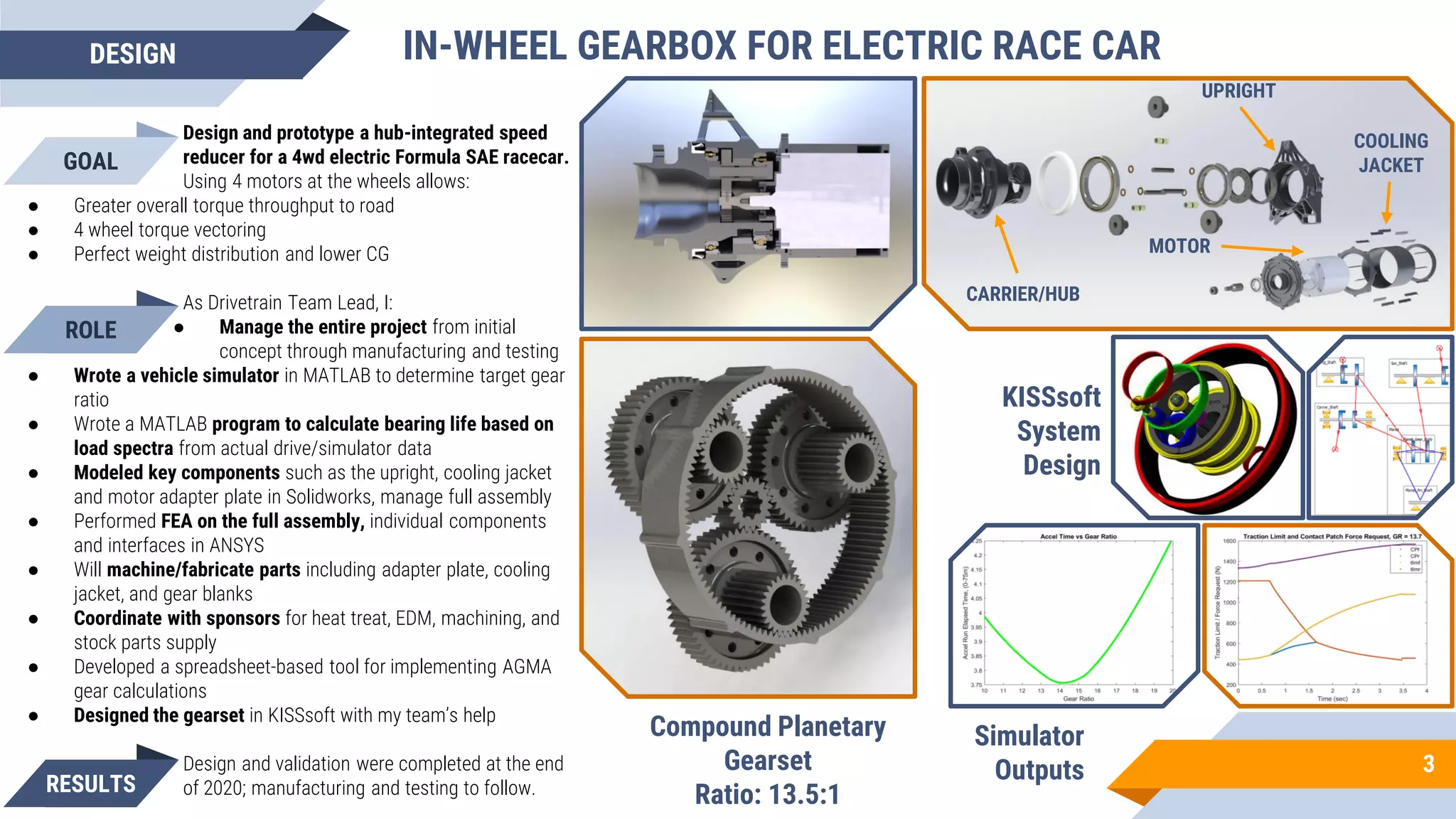
As the article suggests, the goal isn't to create something completely unheard of, but to tackle a problem with technical rigor and creativity. The project showcased in the image below, an in-wheel gearbox for a race car, is a perfect example of a complex, well-documented project that would impress any hiring manager. It demonstrates deep analysis and a clear understanding of advanced mechanical principles.
2. The Brainstorming Process: From Problem to Idea
The best engineering solutions start not with an idea for a product, but with a deep understanding of a problem.
Phase A: Problem-First Thinking
A common pitfall is to start with a solution in mind (e.g., "I want to design a robot arm"). A better approach is to start with a problem (e.g., "Repetitive tasks in a small workshop are inefficient and strain-inducing"). This opens up a much wider range of creative solutions.
18 (ish) Mechanical Design Tips and Tricks for Engineers Inventors and Serious Makers: # 093
This video from Jeremy Fielding, a practicing engineer, perfectly illustrates the importance of separating the problem from the solution.
Watch the segment from 00:48 to 04:09. Pay close attention to his example of the 'lawnmower' versus 'shortening grass' and his advice on defining constraints and researching existing solutions. This mindset is the key to innovation.
Think about your own life, hobbies, or past work experiences.
- What daily tasks are inefficient or frustrating?
- What device or tool do you own that could be significantly improved?
- What common problem have you seen that lacks a good mechanical solution?
Phase B: Finding Inspiration
Sometimes, the best way to get your own ideas flowing is to see what problems others are solving. University capstone projects are a goldmine for this.
2025 Mechanical Engineering Capstone Designs
Let's look at a list of recent capstone design projects from the University of Waterloo. These are all real-world problems tackled by senior engineering students.
Browse through the project descriptions (Projects 1-38). Don't get bogged down in the details. Instead, look for project themes that interest you. For example: assistive devices (LiftAssist, EasyTurn), automation (PHANTOM, WeedWarden), recycling/sustainability ((PLA)yback), or manufacturing tools (PivotPrint, Custom CNC Plasma Cutter).
Your Task (Part 1): Generate Initial Ideas (15 minutes)
Based on the videos, articles, and your own reflections, list 3 to 5 potential project ideas. For each one, write a single sentence describing the problem it aims to solve.
- Example 1: Problem: Photographers and videographers who need smooth, repeatable camera motion on a slider often have to buy expensive motorized systems or rely on inconsistent manual pushes.
- Example 2: Problem: At-home 3D printing often fails due to filament spools becoming tangled, requiring manual intervention and wasting material.
- Example 3: Problem: Cyclists who store their bikes vertically in an apartment struggle to lift and secure them onto high wall mounts.
Don't filter yourself yet. The goal is to get a range of possibilities on paper.
3. Scoping and Selecting Your Project
Now that you have a list of potential problems, it's time to evaluate them and choose the one that will become Project 3. A project that is too simple won't be impressive, but one that is too ambitious may be impossible to complete.
Best Personal Engineering Project Ideas for College Students (AT HOME)
The video 'Best Personal Engineering Project Ideas' offers some practical advice on scoping your first independent project.
Please watch from 00:55 to 01:32 and from 02:00 to 02:51. The key takeaway here is to balance ambition with feasibility. Your project needs to be complex enough to be challenging, but simple enough that you can successfully complete it and create a polished portfolio piece.
Use the following questions to evaluate each of your ideas:
- Personal Interest: Am I genuinely curious and excited about this problem? Your motivation will be your most valuable asset.
- Scope & Feasibility: Can this be designed and documented digitally within the remaining ~20 hours of the course? Is it a mechanical system that can be modeled in OnShape and analyzed with its FEA tools?
- Technical Showcase: Does this project require designing moving parts (linkages, gears, lead screws)? Will it have structurally critical components suitable for FEA? Can I apply DFMA and GD&T principles meaningfully?
- Portfolio Narrative: Does this project solve a clear, compelling problem that will be easy to explain in a portfolio or interview?
Test your understanding!
Imagine one of your ideas is to "design a fully autonomous warehouse sorting robot." How does this idea fare against the evaluation criteria, especially scope and feasibility for this course?
Show answer
While highly ambitious and interesting, this project is likely too large in scope. A "fully autonomous" robot involves complex electronics, sensor fusion, and advanced software, which fall outside the focus of our mechanical design course and digital-only constraint.
A better, more focused version would be to scope it down. For example: "Design the mechanical gripper and wrist mechanism for a warehouse sorting robot, optimized for handling various package sizes and manufacturability." This is a purely mechanical problem that is challenging, feasible, and allows you to showcase all your core skills.
Your Task (Part 2): Select Your Project (10 minutes)
Review your list of ideas from Part 1. Choose the one that best balances personal interest with technical challenge and feasibility.
Once you have made your choice, write a one-paragraph "Project Intent" statement. This should briefly explain:
- The problem you are tackling.
- A high-level vision for your mechanical solution.
- Why you chose this project and believe it's a good fit for your portfolio.
This statement will be the starting point for our next lesson.
Conclusion
You've taken the first, decisive step in your capstone project today. By exploring different problem spaces and applying a structured evaluation process, you have defined a project that is not only a vehicle for learning but also a future centerpiece of your professional portfolio.
Key Takeaways:
- A great engineering project starts with a well-defined problem, not a pre-conceived solution.
- Inspiration can come from daily life, but looking at academic and industry projects can spark new ideas.
- A good portfolio project must balance ambition with feasibility. It should be technically deep but achievable within your constraints.
- Selecting a project you are genuinely interested in is crucial for maintaining motivation and producing your best work.
Preview of the Next Lesson:
With your project idea selected, our next step will be to formalize it. You will learn to define the project scope, including key requirements, constraints, and deliverables. This is where we transform your idea into a concrete engineering task, setting the stage for the entire design process.