Hello! Welcome to the next lesson in our module, Visual Storytelling with AI.
In our previous session, you learned the critical techniques for creating a consistent character across multiple images using descriptive persistence (the "Character DNA") and fixed seed numbers. This is a huge step, as you can now create a recognizable star for your stories.
But a character is only one part of the puzzle. A story unfolds through a sequence of actions and events. This lesson bridges the gap between your character and your narrative by teaching you how to script a comic book page, including panel descriptions, action, and dialogue.
Think of a script as the architectural blueprint for your comic page. Just as clear specifications in an IT project lead to a predictable outcome, a well-structured script ensures your AI image generator produces the exact panels you need, saving you countless hours of trial and error. We'll cover the professional format for comic scripts and, most importantly, how to adapt it for an AI "artist."
1. The Anatomy of a Comic Script
Unlike a movie screenplay, the comic book industry doesn't have a single, universally mandated script format. However, there are professional conventions that writers follow to ensure clarity for their collaborators—the artist, letterer, and editor. For us, our primary collaborator is the AI.
To get a sense of the professional landscape, let's start with an overview of comic book scripting.
How to write a comic book script - Snooby Comics - Shannon Newby
In this video, 'How to write a comic book script,' creator Shannon Newby explains that while there isn't one single standard format, clarity and organization are paramount. This will give you the foundational mindset for writing a good script.
Watch the first 3 minutes and 35 seconds. Pay attention to his main point: the most important thing is for the script to be clear, concise, and easy for your team (in our case, the AI and you) to follow.
The core principle, as you just heard, is clarity. Your script is a set of instructions. If the instructions are vague, the output will be unpredictable.
2. The Core Components of a Script
Now, let's break down a script into its essential building blocks. We'll use a professional format as our guide. It may look detailed, but each part serves a specific purpose in organizing the story.
This article, 'Anatomy of a Comic Script,' by veteran comic writer Fred Van Lente, is an excellent, detailed guide to a professional script format. We'll use it to understand the key components.
Read the sections titled 'A) PAGE NUMBERS,' 'B) Panel Numbers,' 'C) Line (or Balloon) Numbers,' and 'D) Formatting Dialogue.' These sections break down the fundamental structure you'll be using.
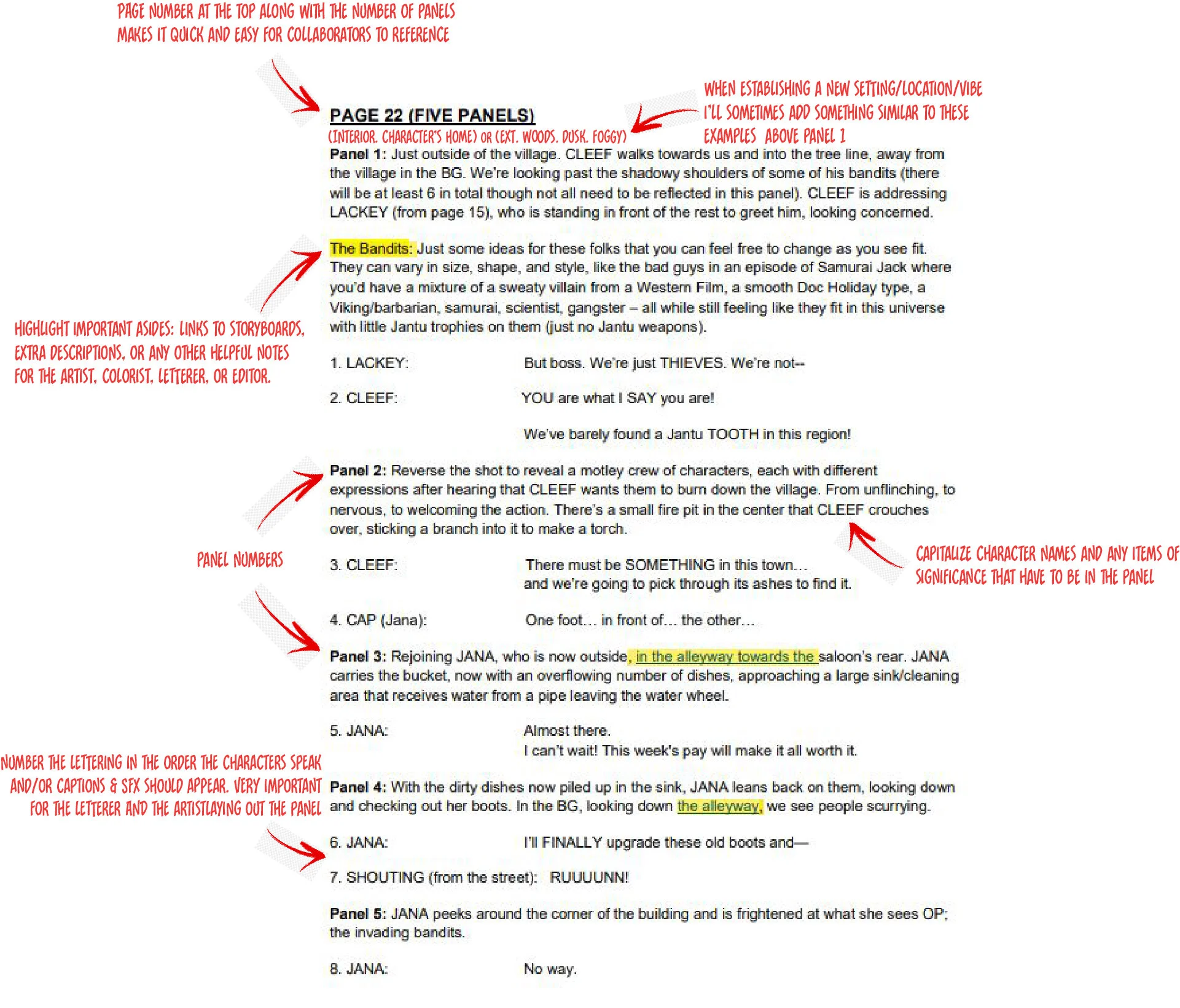
Based on that reading, here are the essential elements you'll structure your script with:
- Page: This is the highest level of organization. Each page of your final comic gets its own
PAGEheading in the script (e.g.,PAGE ONE). - Panel: Each page is broken down into panels, which are the individual boxes on the comic page. You'll number them sequentially (e.g.,
PANEL 1,PANEL 2). - Panel Description: This is where you describe everything the reader sees in the panel: the setting, the characters, the "camera" angle, and any actions taking place. For us, this is the most important part, as it will form the basis of our AI image prompt.
- Dialogue: This is what a character says. It's typically indented and formatted with the character's name first.
- Caption: This is narration or a character's thoughts, often presented in a rectangular box rather than a speech bubble.
Here is an example of a professionally formatted script page that puts all these pieces together. Notice how it clearly separates visual descriptions from dialogue for each panel.
3. Adapting the Script for an AI Artist
The format we just learned is designed for a human artist who can interpret instructions like "she looks worried." An AI cannot do this. It needs explicit, descriptive instructions. This is where your prompt engineering skills come back into play.
Your Panel Description must become a ready-to-use, detailed prompt.
Your Guide to Using a Comic Book Generator
This article, 'Your Guide to Using a Comic Book Generator,' explains exactly how to 'script for the AI.' It's the perfect bridge between traditional scripting and our AI-powered workflow.
Please read the sections 'From Narrative Idea to Visual Script,' 'Mastering the Character Call Sign,' and 'Generating Panels from Different Angles.' Focus on how it translates a simple narrative idea into the kind of highly specific visual detail an AI needs.
As the article highlights, you need to combine the structure of a comic script with the descriptive precision of a master prompt. Let's make this concrete.
A script for a human might say:
PANEL 1:
Anya enters the dark alley, looking worried.ANYA (Caption):
I had a bad feeling about this.
A script for an AI must be far more detailed:
PAGE ONE
PANEL 1
Description for AI:Wide angle shot of a dark, narrow city alleyway at night. Rain slicks the pavement, reflecting distorted neon signs. Anya, a female detective with short black hair in a messy bob and sharp green eyes, wearing a worn brown leather jacket, stands at the entrance of the alley. Her face shows worry, eyebrows furrowed, looking into the deep shadows. Gritty film noir aesthetic, high contrast, dramatic shadows.ANYA (Caption):
I had a bad feeling about this.
Notice how the "Description for AI" includes:
- The "Character DNA" or "call sign" from our last lesson.
- The shot type (
Wide angle shot). - Specific details about the environment (
Rain slicks the pavement). - A clear description of the character's expression (
eyebrows furrowed). - The overall artistic style (
Gritty film noir aesthetic).
Your script becomes a container for your pre-written, carefully crafted prompts.
4. Using AI to Help Write the Script
You don't have to do all this work from scratch. You can use a text-based AI like ChatGPT to generate a first draft of your comic script, which you can then refine.
How to Make a Professional Comic Book with AI (Step by Step)
Let's watch a short segment from 'How to Make a Professional Comic Book with AI' that demonstrates this process. The creator uses ChatGPT to generate premises and then a panel-by-panel script.
Watch from 02:14 to 03:35. See how the creator gives the AI the characters and a premise, and asks for a multi-page comic script broken down by panels. Notice he also mentions that he still needs to edit the AI's output for better flow.
This is an excellent way to accelerate your workflow. You can provide the AI with your characters, your story idea, and the number of pages/panels, and it will give you a structured starting point that you can then edit and enhance with your detailed "Description for AI" blocks.
Test your understanding!
Let's continue with the character Sir Reginald from the last lesson's exercise. Your story idea is: Sir Reginald is scared of a noise, but it turns out to be a tiny, friendly dragon stuck in a bush.
Your task is to script the first three panels of this story. For each panel, provide the Panel Number, the Description for AI, and any Dialogue/Caption. Remember to embed Sir Reginald's "Character DNA" into your descriptions!
Sir Reginald's DNA Recap: 8-year-old knight, short and stocky, big expressive brown eyes, freckles, messy red hair, oversized silver armor. Whimsical storybook style.
Show answer
Here is one possible way to script this:
PAGE ONE
PANEL 1
Description for AI: Medium shot. Sir Reginald, an 8-year-old knight with big expressive brown eyes and freckles, wearing oversized silver armor and messy red hair sticking out from his helmet. He is standing in a lush green forest, looking off-panel with a scared expression, eyes wide, body trembling slightly. Whimsical children's storybook illustration, soft watercolor style.
CAPTION:
In the Whispering Woods, Sir Reginald was known for being very brave... most of the time.
PANEL 2
Description for AI: A thorny green bush rustles violently. Leaves and small twigs are shaking. The forest background is slightly out of focus to emphasize the bush. Whimsical children's storybook illustration, soft watercolor style.
SFX (Sound Effect from the bush):
RUSTLE! RUSTLE! SQUEAK!
PANEL 3
Description for AI: Close up on Sir Reginald's face. He is peering cautiously from behind a large oak tree, one eye peeking around the bark. His expression is a mix of fear and curiosity. Whimsical children's storybook illustration, soft watercolor style.
REGINALD (Whispering):
W-what was that?
Conclusion
You now have a complete framework for translating a story idea into a structured, actionable blueprint for your AI image generator. This is a foundational skill for creating coherent comics and picture books.
Key Takeaways:
- A comic script's primary goal is clarity, organized by Page and Panel.
- The main components are the Panel Description, Action, and Dialogue/Captions.
- When scripting for an AI, the Panel Description must be a highly detailed visual prompt, including character DNA, shot type, setting, action, and style.
- You can use AI text generators like ChatGPT to create a first draft of your script, saving you time.
Preview of the Next Lesson:
You've created a consistent character. You've now written a script that tells that character what to do. The next logical step is to execute that script. In our next lesson, we will generate individual comic book panels from a script while maintaining style and scene consistency, bringing your story to life, one panel at a time.