Hello! Welcome back to our module on Editing and Polishing Your Manuscript.
In our last lesson, we focused on using AI as a diagnostic tool. You learned how to prompt it to act as a "debugger" to find and fix major structural issues like plot holes and logical inconsistencies, and how to use rephrasing tools to combat basic repetition.
This lesson addresses the crucial next step. Now that the raw, AI-generated text is structurally sound, we need to apply the human touch to make it readable and engaging. Our goal is to apply human editing to improve the flow, transitions, and narrative coherence of the manuscript. This is where you transform a collection of correct sentences into a smooth, compelling narrative that pulls the reader along effortlessly.
1. What Breaks Flow? Identifying the Hallmarks of AI Writing
Before you can fix a problem, you need to be able to spot it. AI-generated text often has tell-tale signs that, while not "wrong" in a grammatical sense, create a clunky and unnatural reading experience. These "AI-isms" disrupt the flow and signal to the reader that the text is robotic.
A great way to train your editorial eye is to understand these common characteristics.
#5 Humanizing AI Text for Academic Papers (No Tools Needed!)
The video 'Humanizing AI Text for Academic Papers' by Ref-n-Write Academic Software provides a clear breakdown of what makes AI text feel artificial. Though it mentions academic papers, the principles apply universally to any genre of writing.
Please watch from 00:42 to 05:46. Pay close attention to the four main characteristics of AI text discussed: Similar Sentence Length: How this creates a monotonous rhythm. Repetitive Phrases: The AI's tendency to reuse certain words and structures. Clichés and Fluff: Common, meaningless phrases like "In today's world..." Outdated/Formal Language: Word choices that sound unnatural in conversation.
As you edit your manuscript, actively hunt for these four issues. Ask yourself:
- Does this paragraph feel like a monotonous drumbeat of sentences all the same length?
- Am I seeing the same transition words or adjectives over and over?
- Could I remove this phrase without changing the meaning of the sentence?
- Would a person actually say this, or does it sound like a legal document?
2. The Mechanics of Flow: Building Bridges Between Ideas
Now that you know what to look for, let's explore the techniques for fixing it. Improving flow isn't about vague feelings; it's a structural process. In your IT work, you optimize code to reduce processing load. In writing, you optimize sentences to reduce the reader's cognitive load.
The following video is an excellent primer on the core techniques for creating this "syntactic flow."
Make Your Writing Flow | Sentences: Transitions, Subordination, and Modification
The 'Writing with Andrew' channel offers a fantastic explanation of how sentence structure affects readability. This video will give you three powerful tools to add to your editing toolkit.
Watch the entire video (around 10 minutes). It's worth your time. Focus on understanding these three core concepts: Transitions (02:05): How words like however, in fact, and furthermore act as signposts for the reader. Subordination (04:00): Using dependent clauses to create 'ramps' between ideas instead of abrupt 'steps'. This is key to varying sentence structure. Modification (06:47): Turning whole sentences into descriptive phrases to pack in more information without stopping the flow.
To summarize the key takeaways:
- Transitions explicitly tell your reader how one idea connects to the next (e.g., contrast, addition, cause-and-effect).
- Varying sentence structure is crucial. A text made only of short, simple sentences feels choppy. A text made only of long, complex sentences is exhausting. A mix is dynamic and engaging. Subordination and modification are your primary methods for achieving this.
- Don't overdo it. As the video notes, constant flow can become monotonous. A short, punchy sentence can be used for emphasis. Variety is the ultimate goal.
3. Your Practical Checklist for Improving Coherence
We've covered the what and the how. Now, let's put it into a practical, repeatable process. Coherence is the logical and thematic connection of your ideas. When a manuscript is coherent, the reader can follow your argument or story without confusion.
The article below provides an excellent, actionable checklist for the human editing phase.
Writing Coherence & Readability - Humanize ...
The article 'Writing Coherence & Readability' from Writeme.ai consolidates many of these editing techniques into a clear, easy-to-follow list and provides a great before-and-after example.
Please read the following parts of the article: Start at the heading 'Here are some additional ways to humanize AI-generated content to improve coherence' and review the bulleted list of techniques. Pay special attention to 'Paragraphing,' 'Rephrase and Simplify,' and 'Read Aloud.' Carefully study the example under the heading 'Let’s Take an Example of How Human Editing Improves AI Text' and the analysis in 'So, What Changed?'.
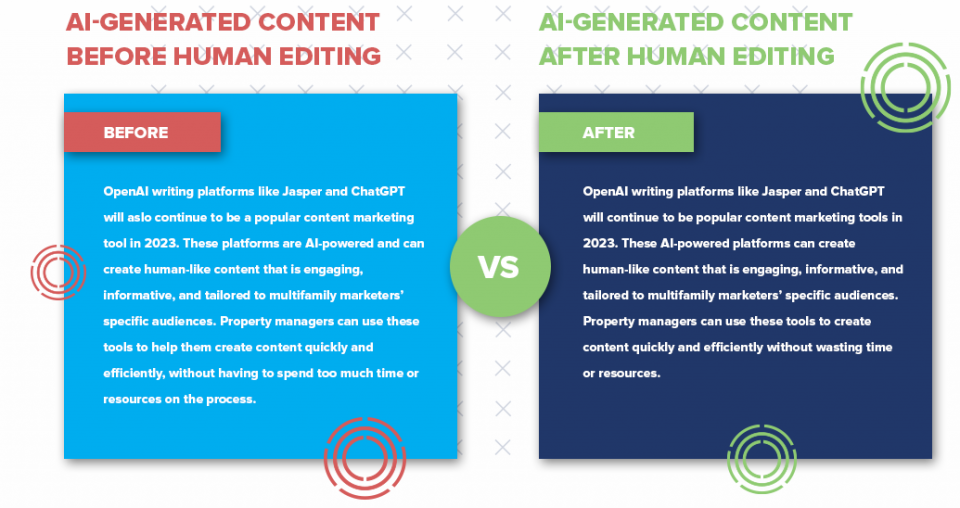
Your Human Editing Workflow
Based on the resources, here is a systematic workflow you can apply to each chapter of your manuscript after you've run the AI-driven checks from our last lesson:
- Read the Text Aloud: This is the single most effective technique. Your ear will catch awkward phrasing, poor rhythm, and clunky sentences that your eyes will skim over. If you stumble while reading a sentence, it needs to be rewritten.
- Break Up Paragraphs: AI models often generate dense walls of text. Break these into smaller paragraphs (3-5 sentences is a good rule of thumb), with each paragraph focusing on a single, core idea. This creates "visual breathing space" for the reader.
- Vary Sentence Beginnings and Lengths: Go through a paragraph. Do several sentences in a row start the same way (e.g., "The system does...", "The user can...", "The algorithm is...")? Rewrite them. Combine short, choppy sentences into longer ones using subordination. Break up long, winding sentences into shorter, more impactful ones.
- Add Transition Words: Check the connections between sentences and paragraphs. Is the logical link clear? If not, add a transition word or phrase (e.g., However, Therefore, In contrast, As a result).
- Simplify and Clarify: Replace complex, formal language ("delving into," "it is essential to grasp") with simpler, more direct alternatives ("getting into," "it's important to understand"). Your IT background gives you the expertise to explain complex topics simply—leverage that.
- Add Your Own Examples: This is especially critical for your non-fiction books (business, tech, mentoring). Where the AI gives a generic example, replace it with a specific one from your 10 years of IT experience, a case study you know, or a personal anecdote. This adds immense value and credibility.

Test your understanding!
Here is a typical AI-generated paragraph for a business book. It is grammatically correct but lacks flow and coherence.
Digital marketing is very important. Companies need to use digital marketing. It helps them reach customers online. Social media is a part of digital marketing. Email marketing is also a part of it. SEO is important for digital marketing too. All of these things help a business grow.
Using the techniques you've learned in this lesson (varying sentence length, adding transitions, simplifying, improving flow), rewrite this paragraph to be more engaging and coherent.
Show answer
Here is one possible rewrite. Many other good versions are possible!
In today's connected world, digital marketing is no longer optional—it's essential for growth. By leveraging a range of online strategies, companies can effectively reach their target customers where they spend their time. These strategies typically include a mix of social media engagement, direct communication through email marketing, and search engine optimization (SEO) to improve visibility. Ultimately, a well-integrated approach using all of these channels is what fuels sustainable business growth.
What changed?
- Opening Hook: The first sentence is more engaging than "Digital marketing is very important."
- Transition & Flow: Phrases like "By leveraging..." and "These strategies typically include..." create smoother transitions between ideas.
- Sentence Variety: The sentences now have different lengths and structures, creating a better rhythm.
- Cohesion: The final sentence ("Ultimately, a well-integrated approach...") ties all the individual elements (social media, email, SEO) back to the main point of business growth.
Conclusion
In this lesson, you've moved from being an AI operator to a true editor. While the previous lesson taught you how to command an AI to fix its own large-scale errors, this lesson equipped you with the human-centric skills to refine the text into something genuinely pleasant to read.
Key Takeaways:
- Effective editing begins with spotting "AI-isms": uniform sentence length, repetition, clichés, and overly formal language.
- You can create flow and coherence using structural writing techniques like adding transition words, using subordination to vary sentence structure, and turning clauses into modifiers.
- A practical editing workflow involves reading aloud, breaking up text walls, varying sentences, adding transitions, and simplifying language.
- Your personal expertise is invaluable for replacing generic AI examples with specific, credible anecdotes and case studies.
Preview of the Next Lesson:
Your manuscript is now structurally sound, logically consistent, and flows smoothly. But it might still lack personality. In our next lesson, "Infuse the manuscript with a unique authorial voice that goes beyond the AI's default style," we will work on the final and most personal layer of editing: making the book sound uniquely like you.