Hello! Welcome to the sixth lesson in our module on Niche Research and Book Planning.
In our previous lesson, we dove deep into creating detailed outlines for non-fiction books. You learned how to break down chapters into subheadings and key points, a crucial skill for guiding an AI to produce high-quality, structured content.
Today, we pivot from informational structures to the architecture of storytelling. Many of your book ideas—children's stories, comics, and even some mentoring narratives—rely on compelling plots. Therefore, this lesson's outcome is to describe common story arcs and plot structures for narrative-driven books.
Think of these as the proven design patterns of storytelling. Just as in software engineering where you have frameworks and patterns like MVC or Singleton to solve recurring problems, story structures are time-tested blueprints for creating engaging narratives. Understanding them is the first step toward using AI to build stories that resonate with readers.
1. The Emotional Journey: Understanding Story Arcs
Before we get into the nuts and bolts of plot points, let's start with the big picture: the emotional journey of your story. This is called the story arc. It maps the protagonist's fortunes—their happiness, success, or well-being—over time. A story without an arc, without a rise and fall, is just a series of events.
The article below provides an excellent visual and conceptual introduction to story arcs, using simple graphs to illustrate how a character's journey can be shaped.
The 6 Types of Story Arcs for Powerful Narratives
To understand the fundamental shapes of stories, let's explore this article from The Write Practice. It clearly defines what a story arc is and breaks down the six most common emotional journeys found in literature.
Read from the beginning down to the end of the section 'The 6 Primary Story Arcs.' Pay close attention to the graphs that visualize each arc. This will give you a strong mental model for the emotional trajectory of a story.
As you've just read, stories can be distilled into a few core emotional patterns:
- Rags to Riches (Rise): A steady upward journey to success.
- Riches to Rags (Fall): A tragic downward spiral.
- Man in a Hole (Fall then Rise): The character gets into trouble and then gets out of it. This is one of the most common and popular arcs.
- Icarus (Rise then Fall): A character flies high only to come crashing down.
- Cinderella (Rise-Fall-Rise): The character gains something, loses it, and then regains it for good.
- Oedipus (Fall-Rise-Fall): A complex tragic arc of a character's doomed struggle.
These arcs are the emotional heartbeat of your story. When you later ask an AI to write a children's book, knowing you want a "Man in a Hole" arc will help you structure your prompts to create the necessary conflict and resolution.
2. The Thematic Blueprint: Basic Plot Archetypes
While arcs define the emotional shape, plot archetypes define the story's thematic blueprint. These are fundamental story types that have been told for centuries across all cultures.
The following short, animated video introduces the seven basic plots as identified by scholar Christopher Booker.
What are the 7 Major Plots in Storytelling?
This video from TruScribe provides a quick and engaging overview of seven foundational plot types. Think of these as high-level categories for your story ideas.
Watch the entire video (it's just over 4 minutes). As you watch, think about how your book ideas (e.g., a children's book, a comic) might fit into one of these categories.
Here are the seven archetypes from the video, which provide a great starting point for brainstorming:
- Overcoming the Monster: A hero must defeat a force of evil.
- Rags to Riches: A humble protagonist acquires success and fortune.
- The Quest: A hero embarks on a long journey to find a person, place, or object.
- Voyage and Return: The protagonist travels to a strange new world and returns changed.
- Comedy: A light-hearted story with confusion and mix-ups, ending happily.
- Tragedy: A story ending in disaster, often due to a character's fatal flaw.
- Rebirth: An event forces a negative character to change their ways.

3. The Step-by-Step Plan: Plot Structures
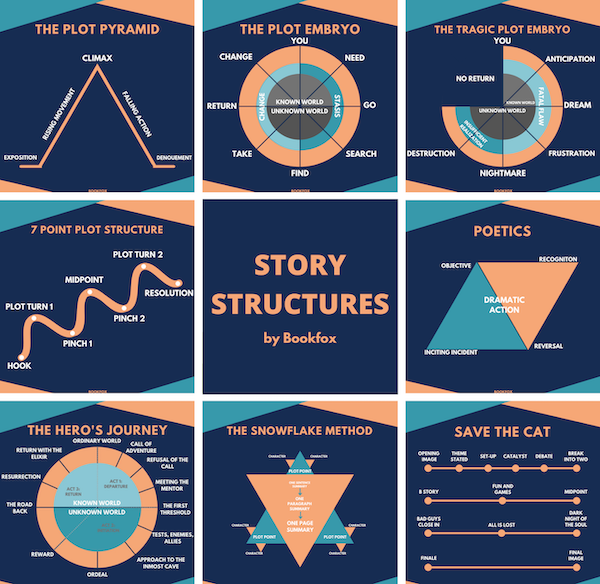
If arcs are the emotional shape and archetypes are the thematic blueprint, then plot structures are the detailed, step-by-step assembly instructions. They break a story down into specific events or "beats" that must happen in a certain order.
There are many, many plot structures. Your goal is not to memorize them all, but to understand a few key ones that you can use as powerful tools for outlining. This article gives a great overview of the landscape.
16 Narrative Structures to Plot a Book With
To appreciate the variety of plotting tools available, we'll consult this comprehensive guide from Campfire Writing. It defines the key terms and lists sixteen different frameworks.
First, read the introduction from the beginning down to the heading 'Sixteen Ways to Structure a Narrative.' Focus on the definitions of story, plot, and narrative structure. Then, quickly scan the list of 16 structures to get a sense of the variety. Don't worry about the details yet.
Now, let's zoom in on a few of the most influential structures. The video below explains several of them in a clear, practical way.
The TOP 10 Story Structures Used By Successful Writers
This excellent video from the Writing Chops channel breaks down ten of the most widely-used story structures. We'll focus on three of the most fundamental ones.
Watch the following three segments to understand these core structures: The Three-Act Structure (09:09 - 10:44): The foundation of almost all modern stories. The Writer's Journey (05:57 - 08:06): Christopher Vogler's practical, 12-step adaptation of the classic Hero's Journey. Save the Cat (13:32 - 16:10): A highly detailed, 15-beat structure popular in commercial fiction and screenwriting.
Let's recap those key structures:
- Three-Act Structure: The simplest and most universal.
- Act I: The Setup: Introduce the character, their world, and the inciting incident that kicks off the story.
- Act II: The Confrontation: The character faces rising stakes, obstacles, and challenges, leading to a major turning point.
- Act III: The Resolution: The character faces the final climax and the story wraps up.
- The Hero's Journey (Vogler's 12-Step Model): A detailed, cyclical structure perfect for adventure, fantasy, and transformation stories. It follows a hero who leaves their ordinary world, faces trials in a special world, and returns home changed.
- Save the Cat: A prescriptive 15-beat "beat sheet." Its detail makes it especially useful for AI-assisted outlining, as it breaks the story into very small, manageable chunks for the AI to handle.
Test your understanding!
Let's imagine a story idea for a children's book:
"A lonely, rule-following robot librarian named Unit 734 discovers a forbidden, imaginative storybook. To save the book from being deleted by the system's "Logic Police," Unit 734 must break the rules for the first time and go on a journey through the library's forgotten sections to find the legendary "Story Core," a place where imagination is safe."
Based on this premise, identify:
- A fitting Plot Archetype.
- A fitting Story Arc.
- A fitting Plot Structure.
Show answer
There can be multiple correct answers, but here are some strong choices:
- Plot Archetype: The Quest is a perfect fit. Unit 734 is on a journey to find a specific object (the Story Core). You could also argue for Overcoming the Monster (the "Logic Police").
- Story Arc: Man in a Hole or Cinderella. Unit 734 starts in a stable (but lonely) state, gets into trouble (discovering the book and being hunted), and must work to get back to a new, better state of safety and fulfillment.
- Plot Structure: The Hero's Journey is an excellent choice. Unit 734 leaves its "Ordinary World" (the orderly library), crosses a threshold into a "Special World" (the forgotten sections), faces tests and enemies, and will eventually return transformed.
Conclusion
Today you've learned to distinguish between the three fundamental layers of narrative design. This knowledge is not just theoretical; it's the strategic foundation you'll use to construct compelling stories with your AI assistant.
Key Takeaways:
- Story Arcs are the emotional shape of your narrative, tracking the rise and fall of your protagonist's fortunes (e.g., Man in a Hole, Cinderella).
- Plot Archetypes are the high-level thematic blueprints for your story (e.g., The Quest, Overcoming the Monster).
- Plot Structures are the detailed, step-by-step frameworks that provide the sequence of events or "beats" for your story (e.g., Three-Act Structure, The Hero's Journey).
Preview of the Next Lesson:
Now that you can describe these essential narrative patterns, the next step is to put them into practice. In our next lesson, you will learn how to apply a chosen plot structure to create a complete story outline using AI assistance. You'll take a story idea and, using a framework like The Hero's Journey, guide an AI to build a detailed, scene-by-scene plan for a narrative book.