Hello! Welcome to the fourth lesson in our module on Niche Research and Book Planning.
In our last lesson, you learned a systematic process for brainstorming and, more importantly, validating your book ideas. You now have a concept that is not only creative but also grounded in market realities—it targets a specific reader's pain point and has a unique angle.
Today, we move from the "what" to the "how." Our learning outcome is to generate a high-level structure for a non-fiction book, including main parts and chapter titles. Think of this as creating the architectural blueprint for your book. Just as a building needs a strong foundation and frame before walls go up, your book needs a solid structure before you start writing prose.
This structure will serve as your roadmap, ensuring a logical flow that guides your reader from their initial problem to the promised solution. Given your IT background, you can think of this as designing the system architecture before writing the code. A well-designed structure makes the entire development (writing) process more efficient and the final product more robust.
We will cover:
- The common structural patterns for non-fiction books.
- The mindset of being the "architect" who directs the AI.
- A practical, iterative process for prompting an AI to generate and refine your book's high-level structure.
Let's start by exploring the types of blueprints available to you.
1. Understanding Non-Fiction Book Structures
Before you can ask an AI to build a structure, you need to know what kind of structure you want. Non-fiction books aren't just a random collection of chapters; they follow established patterns that readers intuitively understand. Choosing the right pattern is the first step in creating a clear and compelling reader journey.
The following article by Emily Grabatin is an excellent guide to the most common non-fiction structures. It will give you the vocabulary and concepts needed to make an informed decision for your book.
How to Structure a Non-Fiction Book: 9 Ways Readers ...
Please read the article "How to Structure a Non-Fiction Book". It provides a comprehensive overview of different non-fiction structures you can use as a model for your own book.
Please read the following sections: Glossary for New Authors: Start here to understand the key terms: Structure, Framework, and Layout. 9 Structures for Non-Fiction Books: This is the core of the article. As you read through each of the 9 structures (e.g., How-To, The Big Idea, Narrative), think about which one would be the best fit for the validated book idea you developed in the last lesson. Pay attention to the "Structure Idea" for each type, as it shows a typical layout of parts and chapters. Why the Structure of a Non-Fiction Book Matters: Read this brief concluding section to reinforce the importance of this step.
After reading, consider your validated book idea. Which structure feels most appropriate?
- If you're writing a guide on "AI for Small Business," a How-To / Step-by-Step structure is a natural fit.
- If your book is about "The Future of Work in the AI Era," you might choose The Big Idea structure.
- If you're sharing your 10-year IT journey to mentor others, a How-to Memoir could be perfect.
Choosing a structure gives you a clear model to follow and instruct the AI on.
2. The Architect's Mindset: Directing Your AI
Now that you know what kind of structure you want to build, let's focus on how to guide your AI assistant. It's crucial to shift your thinking from being a simple user to being an architect or a systems designer. You provide the vision and the specifications; the AI executes the build.
This article by Jaideep Parashar, who has extensive experience using AI for book writing, perfectly captures this mindset.
I Wrote 42 Books Using ChatGPT: Here's What I Learned ...
The article "I Wrote 42 Books Using ChatGPT" explains the philosophy behind effective prompting for large projects. It will help you understand how to manage the AI to get high-quality, structured results.
Read through the short, numbered points in the article. Focus on these key ideas: Prompts as Systems: Think of your prompts as reusable templates, not one-off commands. Positioning Before Tasks: The importance of telling the AI who it is before telling it what to do. Iterative Prompting: The power of building your content in layers, not asking for everything at once. You Are the Architect: The core idea that AI builds the structure, but you inject the vision and insight.
The key takeaway is that you are in control. A strong prompt acts as a detailed project brief for your AI. The "ChatGPT Prompt Formula" image below provides a great visual breakdown of what a well-structured prompt includes.
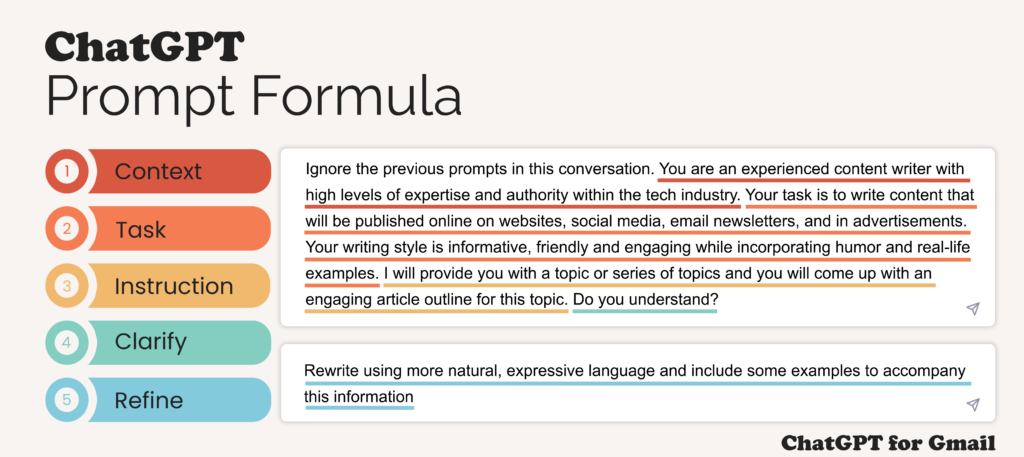
3. Generating Your Book's High-Level Structure
Let's put theory into practice. We'll now combine your chosen book structure with the architect's prompting mindset to generate your book's high-level outline. This is an iterative process: generate, evaluate, and refine.
Step 1: The Initial Generation
Start by crafting a detailed initial prompt. This prompt should include the role, the context, and the desired format.
Here is a template you can adapt:
Role: "Act as an expert book development editor who specializes in creating clear, marketable book structures for [Your Genre, e.g., 'business and tech books']."
Context: "I am writing a book titled '[Your Book Title]' for [Your Target Audience]. The book is a [Your Chosen Structure, e.g., 'How-To/Step-by-Step'] guide. The main goal of the book is to help the reader solve [The Core Problem] and achieve [The Main Benefit]."
Task & Format: "Generate a high-level book structure. The structure should be divided into 3 or 4 logical Parts. Each Part should contain 3-5 descriptive and benefit-driven Chapter Titles. The overall structure should guide the reader logically from their current state of [Problem/Pain Point] to the desired state of [Solution/Success]."
The following video shows a simple version of this process in action.
ChatGPT Prompts for Writing Nonfiction Books Fast
In the video "ChatGPT Prompts for Writing Nonfiction Books Fast," presenter Nicole Broussard demonstrates the basic workflow of asking for an outline after establishing an idea.
Watch the clip from 05:52 to 06:37. Notice how she takes the combined book idea and simply asks the AI to create an outline for it. This is our starting point.
Step 2: Evaluation and Refinement
The AI's first attempt is a draft, not a final product. Your expertise is crucial here. Review the generated structure.
- Does it flow logically?
- Are there any gaps?
- Is any chapter redundant?
- Do the chapter titles speak to your reader's needs?
This is where iterative prompting comes in. You can now use follow-up prompts to refine the structure. The next video clip is excellent for understanding this refinement process. While the presenter mentions a paid tool called Dibbly, the principle of critiquing and refining an AI-generated outline is universal and can be done directly in ChatGPT, Claude, or any other LLM.
How to Use AI to Write a #NoBoringBooks Bestseller: AI Book Ideas & Outlines in Minutes!
The video "How to Use AI to Write a #NoBoringBooks Bestseller" from Book Launchers demonstrates the critical step of analyzing and improving an AI-generated outline.
Watch from 11:25 to 13:37. The key insight here is how the presenter feeds the AI's own outline back to it and asks for a critique. The AI identifies weaknesses like an 'academic tone' and a 'heavy chapter load.' This shows you how to use the AI as a partner in the refinement process.
Examples of refinement prompts you could use:
- "This is a good start, but Part 2 feels too abstract. Rephrase the chapter titles in that section to be more action-oriented."
- "Chapter 7 seems to repeat the ideas from Chapter 3. Can you merge them into a single, more comprehensive chapter and suggest a new title?"
- "The flow from Part 1 to Part 2 isn't smooth. Suggest a new 'bridge' chapter that connects the 'why' (Part 1) to the 'how' (Part 2)."
By going back and forth with the AI, you can shape the initial raw output into a polished, logical, and compelling book structure.
Test your understanding!
Imagine your validated book idea is: "A Guide to Building a Personal Brand for Freelance IT Consultants." Your target audience is experienced IT professionals who are great at their technical work but struggle with marketing themselves.
- Which book structure from the LINK article seems most appropriate?
- Using the prompt template from this lesson, write an initial prompt to generate a high-level structure for this book.
Show answer
-
A How-To / Step-by-Step structure would be an excellent choice, as it's focused on teaching a process. A Big Idea structure could also work if you have a unique, overarching philosophy about personal branding.
-
Here is an example of a strong initial prompt:
"Role: Act as an expert book development editor specializing in practical business guides.
Context: I am writing a book titled 'The IT Consultant's Compass: A Guide to Building Your Personal Brand.' My target audience is freelance IT consultants who are technical experts but beginners at marketing. The book is a How-To/Step-by-Step guide. The main goal is to help them overcome their fear of marketing and build a brand that attracts high-paying clients.
Task & Format: Generate a high-level book structure. It should be divided into 3 logical Parts: 'Part 1: The Foundation,' 'Part 2: The Framework,' and 'Part 3: The Fuel.' Each Part should contain 3-4 descriptive, benefit-driven Chapter Titles. The structure should guide the reader from being an unknown technician to a recognized industry authority."
Conclusion
Today you've learned how to create the essential blueprint for your non-fiction book. By understanding the different types of structures and adopting an "architect's mindset," you can guide AI tools to produce a logical and robust high-level outline that will serve as your roadmap for the entire writing process.
Key Takeaways:
- Non-fiction books follow established structures (like How-To, Big Idea, etc.) that create a familiar journey for the reader.
- Your role is the architect: you define the vision, choose the structure, and provide the specifications. The AI is the tool that executes the build.
- Creating a book structure is an iterative process: use detailed prompts to generate a first draft, then use your expertise and further prompts to evaluate and refine it.
Preview of the Next Lesson:
With the skeleton of your book now in place, the next step is to add the muscle and connective tissue. In the next lesson, we will dive deeper and develop a detailed chapter outline with key concepts, subheadings, and supporting points. This will take your high-level structure and flesh it out, getting you one step closer to drafting your first chapter.