Bonjour ! Welcome to your first English lesson. I'm excited to help you on your journey to learning English.
This first lesson is the starting point for building sentences. We will focus on the most essential parts of a simple sentence: the subject pronoun and the verb 'to be'. By the end of this lesson, you will be able to use subject pronouns like I, you, and he with the correct form of the verb 'to be' (am, is, are) to talk about yourself and others.
You already know how to introduce yourself with sentences like "I am a nurse." Today, we'll explore the grammar behind that sentence so you can create many more.
1. Subject Pronouns: Who Are We Talking About?
In any language, we need to know who or what the sentence is about. In English, we often use subject pronouns to do this. They replace a person's name or a thing.
This chart shows the main subject pronouns in English. You'll notice it's organized by person (1st, 2nd, 3rd) and number (singular, plural), which is a concept that should be familiar to you from French grammar.
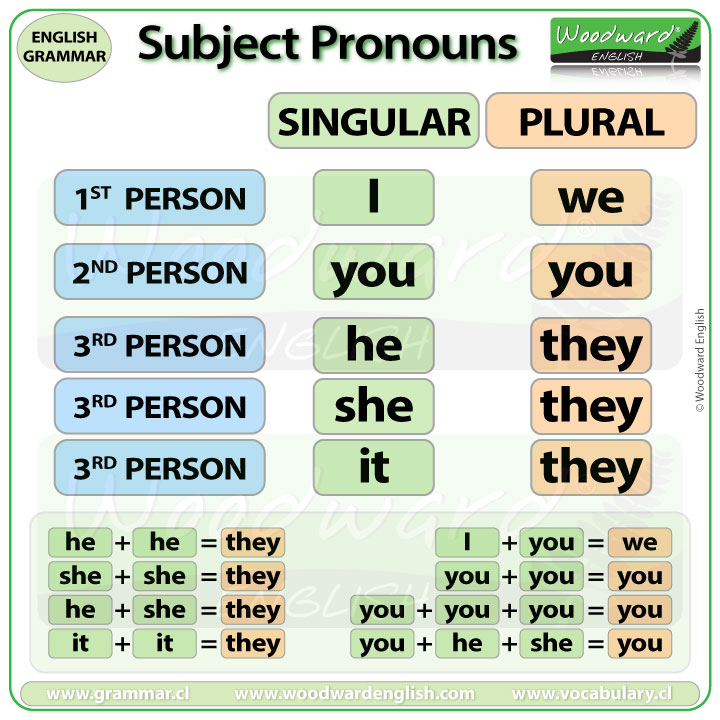
The most important pronouns for us today are:
- I (refers to yourself, like je)
- You (refers to the person you are talking to, like tu or vous)
- He (refers to a male person, like il)
- She (refers to a female person, like elle)
A very important rule: In English, you must always include the subject pronoun in a sentence. This is different from French, where the verb ending often tells you who the subject is.
- Correct: He is a doctor.
- Incorrect:
Is a doctor.
2. The Verb 'To Be': Am, Is, Are
The verb 'to be' is the most common verb in English. We use it to describe:
- Who or what someone/something is (name, job)
- How someone/something is (feelings, qualities)
- Where someone/something is (location)
In the present tense, 'to be' has three forms: am, is, and are. The form you use depends on the subject pronoun.
Let's watch a short video that introduces these pairings and their shortened forms, called contractions. Contractions are very common in spoken English, so they are important for your goal of understanding conversations.
Learn Subject Pronouns + 'be' verb ( am, is, are ) | Basic English Grammar Course
Please watch the first part of this video from Shaw English Online. It will show you which form of the verb 'to be' to use with each subject pronoun.
Watch from the beginning until 01:42. Pay close attention to how the pronouns (I, he, she, you, we, they) are paired with the verbs (am, is, are) and how they are shortened into contractions (I'm, he's, you're).
Here is a summary of what you saw in the video:
| Subject Pronoun | Full Form | Contraction | Example |
|---|---|---|---|
| I | I am | I**'m** | I'm a nurse. |
| You | You are | You**'re** | You're a student. |
| He | He is | He**'s** | He's a doctor. |
| She | She is | She**'s** | She's my friend. |
| It | It is | It**'s** | It's a hospital. |
| We | We are | We**'re** | We're from France. |
| They | They are | They**'re** | They're colleagues. |
Important Note for French Speakers: In English, we use the verb 'to be' to state our age. We do not use the verb 'to have' as you do in French.
- Correct: I am 30 years old.
- Incorrect:
I have 30 years.
Test your understanding!
Choose the correct form of the verb 'to be' (am, is, or are) to complete each sentence.
- I ___ ready to learn.
- He ___ a teacher.
- You ___ my classmate.
- She ___ from Paris.
Show answer
- I am ready to learn.
- He is a teacher.
- You are my classmate.
- She is from Paris.
3. Building Your First Sentences
Now let's put it all together to build simple, positive sentences. The structure is simple:
Subject + 'be' verb + information
The "information" can be a job, a name, a nationality, or an age. Let's see more examples in another video. This will help you with listening and pronunciation.
Basic English Grammar | Be verbs AM IS ARE
This video from Acquire English gives many clear examples of how to use 'am', 'is', and 'are' to talk about people.
Watch from 00:22 to 02:09. Listen to how the speaker describes different people using their name, job, nationality, and age.
As you saw, you can say a lot with just this simple structure:
- I am a nurse.
- He is from Brazil.
- She is a student.
- They are doctors.
4. Reading Practice
Grammar is best understood when you see it used in a real conversation. Let's read a short dialogue between two new students.
Please read the first conversation from this webpage by elllo.org. It's a simple dialogue where you can see the verb 'to be' in action.
On the webpage, find and read 'Conversation 1'. As you read, try to spot all the examples of subject pronouns followed by 'am', 'is', or 'are'.
Did you see these sentences?
- "Yes, I am."
- "Today is my first day."
- "My name is Tony."
- "I’m Beth."
- "That is so cool."
These are all examples of the grammar we learned today used in a natural way.
Conclusion
Great work today! You have learned the essential foundation for making sentences in English.
Key Takeaways:
- Subject pronouns (
I,you,he,she, etc.) are required in English sentences. - The verb 'to be' connects a subject to a description and has three present-tense forms:
am,is,are. - The correct pairings are:
I am,you are,he/she/it is,we are,they are. - Use
am,is, orareto talk about your age, not the verb 'to have'.
In our next lesson, we will build on this knowledge. You will learn how to form negative sentences (e.g., "I am not tired") and how to ask questions with the verb 'to be' (e.g., "Are you a student?"). This will allow you to have more complete conversations. Keep practicing