Bonjour! Welcome to your third lesson.
In our last lesson, you learned how to form negative sentences ("She is not a doctor") and questions ("Are you a nurse?"). This is excellent progress.
Today, we will learn how to talk about things that belong to people and the relationships between them. The learning goal is to use possessive adjectives like my, your, his, and her. By the end of this lesson, you'll be able to form sentences like, "This is my book," or "She is his sister." This is another essential skill for everyday conversation.
1. What Are Possessive Adjectives?
Possessive adjectives are words that show who owns something or has a relationship with someone. They answer the question, "Whose?"
- Whose book is it? It's my book.
- Whose name is it? It's her name.
Let's start with a short, clear video that introduces the main possessive adjectives.
Possessive Adjectives in English | My, Your, His, Her, Its, Our, Your, Their | Learn English Grammar
This video from Woodward English introduces each possessive adjective and shows how it connects to a subject (like 'I' or 'she').
Watch the video from the beginning to 02:01. Pay attention to how each subject pronoun you already know (I, you, he, she) changes to a possessive adjective.
As the video explained, each subject pronoun has a matching possessive adjective. Here is a chart to help you remember them.
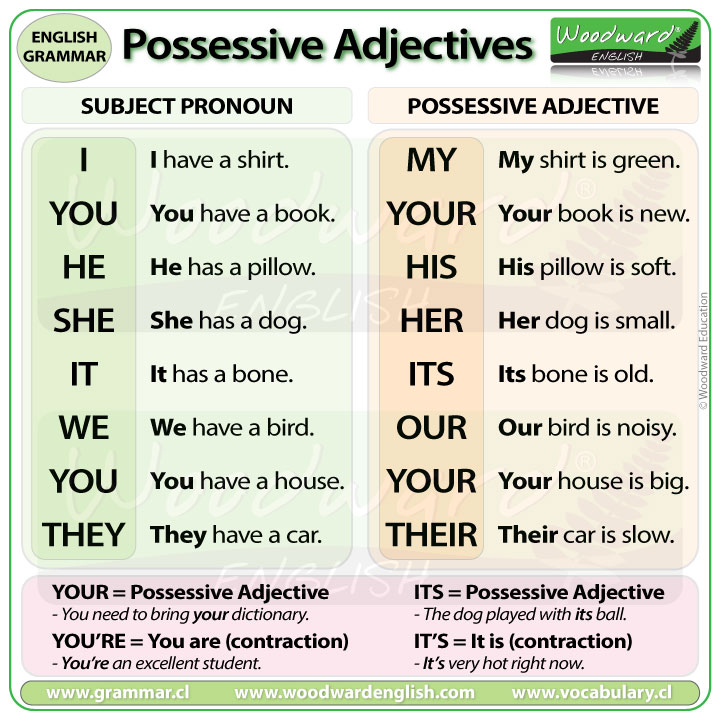
Today, we will focus on the most common singular forms:
- I → my (for me)
- You → your (for you)
- He → his (for a man or boy)
- She → her (for a woman or girl)
2. How to Use Possessive Adjectives
There are two very important rules for using these words. Let's look at them closely.
Rule 1: Always use a possessive adjective before a noun.
A noun is a word for a person, place, or thing (e.g., sister, office, pen).
- This is my sister. (Correct)
This is sister my.(Incorrect)- That is his car. (Correct)
That is car his.(Incorrect)
Rule 2: The possessive adjective never changes.
This is an important difference from French. In English, the possessive adjective is the same for singular and plural nouns.
- my book (one book)
- my books (many books)
- her friend (one friend)
- her friends (many friends)
For a more detailed explanation of these rules, please read the following short text.
This document from Michigan ELT provides a clear grammar lesson on possessive adjectives.
Please read the section titled 'Grammar Lesson', which starts after the 'Discover the Grammar' part. Focus on the chart that connects subject pronouns to possessive adjectives and on Rules 1, 2, and 3. You can skip the 'ONE-MINUTE LESSON' about pets for now.
Test your understanding!
Choose the correct word to complete the sentence.
- He is a student. (He / His) name is Mark.
- I am a nurse. This is (I / my) uniform.
- She has a new car. (She / Her) car is blue.
- You have two sisters. What are (you / your) sisters' names?
Show answer
- His name is Mark.
- This is my uniform.
- Her car is blue.
- What are your sisters' names?
3. Talking About Belongings and Relationships
Now let's practice using these words to talk about both objects (belongings) and people (relationships).
Belongings:
- A: "Is this your phone?"
- B: "No, it's not my phone. I think it is her phone."
Relationships:
- A: "Who is that?"
- B: "That is my brother. His name is Jean."
- A: "Is Marie your colleague?"
- B: "Yes, she is my colleague."
Let's try a quick practice exercise to build your confidence.
Practice Exercise
Fill in the blanks with the correct possessive adjective: my, your, his, or her.
- My friend's name is Susan. _______ last name is Williams.
- I live in Paris. _______ apartment is small.
- Paul works at a hospital. _______ job is very busy.
- A: "Excuse me, I think this is _______ bag." B: "Oh, yes, it is! Thank you."
Show answer
- Her last name is Williams.
- My apartment is small.
- His job is very busy.
- A: "Excuse me, I think this is your bag."
4. Speaking Practice
Your goal is to improve your speaking, so let's practice! Try to say these sentences out loud. Think about your own life.
- Think about a friend or family member.
- Say their name, and then say something about them using his or her.
Example 1: "This is my friend, Antoine. His apartment is in Lyon."
Example 2: "I have a sister. Her name is Chloé. Her children are very young."
Try to create 2-3 sentences of your own and say them aloud. This is excellent practice for making the grammar automatic.
Conclusion
Great work today! You have learned how to use possessive adjectives to show who owns something or to describe relationships.
Key Takeaways:
- Possessive adjectives (
my,your,his,her) show possession. - They always go before a noun (e.g.,
my name). - They do not change for singular or plural nouns (e.g.,
his friend,his friends).
In our next lesson, we will learn how to describe yourself and others using simple adjectives like happy, tired, or French. You will be able to combine what you learned today with new words to say things like, "My sister is happy" or "His car is new."
Keep up the fantastic effort