Hello! Welcome to the fourth lesson in our module on Graph Traversal Algorithms.
In our previous lessons, we explored both Depth-First Search (DFS) and Breadth-First Search (BFS), understanding their core mechanics and implementation using stacks and queues. We saw how DFS dives deep into a graph, while BFS explores layer by layer.
Today, we will apply our knowledge of DFS to solve a crucial problem in graph theory: cycle detection. Your goal is to learn how to detect cycles in both undirected and directed graphs using DFS. This is a fundamental technique in competitive programming, often appearing in problems related to task scheduling, dependency resolution, and identifying deadlocks.
We'll tackle this in two parts:
- First, we'll see how to find cycles in undirected graphs.
- Then, we'll adapt our approach for directed graphs, where the logic is a bit different.
Recap: The Essence of DFS
As a quick refresher, DFS explores a graph by going as deep as possible down one path before backtracking. This "deep-dive" nature is exactly what we need for cycle detection. A cycle occurs when our deep exploration leads us back to a node we've already encountered in our current path.
Part 1: Cycle Detection in Undirected Graphs
In an undirected graph, if an edge exists between u and v, we can travel from u to v and also from v to u.
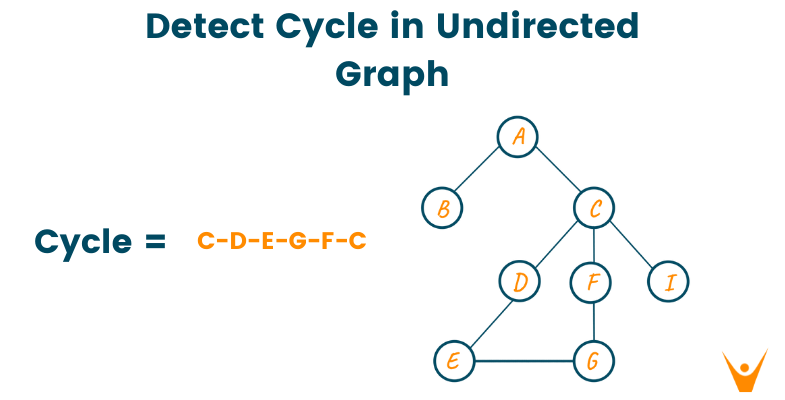
The simplest idea for cycle detection is: while traversing, if we encounter a node that has already been visited, we have found a cycle. But there's a catch with undirected graphs.
Consider an edge A -- B.
- We start DFS from
A. - We visit
Aand move to its neighborB. - From
B, one of its neighbors isA. SinceAis already visited, does this mean we have a cycle? No, this is just the edge we used to get toB.
To solve this, we need to distinguish between finding a true cycle and simply moving back to the immediate node we came from. The solution is to keep track of the parent of the current node in the DFS traversal. A cycle is detected if we encounter a visited node that is not the parent of the current node.
The Algorithm
For each vertex u:
- Mark
uas visited. - For each neighbor
vofu:- If
vis not visited, recursively call DFS onv, withuas its parent. If the recursive call returnstrue(finds a cycle), then propagatetrueup. - If
vis visited ANDvis not the parent ofu, we have found a back edge, which means there is a cycle. Returntrue.
- If
- If the loop finishes without finding a cycle, return
false.
To see this logic in action, let's watch a detailed walkthrough.
G-12. Detect a Cycle in an Undirected Graph using DFS | C++ | Java
The video 'Detect a Cycle in an Undirected Graph using DFS' from the channel 'take U forward' provides an excellent, step-by-step dry run of this algorithm. It clearly demonstrates how tracking the parent node is key to correctly identifying a cycle.
Watch the segment from 01:44 to 11:37. Focus on how the algorithm uses the visited array and the parent node to differentiate between a simple back-edge to a parent and a true cycle.
Python Implementation
Here is a Python implementation based on the logic we've discussed. We use an adjacency list to represent the graph, which is standard in competitive programming.
from collections import defaultdict

def has_cycle_undirected_util(u, parent, visited, adj):
    """A recursive DFS utility to detect cycles."""
    visited.add(u)

    for v in adj[u]:
        if v not in visited:
            # If a cycle is found in the subtree, propagate it up.
            if has_cycle_undirected_util(v, u, visited, adj):
                return True
        # If v is visited and is not the parent of u, we found a back edge.
        elif v != parent:
            return True

    return False

def has_cycle_undirected(num_nodes, edges):
    """Checks for a cycle in an undirected graph."""
    adj = defaultdict(list)
    for u, v in edges:
        adj[u].append(v)
        adj[v].append(u)

    visited = set()

    # This loop handles disconnected components in the graph.
    for i in range(num_nodes):
        if i not in visited:
            # Call DFS. The parent of the starting node is -1 (a dummy value).
            if has_cycle_undirected_util(i, -1, visited, adj):
                return True

    return False

# --- Example Usage ---
num_nodes_1 = 5
edges_1 = [(0, 1), (1, 2), (2, 3), (3, 4), (4, 1)] # Cycle: 1-2-3-4-1
print(f"Graph 1 has cycle: {has_cycle_undirected(num_nodes_1, edges_1)}") # Expected: True

num_nodes_2 = 4
edges_2 = [(0, 1), (1, 2), (2, 3)] # No cycle
print(f"Graph 2 has cycle: {has_cycle_undirected(num_nodes_2, edges_2)}") # Expected: False
Part 2: Cycle Detection in Directed Graphs
The "parent" trick does not work for directed graphs. Consider the path A -> B and C -> B. If we traverse A -> B first, B becomes visited. Later, if we start a new traversal from C and reach B, B is visited, and its parent in this new path is C, not A. Our previous logic would incorrectly flag a cycle.
The key difference in a directed graph is that a cycle only exists if we follow the direction of the edges and end up back where we started.

To detect this, we need to know if we've encountered a node that is currently part of our active exploration path (i.e., it's an ancestor in the current recursion stack).
The Three-State Approach
We can track the state of each node using three categories:
- UNVISITED: The node has not been seen yet.
- VISITING: The node is currently in our recursion stack. We have started exploring from it, but we haven't finished exploring all its descendants.
- VISITED: We have finished exploring this node and all its descendants.
A cycle is detected if, during our DFS, we encounter a neighbor that is in the VISITING state.
Algorithm Walkthrough
A classic competitive programming problem that boils down to detecting a cycle in a directed graph is "Course Schedule" (LeetCode 207). To take a set of courses, you must satisfy all prerequisites. A cyclic dependency (e.g., Course A requires B, and B requires A) makes it impossible to finish.
The following video explains this problem and demonstrates the three-state DFS approach.
Course Schedule (Detecting Cycles in a Graph) - Leetcode 207 - Graphs (Python)
This video from Greg Hogg frames cycle detection in a directed graph within the context of the 'Course Schedule' problem. It clearly explains the three-state (unvisited, visiting, visited) logic for detecting cycles.
Watch from the beginning to 08:18. Focus on why a cycle represents an impossible schedule and how the three states are used to find that cycle during a DFS traversal.
Python Implementation
We can implement the three states using an array, say states, where 0 = unvisited, 1 = visiting, and 2 = visited.
from collections import defaultdict

# States for directed graph cycle detection
UNVISITED = 0
VISITING = 1
VISITED = 2

def has_cycle_directed_util(u, states, adj):
    """A recursive DFS utility for directed graphs."""
    states[u] = VISITING

    for v in adj[u]:
        if states[v] == UNVISITED:
            if has_cycle_directed_util(v, states, adj):
                return True
        # If we encounter a node that is currently in our recursion stack.
        elif states[v] == VISITING:
            return True

    # Mark as fully explored once all neighbors are done.
    states[u] = VISITED
    return False

def has_cycle_directed(num_nodes, edges):
    """Checks for a cycle in a directed graph."""
    adj = defaultdict(list)
    for u, v in edges:
        adj[u].append(v)

    states = [UNVISITED] * num_nodes

    for i in range(num_nodes):
        if states[i] == UNVISITED:
            if has_cycle_directed_util(i, states, adj):
                return True

    return False

# --- Example Usage ---
num_nodes_3 = 4
edges_3 = [(0, 1), (1, 2), (2, 0), (2, 3)] # Cycle: 0->1->2->0
print(f"\nGraph 3 has cycle: {has_cycle_directed(num_nodes_3, edges_3)}") # Expected: True

num_nodes_4 = 4
edges_4 = [(0, 1), (0, 2), (1, 3), (2, 3)] # No cycle (DAG)
print(f"Graph 4 has cycle: {has_cycle_directed(num_nodes_4, edges_4)}") # Expected: False
Test your understanding!
Consider a directed graph with 4 nodes and the following edges: (0, 1), (1, 2), (2, 3), (3, 1).
Trace the has_cycle_directed function starting from node 0. Does it contain a cycle?
Show answer
Yes, there is a cycle. Here's a trace:
has_cycle_directed(4, ...)starts. It callshas_cycle_directed_util(0, ...).dfs(0):states[0]becomesVISITING.- Neighbor of
0is1.states[1]isUNVISITED, so calldfs(1). dfs(1):states[1]becomesVISITING.- Neighbor of
1is2.states[2]isUNVISITED, so calldfs(2). dfs(2):states[2]becomesVISITING.- Neighbor of
2is3.states[3]isUNVISITED, so calldfs(3). dfs(3):states[3]becomesVISITING.- Neighbor of
3is1. Now, we checkstates[1]. It isVISITING. - Since we found a neighbor in the
VISITINGstate, a cycle is detected!dfs(3)returnsTrue. - This
Truevalue propagates all the way up the call stack. The final result isTrue. The cycle is1 -> 2 -> 3 -> 1.
Complexity Analysis
For both the undirected and directed versions of the DFS-based cycle detection:
- Time Complexity: , where is the number of vertices and is the number of edges. Each vertex is visited once, and all its outgoing edges are checked once.
- Space Complexity: . This is for the
visitedset/statesarray and for the recursion call stack, which in the worst case (a long chain of nodes) can go as deep as .
Conclusion
You've now mastered a critical graph algorithm: using Depth-First Search to detect cycles. This skill is invaluable for solving a wide range of problems in competitive programming and software engineering.
Key Takeaways:
- Cycle detection builds directly on the DFS traversal pattern.
- For undirected graphs, the key is to track the
parentnode to avoid false positives from immediate back edges. A cycle exists if you find a visited neighbor that is not your parent. - For directed graphs, the
parentmethod is insufficient. The correct approach is to use a three-state system (unvisited,visiting,visited) to track nodes in the current recursion path. A cycle exists if you find a neighbor that is currently in thevisitingstate.
Up Next:
We will continue building on our graph traversal skills. In the next lesson, we'll see how to use DFS or BFS to another common problem: finding connected components in an undirected graph. This is useful for determining if a graph is a single entity or composed of several disjoint subgraphs.