Hello! Welcome back to our course on Python for competitive programming.
In our previous lesson, we explored a sophisticated use of heaps by combining a max-heap and a min-heap to efficiently find the median of a data stream. This demonstrated how heaps can manage dynamically changing, ordered partitions of data.
Today, we'll apply our knowledge of heaps to solve another classic problem: merging multiple sorted collections of data. By the end of this lesson, you will be able to merge K sorted arrays efficiently using a heap. This is a fundamental pattern that appears frequently in coding interviews and competitive programming, often as a building block for more complex problems.
1. The Problem: Merging K Sorted Arrays
Imagine you are given K separate arrays, each already sorted in ascending order. Your task is to combine them into a single, large array that is also sorted.
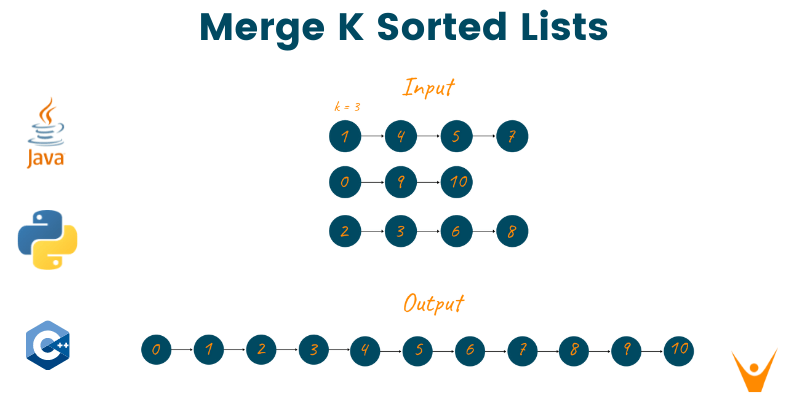
A straightforward idea might be to concatenate all K arrays into one massive list and then sort it. If N is the total number of elements across all arrays, this approach would have a time complexity of O(N log N). However, this method completely ignores a crucial piece of information: the input arrays are already sorted. This suggests we can devise a more efficient strategy.
2. From Two Arrays to K: Building the Intuition
Let's simplify. How would you merge two sorted arrays? You'd likely use a two-pointer approach: compare the elements at the current pointers of each array, take the smaller one, and advance that array's pointer. This is the core logic of the merge step in Merge Sort.
Now, how can we generalize this to K arrays? The core idea remains the same: at each step, we need to find the single smallest element among all the current candidate elements (one from each array) and add it to our result.
The main challenge is this: how do we efficiently find the minimum among K elements, over and over again? A simple loop to scan the K candidates would take O(K) time for each element we select. Since we have to do this for all N elements, the total time complexity would be O(N * K), which is often slower than the naive "concatenate and sort" method.
This is where we need a better data structure to track the K candidates.
Merge K Sorted Arrays - Min Heap Algorithm ("Merge K Sorted Lists" on LeetCode)
This video from Back To Back SWE provides an excellent visual intuition. It starts by reviewing the two-array merge and then extends the logic to K arrays, highlighting the challenge of finding the minimum element repeatedly.
Please watch from 01:04 to 06:11. Focus on: 01:04 - 03:10: The review of merging two sorted arrays. Notice that we only care about the smallest available element in each array. 03:10 - 06:11: How this logic is extended to K arrays and why this leads to the need for a data structure like a min-heap to efficiently manage the K smallest elements.
As the video suggests, the perfect tool for repeatedly and efficiently finding the minimum element from a collection is a min-heap.
3. The Min-Heap Solution
A min-heap can store the K candidate elements (one from each array) and allow us to extract the overall minimum in O(log K) time. This is a huge improvement over the O(K) linear scan.
Here is the algorithm:
- Initialize: Create a min-heap and an empty list for the final result.
- Seed the heap: For each of the
Karrays, if it's not empty, push its first element into the heap. To keep track of where each element came from, we'll store a tuple:(value, array_index, element_index). The heap will automatically sort these tuples based on thevalue. - Process: While the heap is not empty:
a. Pop: Extract the tuple with the smallest value from the heap. Let's call it(val, arr_idx, elem_idx).
b. Append: Addvalto our result list.
c. Replace: Look back at the array from which the element came (arrays[arr_idx]). If there's a next element in that array, push it onto the heap as a new tuple:(next_value, arr_idx, elem_idx + 1).
This process continues until the heap is empty, which means we have processed all elements from all K arrays.
Let's watch a detailed walkthrough of this algorithm. The following video uses "linked lists" instead of arrays, but the core logic is identical.
Merge K Sorted Linked Lists - Leetcode 23 - Heaps (Python)
This video from Greg Hogg provides a clear, step-by-step visual of the heap-based algorithm and then walks through a Python implementation.
Watch from 01:50 to 09:10. Pay close attention to: 01:50 - 02:36: The justification for using a min-heap to turn an O(K) search into an O(log K) operation. 02:36 - 06:08: The visual walkthrough of popping from the heap, adding to the result, and pushing the next element back onto the heap. 06:08 - 09:10: The Python implementation using heapq. Note the structure of the tuple being pushed to the heap and why the array index is included to handle ties.
4. Implementation and Complexity
Now, let's look at a clean Python implementation for merging K sorted arrays.
import heapq

def merge_k_sorted_arrays(arrays):
    """
    Merges K sorted arrays into a single sorted array.

    Args:
        arrays: A list of sorted lists (arrays).

    Returns:
        A single sorted list containing all elements.
    """
    min_heap = []

    # 1. Initialize the heap with the first element of each non-empty array.
    for i, arr in enumerate(arrays):
        if arr:
            # Push a tuple: (value, array_index, element_index_in_array)
            heapq.heappush(min_heap, (arr[0], i, 0))

    result = []

    # 2. Process elements until the heap is empty.
    while min_heap:
        # Pop the element with the smallest value.
        val, arr_idx, elem_idx = heapq.heappop(min_heap)

        # Add it to the result list.
        result.append(val)

        # If there's a next element in the array we just took from,
        # push it to the heap.
        if elem_idx + 1 < len(arrays[arr_idx]):
            next_elem_idx = elem_idx + 1
            next_val = arrays[arr_idx][next_elem_idx]
            heapq.heappush(min_heap, (next_val, arr_idx, next_elem_idx))

    return result

# --- Example Usage ---
k_arrays = [
    [3, 6],
    [4, 7, 11, 12],
    [1, 4, 5]
]
merged_array = merge_k_sorted_arrays(k_arrays)
print(f"Input arrays: {k_arrays}")
print(f"Merged array: {merged_array}")
# Expected Output: [1, 3, 4, 4, 5, 6, 7, 11, 12]
Test your understanding!
Let's trace the state of the min_heap for the example above: [[3, 6], [4, 7, ...], [1, 4, 5]].
What is the content of the min_heap after the first two elements (1 and 3) have been popped and added to the result list?
Show answer
-
Initial state:
- The heap is initialized with the first element from each array.
min_heap = [(1, 2, 0), (3, 0, 0), (4, 1, 0)](after heapify).
-
First pop:
heappopreturns(1, 2, 0).resultbecomes[1].- We look at
arrays[2], which is[1, 4, 5]. The next element is4at index1. - We push
(4, 2, 1)to the heap. min_heapnow contains[(3, 0, 0), (4, 1, 0), (4, 2, 1)].
-
Second pop:
heappopreturns(3, 0, 0).resultbecomes[1, 3].- We look at
arrays[0], which is[3, 6]. The next element is6at index1. - We push
(6, 0, 1)to the heap. - Final state:
min_heapnow contains[(4, 1, 0), (4, 2, 1), (6, 0, 1)]. Notice there are two4s, but Python's tuple comparison will handle them gracefully. The next element to be popped will be(4, 1, 0).
Complexity Analysis
Let's formalize the efficiency of this algorithm.
-
Kis the number of sorted arrays. -
Nis the total number of elements across all arrays. -
Time Complexity: O(N log K)
- We process each of the
Nelements exactly once. - For each element, we perform one
heappopand at most oneheappush. - The size of the heap is at most
K, so each heap operation takes O(log K) time. - Therefore, the total time is N * O(log K) = O(N log K). This is significantly better than O(N log N) when
Kis much smaller thanN.
- We process each of the
-
Space Complexity: O(K)
- The primary auxiliary space used is for the min-heap, which stores at most one element from each of the
Karrays. - The
resultarray takes O(N) space, but this is typically considered output space, not auxiliary space.
- The primary auxiliary space used is for the min-heap, which stores at most one element from each of the
The video you watched previously also provides a good summary of this analysis.
Merge K Sorted Linked Lists - Leetcode 23 - Heaps (Python)
For a quick recap of the complexity analysis, you can re-watch this short segment.
Watch from 09:10 to 10:05.
Conclusion
You have successfully learned how to solve the "Merge K Sorted Arrays" problem using a min-heap. This pattern is a cornerstone of many efficient algorithms.
Key Takeaways:
- The problem involves merging
Kpre-sorted arrays into a single sorted array. - A naive approach of concatenating and sorting is O(N log N) and fails to use the sorted property of the inputs.
- The optimal solution uses a min-heap of size
Kto efficiently track the smallest available element from each array. - This heap-based approach achieves a time complexity of O(N log K) and an auxiliary space complexity of O(K).
- Storing tuples like
(value, array_index, element_index)in the heap is crucial for tracking which element to add next.
Up Next:
In our final lesson of this module, we will formalize a technique we've touched upon before: how to implement a max-heap using Python's heapq module by negating values. This is a simple but essential trick for your competitive programming toolkit.