Hello! Welcome back to our module on Binary Search Trees.
In the last lesson, we established the fundamental properties of a BST: for any node, all values in its left subtree are smaller, all values in its right subtree are larger, and both subtrees are also BSTs. We saw how these properties allow for efficient searching, theoretically reducing the search space by half at each step.
Today, we move from theory to practice. This lesson is dedicated to implementing the two most fundamental operations on a BST: searching for a value and inserting a new value. Mastering these is crucial for leveraging BSTs in competitive programming problems.
Our learning outcome is to implement search and insertion operations in a BST. We will write the Python code to perform these actions while ensuring the BST's properties are always maintained.
1. Representing a BST Node in Python
Before we can search or insert, we need a way to represent the tree itself. Since a tree is a collection of connected nodes, we'll start by defining a class for a single node. Each node needs to store its own value and have pointers (or references) to its left and right children.
A straightforward way to structure this in Python is as follows:
class BSTNode:
    def __init__(self, val=None):
        self.val = val
        self.left = None
        self.right = None
This simple class is the building block for our entire tree. The __init__ method initializes a new node with a given value and sets its children to None. We can then connect these nodes to form a tree structure. An empty tree can be represented by a root that is None.
2. The Search Operation
The search operation in a BST is a beautiful demonstration of the "divide and conquer" principle. The process is inherently recursive.
The Logic:
- Start at the root of the tree.
- Compare the value you're searching for with the current node's value.
- If they are equal, you've found the value. Return
True. - If the target value is less than the current node's value, you know it can only be in the left subtree. Recursively search the left child.
- If the target value is greater than the current node's value, it must be in the right subtree. Recursively search the right child.
- If they are equal, you've found the value. Return
- If you reach a point where the current node is
None, it means you've followed the correct path to where the value should be, but it's not there. The search has failed, so returnFalse.
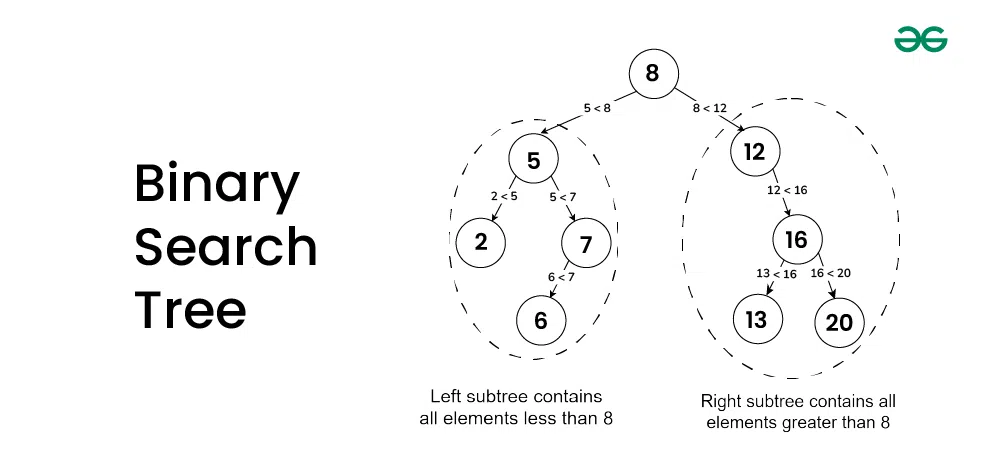
Now, let's look at how to translate this logic into code. The following article provides a clean, recursive implementation.
Writing a Binary Search Tree in Python With Examples
The article 'Writing a Binary Search Tree in Python With Examples' from Boot.dev presents a very clear, class-based implementation of BST operations. We'll focus on the exists method, which is their name for the search operation.
First, review the 'BSTNode Class' section to see the structure we just discussed. Then, read the section 'Step 5 - Exists' carefully. It contains the Python code for the search function. Notice how it directly mirrors the recursive logic described above.
To see this logic explained with animations and a code walkthrough, let's watch a segment of the video from LucidProgramming.
Binary Search Trees in Python: Introduction - Insertion and Search
This video, 'Binary Search Trees in Python: Introduction - Insertion and Search', provides an excellent visual and coded explanation of the search operation.
First, watch from 07:11 to 08:56 to see a visual demonstration of the search process. Then, watch the code implementation from 19:16 to 23:34. The video uses a helper function _find, which is a common and robust pattern for recursion within a class.
Test your understanding!
Given the BST from the image above (root at 8), trace the sequence of nodes you would visit to search for the value 13.
Show answer
- Start at 8.
13 > 8, so go right. - Visit 12.
13 > 12, so go right. - Visit 16.
13 < 16, so go left. - Visit 13.
13 == 13, value found!
The path is: 8 -> 12 -> 16 -> 13.
3. The Insertion Operation
The logic for insertion is closely related to searching. To insert a new value, you first search for it to find the correct position. The place where the search would fail (i.e., where you'd hit a None pointer) is precisely where the new node should be attached.
The Logic:
- Start at the root. If the tree is empty, the new node becomes the root.
- Compare the value to be inserted with the current node's value.
- If the new value is the same as the current node's value, we do nothing to avoid duplicates.
- If the new value is less than the current node's value, we move to the left child. If the left child is
None, we insert the new node here. Otherwise, we recursively call insert on the left child. - If the new value is greater than the current node's value, we move to the right child. If the right child is
None, we insert the new node here. Otherwise, we recursively call insert on the right child.
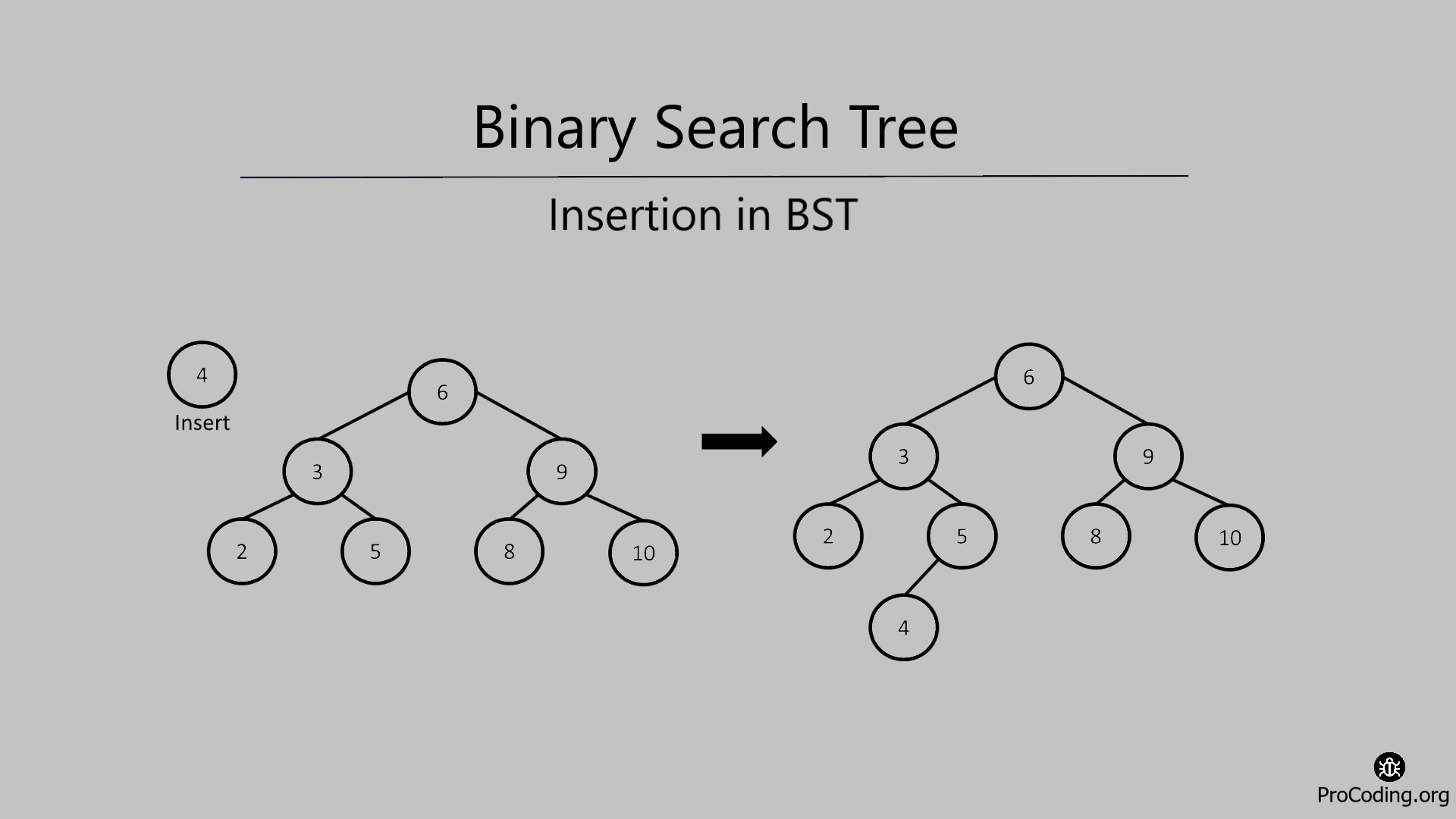
Let's turn to our resources for the implementation.
Writing a Binary Search Tree in Python With Examples
We'll return to the Boot.dev article for a concise implementation of the insert method.
Read the section 'Step 2 - Insert'. Analyze the code and see how it handles the three cases: the new value is smaller, larger, or equal to the current node's value. Pay attention to the base case where a child is None.
Now, let's watch a video walkthrough of the implementation. The speaker's explanation of the recursive calls is particularly helpful.
Binary Tree Part 1 | BST | Binary Search Tree - Data Structures & Algorithms Tutorials In Python #10
The 'codebasics' channel, which you saw in the last lesson, has a clear walkthrough for implementing the insertion method, which they call add_child.
Watch from 09:47 to 13:34. The presenter codes the add_child method from scratch. Notice how the logic for the left and right subtrees is nearly identical, a common pattern in tree algorithms.
4. Putting It All Together
Now that we have the search and insert methods, let's see how to use them to build a tree from a list of numbers and then query it. This is a very common task in competitive programming.
The codebasics video demonstrates how to build a tree from a list of elements and then test the search functionality.
Binary Tree Part 1 | BST | Binary Search Tree - Data Structures & Algorithms Tutorials In Python #10
Let's see our new methods in action. This final clip shows how to construct a tree and then test the search function.
Watch from 16:33 to 17:53 to see the build_tree helper function, and then from 21:27 to 23:40 to see the search method being tested with values that are present and absent from the tree. This demonstrates the practical application of what we've just built.
Here's the complete BSTNode class with the methods we've just learned, structured similarly to the Boot.dev article. You can run this code yourself to experiment.
class BSTNode:
    def __init__(self, val=None):
        self.val = val
        self.left = None
        self.right = None

    def insert(self, val):
        # If the node is empty, this becomes the root node
        if not self.val:
            self.val = val
            return

        # Ignore duplicate values
        if self.val == val:
            return

        # If val is smaller, go to the left subtree
        if val < self.val:
            if self.left:
                self.left.insert(val)
            else:
                self.left = BSTNode(val)
        # If val is larger, go to the right subtree
        else:
            if self.right:
                self.right.insert(val)
            else:
                self.right = BSTNode(val)

    def exists(self, val):
        # Base case: value found
        if val == self.val:
            return True

        # Recursive step: search left subtree
        if val < self.val:
            if self.left is None:
                return False
            return self.left.exists(val)

        # Recursive step: search right subtree
        if self.right is None:
            return False
        return self.right.exists(val)

# --- How to use it ---
nums = [15, 10, 20, 8, 12, 18, 25]

# Create the root node with the first element
bst = BSTNode()
for num in nums:
    bst.insert(num)

# Test the search function
print("Does 12 exist?", bst.exists(12))  # Output: True
print("Does 99 exist?", bst.exists(99)) # Output: False
Conclusion
In this lesson, we transitioned from understanding the theory of BSTs to implementing their core functionalities. You have learned how to write recursive functions to efficiently search for and insert data while preserving the crucial ordering properties of the tree.
Key Takeaways:
- A BST can be represented in Python using a
Nodeclass withval,left, andrightattributes. - The search operation recursively follows a single path down the tree, guided by comparisons, resulting in time complexity (where is the tree's height).
- The insertion operation works by first searching for the correct position and then adding the new node at the point where the search fails, also in time.
- Both operations are elegant recursive algorithms that directly leverage the BST's defining properties.
Up Next:
While search and insertion are relatively straightforward, removing a node from a BST is more complex. You have to handle three different cases depending on whether the node to be deleted has zero, one, or two children. In our next lesson, we will tackle the logic and implementation for deleting a node from a BST.