Welcome to our lesson on A/B testing. In the last session, we explored how to analyze your Key Performance Indicators (KPIs) to diagnose which prospecting channels and messages are working. You learned to move from simply knowing your numbers (descriptive analytics) to understanding why those numbers are what they are (diagnostic analytics). This set the stage for targeted improvement.
Today, we transition from analysis to action. Your goal is to apply A/B testing principles to experiment with different outreach messages or value propositions. A/B testing is a powerful, systematic method for improving your messaging based on data rather than intuition. It’s the practical application of the "small levers, big doors" principle we discussed, allowing you to make precise changes to your outreach and measure their impact on your reply rates. This process will leverage your analytical mindset to turn your outreach into a well-oiled machine for booking high-ticket appointments.
The Scientific Method for Outreach
At its core, A/B testing is simply a controlled experiment. You create two or more versions of a single asset—in your case, a DM—and show them to similar groups of people to see which one performs better. This isn't just about trying new things; it's about doing so in a structured way that allows you to draw reliable conclusions about what causes a change in performance.
The following video introduces this fundamental concept. The speaker, a data science manager, explains why A/B testing is considered a scientific approach to making decisions.
Data Science Interview - Increasing Sales through A/B Testing (with Tinder Sr. Data Science Mgr)
This clip from the Exponent channel features a Senior Data Science Manager from Tinder explaining the core principles of A/B testing.
Please watch the introduction from the beginning of his explanation. Pay close attention to his emphasis on "causal conclusions" and "randomization." This is the foundation that makes A/B testing so powerful.
As he explained, the key is causality. By changing only one thing at a time and randomly assigning prospects to each version, you can be confident that any difference in reply rates is caused by the change you made, not by chance or other factors.
The 4 Steps to a Successful A/B Test
A properly structured A/B test follows a clear, logical sequence. This framework ensures your experiments are designed to produce trustworthy and actionable results.
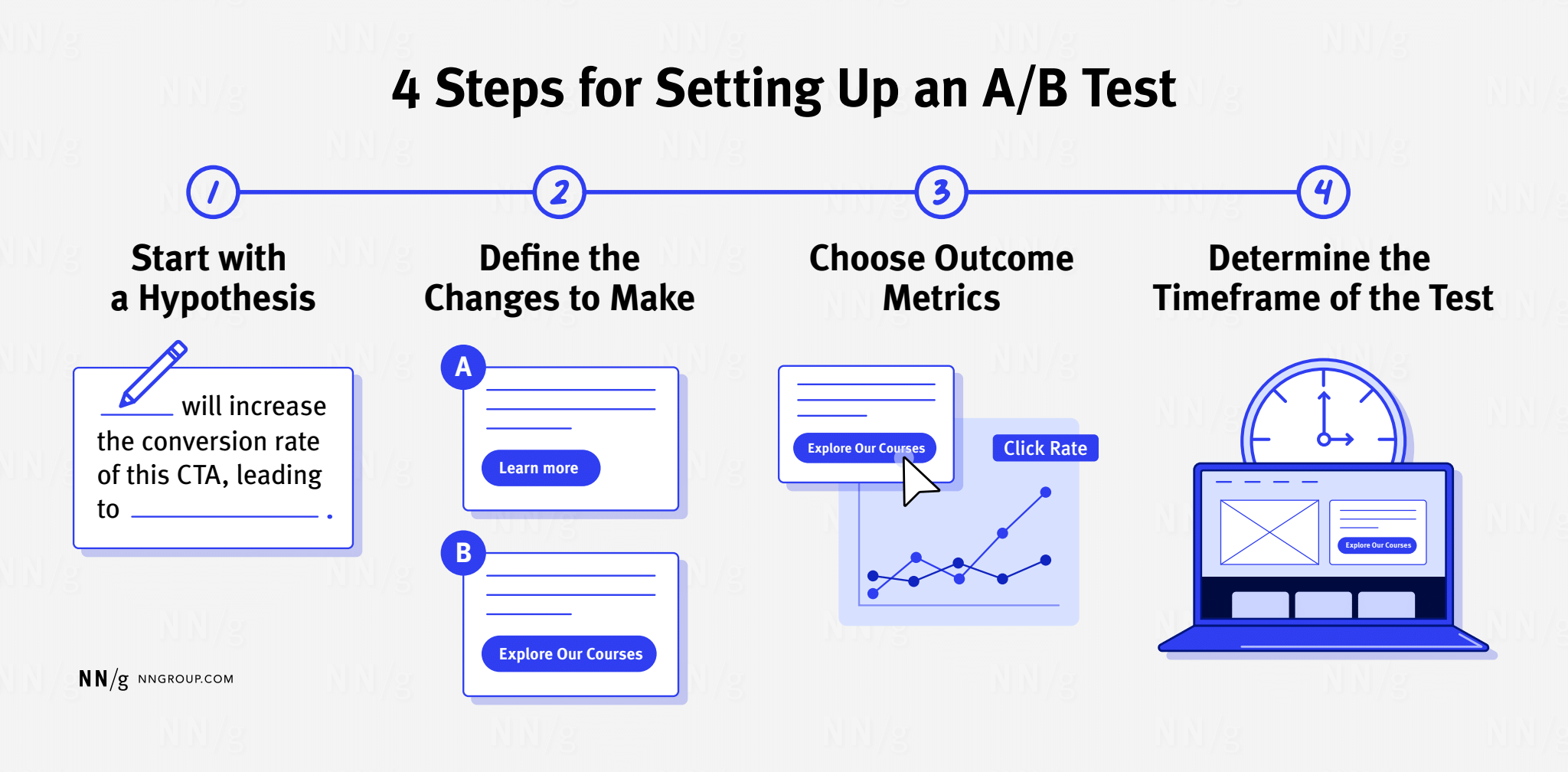
Let's break down each step in the context of your DM outreach.
Step 1: Start with a Hypothesis
A hypothesis is a clear, testable statement about what you believe will happen. It’s not just a vague idea; it's a formal prediction. It usually takes the form: "If I change [Independent Variable], then [Dependent Variable] will [change in some way], because [Your Rationale]."
For example:
- Hypothesis: "If I change my opening line from a direct pitch to a question, my reply rate will increase, because it invites a conversation rather than triggering a sales defense."
In the same video from Exponent, the speaker elaborates on the importance of formalizing your hypothesis before you begin.
Data Science Interview - Increasing Sales through A/B Testing (with Tinder Sr. Data Science Mgr)
Here, the speaker discusses the importance of formally stating your hypothesis.
Watch the short segment on formally figuring out the hypothesis. His example about simplifying an email campaign to increase conversion is directly analogous to what we are doing with DM outreach.
Step 2: Define the Changes to Make
This is the most crucial rule of A/B testing: change only one variable at a time. If you test a new opener and a new call-to-action in the same message, you'll have no idea which change was responsible for the result.
The following article, though about cold calling, explains this principle perfectly.
A/B Testing Cold Calling Scripts for Better Results | SalesHive Blog
This article from the SalesHive Blog provides a rigorous framework for A/B testing outreach scripts. We'll use it to understand the discipline required for good testing.
Read the section Start with one metric and one variable. The key takeaway is: "change one thing per test, no exceptions."
So, what variables can you test? Start with the parts of your message that have the biggest impact. The SalesHive article recommends a clear order of operations.
A/B Testing Cold Calling Scripts for Better Results | SalesHive Blog
This section of the SalesHive blog post explains where to focus your testing efforts for maximum impact.
Read the section titled What to test first. This gives you a strategic roadmap for your experiments.
Based on this, here is a hierarchy of elements to test in your DMs:
- The Opener / Hook: Your first sentence is critical.
- Variant A (Direct): "Hi [Name], I came across your profile and see you help [client type]. I help coaches like you book more calls via DMs..."
- Variant B (Question-Based): "Hi [Name], quick question about your work with [client type]..."
- Variant C (Hyper-Personalized): "Hi [Name], just saw your post about [recent topic]. It made me think about..."
- The Value Proposition: How you frame what you do.
- Variant A (Problem-Agitation): "Most coaches struggle to manage their DMs, leading to lost leads..."
- Variant B (Outcome-Focused): "I help coaches add 2-3 qualified sales calls to their calendar each week..."
- The Call-to-Action (CTA): How you ask for the next step.
- Variant A (Interest-Based): "Would you be open to hearing more?"
- Variant B (Low-Friction Question): "What's your current process for managing inbound leads?"
For inspiration on what makes a truly standout message, the "Show me you know me" strategy is a goldmine of ideas for creating your test variants.
Her Cold Email Strategy Has a 43% OPEN RATE!
This video from Apollo explains the "show me you know me" outreach strategy. While not about A/B testing itself, it's an excellent resource for generating ideas for your test messages.
You don't need to watch the whole thing, but skim through these sections to get ideas for what to test: Subject Lines & Openers: How can you make your first line impossible to ignore? First Sentences: See how the opener works with the first sentence. Value Proposition: Note how they frame value by solving challenges and preempting objections. Call to Action: See examples of non-presumptuous, flexible CTAs.
Step 3: Choose Outcome Metrics
For each test, you must define what success looks like. As we discussed in the previous lesson, your primary KPIs are Reply Rate and Booking Rate. For A/B testing your initial outreach message, the most direct and sensitive metric is Reply Rate. It gives you the fastest feedback on whether your message is compelling enough to start a conversation.
Step 4: Determine the Timeframe and Sample Size
This is where your mathematical background will be a great asset. A test is only as good as its data. Declaring a winner based on just 10 messages is statistically meaningless; it's likely due to random luck.
The SalesHive article gives a robust recommendation for sample size.
A/B Testing Cold Calling Scripts for Better Results | SalesHive Blog
Revisit the SalesHive blog post for its guidance on sample size.
In the section titled "How to run a script A/B test in the real world," focus on the paragraph that begins Sample size.
A minimum of 50-100 prospects per variant is a good rule of thumb to ensure your results are reliable.
- Let's do the math: If you send 25 DMs per day, you can test two variants across 100 people in just 4 days (25/day * 4 days = 100 total DMs; 50 for Variant A, 50 for Variant B). This makes weekly testing cycles very feasible.
Your A/B Testing Workflow
Now, let's put all these principles into a practical, repeatable workflow. The following resource provides a simple, step-by-step guide tailored for Instagram DMs, which we can adapt for your multi-platform outreach.
Instagram Outreach Tracking: How to Measure DM Performance
This article from DM Tracker provides an excellent, actionable workflow for A/B testing outreach messages.
Read the section How to A/B Test. This gives you a clear, four-step process to follow.
Here is your workflow, combining everything we've learned:
-
Formulate Hypothesis & Create Variants:
- Decide on the one variable you want to test (e.g., the opener).
- Write your control message (your current best message) as "Variant A".
- Write your new test message as "Variant B".
-
Split Outreach & Track:
- For the next 100 prospects you contact, send Variant A to the first, Variant B to the second, A to the third, and so on.
- In your Notion tracker, add a "Select" property called "Message Variant" with options "A" and "B". Tag every prospect you contact. This is crucial for analysis.
-
Analyze Results:
- After a set time (e.g., 5-7 days to allow for delayed replies), filter your Notion view to show only prospects who received Variant A. Calculate the Reply Rate.
- Do the same for Variant B.
- Compare the two. For example:
- Variant A: 50 sent, 5 replies = 10% Reply Rate
- Variant B: 50 sent, 9 replies = 18% Reply Rate
-
Decide & Iterate:
- In this case, Variant B is the clear winner. It now becomes your new control message (your new "Variant A").
- Your next test will be to create a new "Variant B" that tries to beat this new, higher benchmark. This cycle of continuous improvement is the goal.
This iterative process is visualized well in this flowchart for email testing, which follows the same logic.

Conclusion
In this lesson, you've learned how to move beyond simple analysis and into structured experimentation. A/B testing provides a scientific framework to systematically improve your outreach effectiveness, taking the guesswork out of what messages to send.
Key Takeaways:
- A/B testing is a controlled experiment designed to determine the causal impact of a single change.
- A successful test requires a clear hypothesis, a single variable, a defined metric (like Reply Rate), and a sufficient sample size (50-100+ per variant).
- Prioritize your tests: Start with the opener, then the value proposition, then the call-to-action for the greatest impact.
- The process is iterative: The winner of one test becomes the control for the next. This creates a cycle of continuous improvement.
You now have the tools to not only analyze your performance but to actively and systematically enhance it. In our final lesson, you will learn how to create a simple weekly report to review your pipeline health and adjust your strategy. This will bring together your KPI analysis and your A/B testing results into a single, cohesive weekly routine that drives your decision-making and accelerates your progress.