Welcome to the first lesson of our final module on performance analysis. In the last module, you built a complete system for managing your outreach pipeline, culminating in a daily routine for prospecting and logging your activities. You are now systematically collecting raw data in your Notion tracker. This lesson marks a pivotal shift: we will now transform that raw data into actionable intelligence.
Your goal is to calculate the key performance indicators (KPIs) that measure the effectiveness of your outreach, such as your reply rate and call booked rate. This is where your analytical mindset and mathematics background become a powerful professional advantage. Instead of simply "doing the work," you will learn to measure your work, diagnose performance, and understand the levers you can pull to improve your results and, ultimately, your income.
From Activities to Metrics: The Setter's Funnel
Every sales process can be viewed as a funnel. For an appointment setter, the funnel starts with a large number of outreach messages and narrows down to a smaller number of booked calls. Key Performance Indicators (KPIs) are the conversion rates between each stage of this funnel. They tell you exactly where your process is efficient and where it might be leaking.
The following resource from DM Tracker provides an excellent overview of the four most critical KPIs for any appointment setter.
Appointment Setter Tracking: Metrics, Tools & Systems - DM Tracker
This article breaks down the essential metrics you need to track. It defines each one, explains why it's important, and provides healthy benchmarks to aim for.
Please read the first four sections, which define each key metric: Outreach Volume Reply Rate Follow-Up Consistency Booking Conversion Rate As you read, focus on the formula behind each metric (e.g., "replies received divided by outreach messages sent") and the reason it matters.
Let's formalize these concepts. Based on what you've just read and the data you're collecting in Notion, here are the formulas for your core KPIs.
1. Outreach Volume
This is the most straightforward metric. It is simply the total count of new initial outreach messages you send over a specific period (e.g., a day or week).
In your Notion tracker, this corresponds to the number of new entries you create or move to an "Initial Contact" status each week. This is your activity baseline.
2. Reply Rate
This is the first and arguably most important conversion metric. It measures the quality of your targeting and the effectiveness of your initial message.
A low reply rate signals that you need to adjust either who you're messaging or what you're saying.
3. Booking Conversion Rate
This is the ultimate measure of your success as a setter. It shows your ability to turn a conversation into a scheduled appointment. There are two common ways to calculate this, each telling a slightly different story.
a) Rate from Replies: This measures your skill within the conversation itself—your ability to qualify, handle objections, and present the call-to-action. The article you read defines it this way.
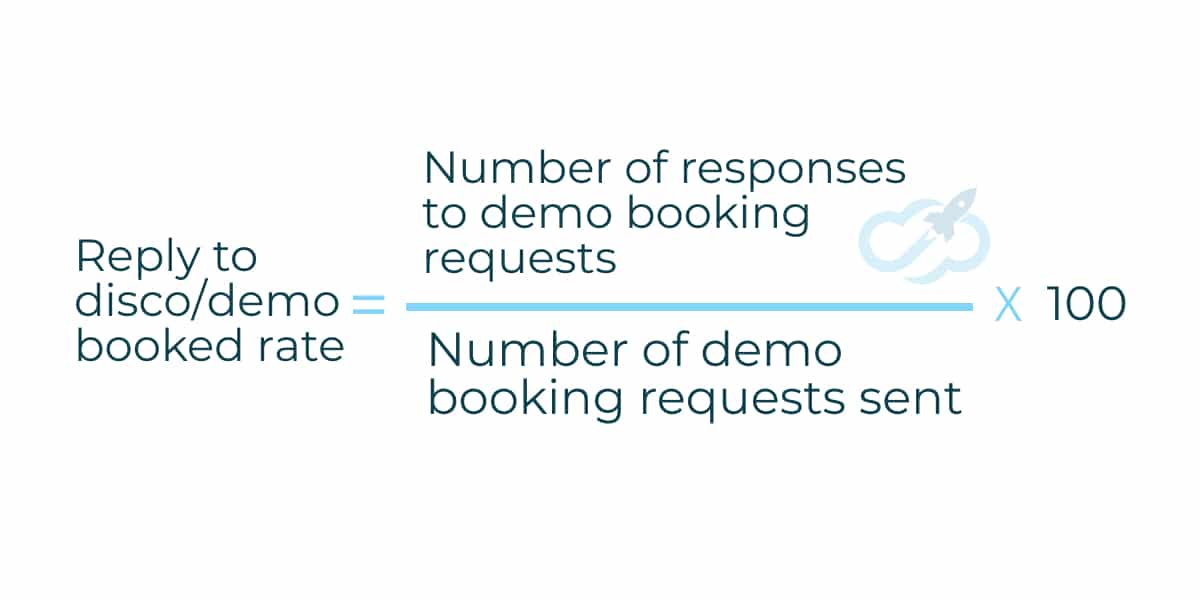
b) Rate from Outreach: This measures the efficiency of your entire top-of-funnel process, from the first message to the booked call. This is often called the "Contact-to-Meeting" rate.
The following resource provides clear formulas for this and other related metrics. While it's aimed at B2B teams, the principles are universal.
Appointment Setting Conversion Rates (2026): Benchmarks, Averages and What Is Normal
This article gives explicit, simple formulas for calculating the key conversion rates in a sales pipeline.
Focus on the section How to Calculate. Notice the clear, step-by-step formulas for Contact to Meeting Rate, Show Rate, and others. We are focusing on the Contact to Meeting Rate for now.
For your purposes, tracking both Reply Rate and Booking Rate (from Replies) is ideal. Together, they allow you to diagnose problems effectively.
- Low Reply Rate + High Booking Rate -> Your initial message needs work, but your conversation skills are strong.
- High Reply Rate + Low Booking Rate -> Your opener is great at getting attention, but you're struggling to convert those conversations.
Connecting KPIs to Your Goals
Tracking metrics isn't just an academic exercise; it's the most reliable way to connect your daily activities to your income goals. Top-performing sales professionals know their numbers inside and out because they treat them as levers to control their performance.
This next video introduces the powerful concept of an "income calculator," which works backward from a desired income to determine the activity levels needed to achieve it. It perfectly illustrates why knowing your KPIs is non-negotiable.
Sales Metrics to Track: The Ultimate Guide
This video from sales trainer Jeremy Miner explains how to think about metrics not just as reports, but as diagnostic tools and levers for improvement.
First, watch the section that introduces the income calculator concept. Pay attention to how changing one metric, like the close rate or show-up rate, impacts the total work required. Then, watch the following segment on how small levers open big doors. The speaker gives a personal example of how improving just one KPI—the show-up rate—doubled his income. This highlights the power of what you are learning to do.
As the video emphasizes, knowing your metrics allows you to identify the single biggest bottleneck in your process and focus all your energy on improving it.
Now, let's look at a concrete example of how a setter's KPIs translate directly into monthly earnings. This video breaks down the math for a typical high-ticket offer.
Remote Closer VS Appointment Setter | Which is Right For YOU?
This video provides a clear, numerical walkthrough of how an appointment setter's performance metrics translate into their monthly commission.
Watch the section explaining the setter's income potential. Follow the calculation from weekly "sets" (booked calls) to closed deals and finally to the monthly commission. This is the exact math you will soon be able to do for your own outreach.
The calculation in the video demonstrates the direct financial impact of your KPIs. If you know your average Contact-to-Meeting Rate and the average commission per deal for a potential client, you can accurately forecast your potential earnings and determine if an offer is worth pursuing.
How to Calculate Your KPIs in Notion
Your Notion tracker is now your data source. While you can build complex formulas directly in Notion, the easiest way to start is by using filtered views to get the numbers you need, then plugging them into a calculator.
For a weekly review, you would do the following:
- Find Outreach Volume: Create a filter on your main prospect database for
Initial Contact DateisThis week. The total count of items is your Outreach Volume. - Find Replies Received: Create a filter for
Statuschanged toIn ConversationduringThis week. The total count is your Number of Replies. - Find Calls Booked: Create a filter for
Statuschanged toCall BookedduringThis week. The total count is your Number of Calls Booked.
With these three numbers, you can calculate all the core KPIs we've discussed.
Conclusion
In this lesson, you've learned how to move beyond tracking simple activities and start measuring true performance. By calculating KPIs, you transform your daily work log into a powerful diagnostic tool.
Key Takeaways:
- Your outreach performance can be measured by four core KPIs: Outreach Volume, Reply Rate, Follow-Up Consistency, and Booking Conversion Rate.
- Each KPI provides a specific insight: Reply Rate measures your opener's effectiveness, while Booking Rate measures your conversation skills.
- Knowing your KPIs allows you to work backward from an income goal to determine the required activity level, turning your outreach into a predictable system.
- Your Notion tracker, combined with simple weekly filtering, is all you need to gather the data for these calculations.
You now have the tools to quantify your performance. In our next lesson, we will focus on analyzing these numbers. You'll learn how to spot trends, compare the effectiveness of different prospecting channels, and use your data to make strategic decisions about where to focus your efforts for maximum results.