Welcome to your first lesson! We'll begin our journey into music composition by starting with the most fundamental building block of all Western music: the twelve notes. Your goal is to compose moving piano pieces like Ludovico Einaudi, and understanding this basic musical alphabet is the essential first step.
In this lesson, you will learn to identify all 12 notes of the chromatic scale using the layout of a piano keyboard. Since you prefer a visual, hands-on approach using your Digital Audio Workstation (DAW), we'll focus on how these notes appear in the piano roll editor, which will be your primary canvas for composing.
The Musical Alphabet: The White Keys
All the music you hear is created from just 12 notes that repeat in higher and lower versions. We can visualize these notes on a piano keyboard. The keyboard might look complex, but it's based on a simple, repeating pattern. Let's start with the seven "natural" notes, which are the white keys.
The key to navigating the keyboard is to look at the black keys. You'll notice they are arranged in a repeating pattern of groups of two and three.
To quickly learn the names of the white keys, we can use a simple mnemonic. The video below offers a memorable trick using a "dog house" (the group of two black keys) and "Grandma's house" (the group of three black keys).
Memorize the Piano Notes in Under 2 Minutes (Easy!)
Watch this short segment from the video "Memorize the Piano Notes in Under 2 Minutes (Easy!)" by the channel Become a Piano Superhuman. It provides a fun and easy way to remember the white notes.
Pay close attention to the mnemonic devices from the main explanation. This trick will help you instantly find any white note on any keyboard or piano roll.
To summarize the video and provide a reference you can read, the white key notes are named with the first seven letters of the alphabet: A, B, C, D, E, F, G.
- The note C is always the white key immediately to the left of the group of two black keys.
- The note F is always the white key immediately to the left of the group of three black keys.
Once you find C, the rest of the white keys follow in alphabetical order: C, D, E, F, G, A, B. After B, the pattern repeats with the next C. You might notice there are no black keys between E and F, or between B and C. This is a crucial detail that will become important when we discuss scales in a later lesson.
The Black Keys: Sharps and Flats
Now, let's look at the five black keys. Each black key can have two different names, depending on the context. This is a concept called enharmonic equivalence—different names for the same pitch.
- A sharp (♯) means a note is raised by one step. The sharp symbol refers to the key immediately to the right of a white key (higher in pitch). For example, C-sharp (C♯) is the black key to the right of C.
- A flat (♭) means a note is lowered by one step. The flat symbol refers to the key immediately to the left of a white key (lower in pitch). For example, D-flat (D♭) is the black key to the left of D.
Notice that C♯ and D♭ are the exact same key. They are enharmonic equivalents.

To solidify this, let's read a short explanation.
This text from Piano Keyboard Guide explains how to name the black keys using sharps and flats.
Read the two paragraphs that begin here to understand the formal definition of sharps and flats and see examples like C sharp and D flat.
The 12 Notes of the Chromatic Scale
When we combine the 7 white keys and the 5 black keys, we get our full set of 12 unique notes. A scale that includes all 12 of these notes in order is called the chromatic scale.
Starting from C, the 12 notes are:
- C
- C♯ / D♭
- D
- D♯ / E♭
- E
- F
- F♯ / G♭
- G
- G♯ / A♭
- A
- A♯ / B♭
- B
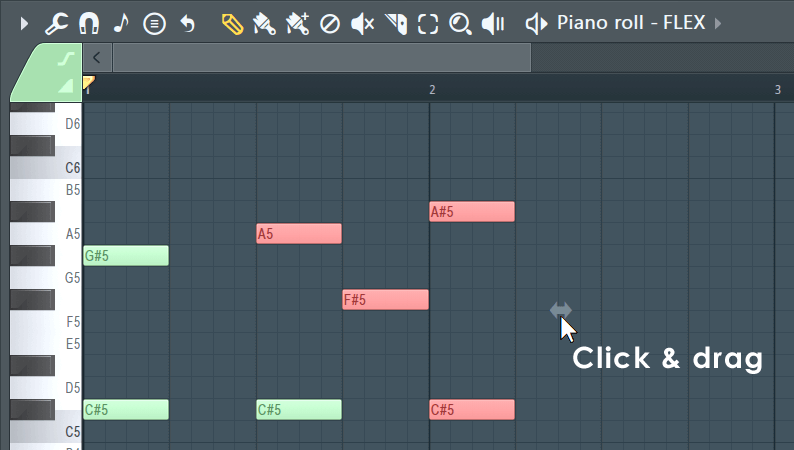
After B, we arrive at the next C, and the entire 12-note pattern repeats. The distance from one C to the next C is called an octave. In your DAW's piano roll, you will see numbers next to the note names (e.g., C4, C5, C6) to indicate which octave you are in. C5 is one octave higher than C4, but it's still the note C.
The following video provides a great summary of these concepts within the context of a producer's piano roll.
Music Theory For Producers (This Is All You Need)
Watch this clip from "Music Theory For Producers" by Ethan Davis. It directly connects the idea of the 12 notes to the piano roll interface you'll be using.
First, watch the brief introduction from the beginning, which confirms that all music is made of just 12 notes. Then, skip ahead to the review, where he lists the 12 notes and explains the concept of an octave.
Finally, before our next lesson, it's helpful to know where to find the piano roll in BandLab.
MIDI Programming in BandLab: Complete Guide (2026) - Audeobox
This guide from Audeobox describes the MIDI editor in BandLab. We'll explore this more later, but for now, let's just get familiar with the layout.
Read the section titled "The Piano Roll Editor". Pay special attention to the table that describes the layout. You'll see the Piano keyboard on the left edge, which is exactly what we've been studying in this lesson.
Conclusion
In this lesson, you've taken the first crucial step toward your composition goals. You now have the foundational knowledge to navigate the musical landscape.
Here are the key takeaways:
- All Western music is built from a repeating sequence of 12 notes.
- These notes are visualized on a piano keyboard layout, which consists of 7 white keys and 5 black keys within one octave.
- The white keys (C, D, E, F, G, A, B) can be located by finding the repeating pattern of two and three black keys.
- The black keys have two possible names, a sharp (♯) or a flat (♭), which are known as enharmonic equivalents (e.g., C♯ is the same as D♭).
- The complete set of 12 notes played in sequence is called the chromatic scale.
Now that you can identify every note, you're ready to start placing them on the grid to create music. In the next lesson, we'll dive into BandLab and get hands-on with the piano roll, learning how to enter, edit, and quantize notes to bring your first musical ideas to life.